Your email address will not be published. Required fields are marked *
Our expert reaches out shortly after receiving your request and analyzing your requirements.
If needed, we sign an NDA to protect your privacy.
We request additional information to better understand and analyze your project.
We schedule a call to discuss your project, goals. and priorities, and provide preliminary feedback.
If you're satisfied, we finalize the agreement and start your project.
Read: Healthcare Application Development in 2024
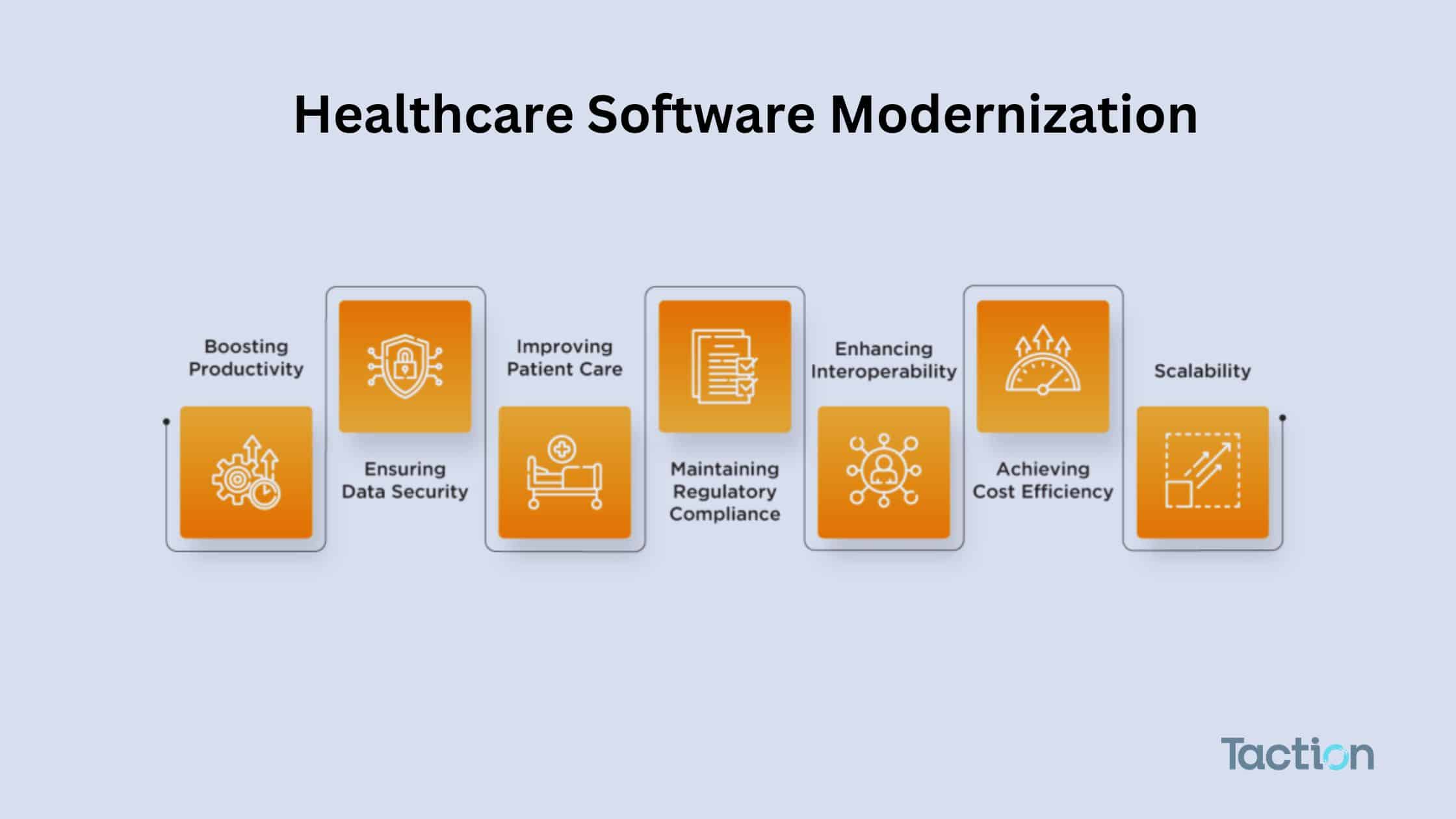
The need to modernize healthcare software is one of the hot topics in the IT healthcare community. Outdated software can be a risk to providers as it can lead to several different issues.
Patient Safety and Improved Care
Using modern software ensures that your staff has access to up-to-the-minute data. The end result is better patient care and fewer medical errors.
Regulatory Compliance and Data Security
It’s not a secret that healthcare systems have to deal with regulations and red tape. From HIPPA laws to various healthcare initiatives, your system must adhere to strict data privacy and security rules. Updating to modern software ensures that your system remains in compliance with all applicable laws.
Enhanced Operational Efficiency
Modern healthcare software also streamlines the day-to-day administrative tasks. Your staff will find it easier to schedule appointments, and spend less time filling out paperwork. This leaves more time for actual patient care.
Cost-Effectiveness
Incompatibility with Modern Technologies
Legacy systems often lack the capability to integrate with newer technologies such as artificial intelligence (AI) and machine learning (ML).
Lack of Scalability
As healthcare demands grow, outdated systems can struggle to handle increased loads, leading to performance issues and downtime.
Data Silos and Poor Integration
Older systems can trap data in silos, making it difficult for healthcare providers to access comprehensive patient information across departments.
Cybersecurity Vulnerabilities
Legacy software may not have modern security measures, making it susceptible to data breaches.
Modernizing healthcare software brings a multitude of benefits, including:
You may be wondering whether your software really needs an upgrade. Here are some tell-tale signs:
Before jumping into the modernization process, it’s important to address certain factors:
Identifying Legacy System Limitations
Assess your current system’s limitations, whether it’s performance issues or lack of functionality, to prioritize what needs modernization.
Evaluating User Needs
Gather input from end-users such as doctors, nurses, administrators, and patients to identify pain points and ensure that the modernization addresses their needs.
Budget and Timeline
Software modernization can be costly and time-consuming, so it’s crucial to establish a clear budget and timeline.
Choosing the Right Technology Stack
Selecting the right technology (cloud, AI, machine learning, etc.) is essential to ensure that your system is future-proof.
Modernizing healthcare software is a multi-step process that requires a structured approach:
Refactoring and Rewriting Code
Updating existing code to meet modern standards while preserving functionality.
Re-platforming
Moving from on-premise solutions to cloud-based infrastructure for better scalability and lower operational costs.
API-Driven Integration
Using APIs to ensure that the software integrates seamlessly with newer systems, avoiding data silos.
Containerization and Microservices
Breaking down software into modular components that can be independently updated and scaled.
Migrating healthcare systems to the cloud is one of the most popular modernization strategies today.
Benefits of Cloud in Healthcare
HIPAA Compliance in the Cloud
Ensure that any cloud service provider meets HIPAA standards to keep patient data secure.
Interoperability is critical in healthcare, where systems from different providers need to communicate effectively.
Achieving Seamless Data Exchange
Using standards like FHIR (Fast Healthcare Interoperability Resources) enables the smooth exchange of healthcare data between systems, enhancing care coordination.
Data migration is a sensitive aspect of modernization that requires careful planning to avoid disruptions.
Encryption and secure channels should be used to protect sensitive patient information during migration.
Backups and validation checks are crucial to ensure no data is lost or corrupted during the transfer process.
Modernizing software isn’t just about functionality – it’s also about improving security.
Older systems are vulnerable to hacking and data breaches due to outdated security protocols.
Modern systems incorporate advanced security measures such as encryption, role-based access, and multi-factor authentication (MFA).
A large hospital upgraded its Electronic Health Record (EHR) system, enabling better patient care through real-time access to patient data and reducing medication errors by 30%.
A healthcare provider migrated its management software to the cloud, decreasing operational costs by 20% and increasing scalability.
The cost can vary widely based on the scope and complexity of the project, but it often ranges from $50,000 to several million dollars.
Depending on the size of the healthcare organization and the scope of the modernization, projects can take anywhere from a few months to a couple of years.
Not modernizing can lead to increased costs, inefficiency, non-compliance with regulations, and heightened cybersecurity risks.
Implement encryption, use secure data migration practices, and partner with a reputable software development firm.
Yes, modernized software with user-friendly interfaces and enhanced features can significantly improve patient engagement and satisfaction.