Taction Software® | Healthcare software engineering

Healthcare Software Development Company. HIPAA-Compliant Engineering, EHR Integration That Holds Up in Production.

Healthcare software fails in the same three places every time. The ADT feed that quietly stops writing at 2 a.m. and nobody notices for nine days. The FHIR mapping that never matched what the source system actually sends. The go-live that slips two quarters because interface scope was an afterthought in the SOW. We have spent thirteen years working in that layer. 250+ healthcare and EHR integrations completed across Epic, Oracle Health, Athenahealth, HL7 v2, FHIR R4 and Mirth Connect, built for organizations that cannot afford a learning curve billed at their expense.

HIPAACompliantCMMIDEV / 3CERTIFIEDISO9001CERTIFIEDCOMPANY2015ISO27001CERTIFIEDCOMPANY2013
4.7
CClutch
4.7
GFGoodFirms

Tell Us Your Requirements

Our experts are ready to understand your business goals.

100% confidential & no spam

The Organizations Running on Infrastructure We Built

Behavioral health practice management, revenue cycle platforms processing live 837 and 835 traffic, remote patient monitoring feeds writing into production EHRs, and diagnostic labs moving orders and results over HL7 interfaces we engineered.

Download 4 1 — Taction Software client
Premier Programming Services Log — Taction Software client
Client partner logo 3
FNB Layton 1 — Taction Software client
Download 5 1 — Taction Software client
Techiosoft 1 — Taction Software client
Pephealth 1 — Taction Software client
Voyant 1 — Taction Software client
Healthrise 1 — Taction Software client
Educomp 1 — Taction Software client
Docmate — Taction Software client
Denefits 2 — Taction Software client
Dno — Taction Software client
Crt 1 — Taction Software client
Cobalthealth 1 — Taction Software client
Benebits 1 — Taction Software client
Airtel Paymentbank 1 — Taction Software client
Aht 1 — Taction Software client
Penvasc Taction Software — Taction Software client
Linear Health — Taction Software client
Securis Health — Taction Software client
Safe — Taction Software client
Yennes — Taction Software client
Aaditya Birla 1 — Taction Software client
Packsys — Taction Software client
Sani — Taction Software client
Ookla — Taction Software client
Xoomia 1 — Taction Software client
Procentive — Taction Software client
Download 4 1 — Taction Software client
Premier Programming Services Log — Taction Software client
Client partner logo 3
FNB Layton 1 — Taction Software client
Download 5 1 — Taction Software client
Techiosoft 1 — Taction Software client
Pephealth 1 — Taction Software client
Voyant 1 — Taction Software client
Healthrise 1 — Taction Software client
Educomp 1 — Taction Software client
Docmate — Taction Software client
Denefits 2 — Taction Software client
Dno — Taction Software client
Crt 1 — Taction Software client
Cobalthealth 1 — Taction Software client
Benebits 1 — Taction Software client
Airtel Paymentbank 1 — Taction Software client
Aht 1 — Taction Software client
Penvasc Taction Software — Taction Software client
Linear Health — Taction Software client
Securis Health — Taction Software client
Safe — Taction Software client
Yennes — Taction Software client
Aaditya Birla 1 — Taction Software client
Packsys — Taction Software client
Sani — Taction Software client
Ookla — Taction Software client
Xoomia 1 — Taction Software client
Procentive — Taction Software client

Thirteen Years, One Industry, Measurable Output

Thirteen years inside a single industry produces a specific kind of evidence. Not category awards or generalist credentials, but interfaces still moving live traffic years after go-live, and clients who never had to run a replacement search. Every figure below is drawn from delivered work, and every one of them is a number we can walk through on a call. Healthcare is the only vertical we build for, which means the compliance posture, the interface patterns and the clinical workflow assumptions are already in place before your project starts rather than discovered during it.

13+Years of Healthcare Software Engineering
250+Healthcare and EHR Integrations Completed
200+Organizations Served, 500+ Projects Delivered
20+Years of Leadership Experience

Healthcare Organizations We Serve

Healthcare is not one buyer. A hospital CIO is defending an Epic footprint and a compliance posture. A Series A digital health founder is racing a pilot against remaining runway. An RCM company is watching denial rates climb because eligibility responses parse inconsistently across four payers. The engineering overlaps. The constraints, procurement cycles and definitions of failure do not. Thirteen years in this industry means we scope against the constraint that will actually break the project rather than the one that reads well in a proposal. These are the organizations we build for.

Hospitals and Health Systems

Epic and Oracle Health footprints you are not replacing. We modernize what surrounds them: interface engines, legacy clinical applications, patient access workflows and the ADT and ORU feeds that silently degrade. See our healthcare integration solutions.

HealthTech and Digital Health Companies

Investors fund traction, not architecture debt. We take healthcare SaaS from prototype to a platform that survives enterprise security review, HIPAA scrutiny and its first hospital integration request. Explore HIPAA-compliant app development.

Medical Practices and Provider Groups

Specialty, behavioral health and ambulatory groups running practice management systems that do not talk to each other. We build the scheduling, portal and EHR connections that eliminate duplicate entry across front desk and clinical teams.

RCM and Medical Billing Companies

X12 837, 835, 270 and 271 traffic where every payer interprets the specification slightly differently. We build claim, eligibility and remittance workflows that hold up at production volume rather than in a sandbox.

Telehealth, Remote Monitoring and Medical Devices

Video and device data are the easy part. The hard part is writing observations and IoMT telemetry back into the EHR as structured, reconcilable records clinicians will act on rather than ignore.

Labs, Payers and Pharmacy Companies

LIS and LIMS platforms exchanging orders and results over HL7, payer FHIR APIs and prior authorization pipelines under CMS rules, and NCPDP SCRIPT medication workflows for pharmacy and ePrescribing operators.

Healthcare Software Development Services

Most healthcare projects do not fail at the code. They fail where clinical reality meets the estimate: an interface treated as a line item, a validation cycle nobody budgeted, a portal built for a demo instead of a Monday morning. Our healthcare software development services are scoped around those pressure points. Every engagement runs under a HIPAA-aligned SDLC with a BAA executed before the first commit, encryption and audit logging designed in rather than added during remediation, delivered by engineers who have shipped into live clinical environments and stayed on call afterward.

Custom Healthcare Software Development

Clinical and operational platforms built from scratch when no product fits. Practice management, care coordination, population health, credentialing. Architected for the audit, the integration request and the volume arriving in year three. See healthcare software development.

EHR and Healthcare Interoperability Expertise

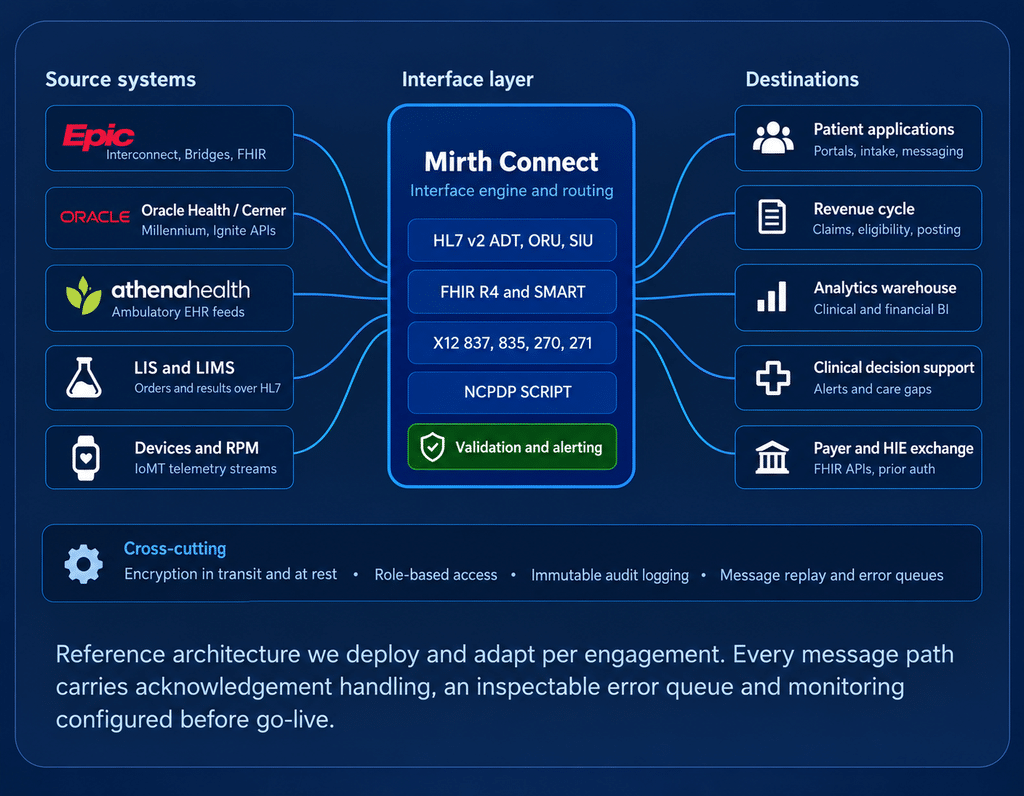
Interoperability is where healthcare projects are won or quietly lost. A specification says one thing, the sending system does another, and the gap surfaces three weeks after go-live when a result lands in the wrong patient chart. We have completed 250+ healthcare and EHR integrations since 2013, which means we have already met most of the ways a feed misbehaves. We test against production message samples, not sanitized examples. We build interfaces that alert when they stop rather than failing silently, because silent failure is the expensive kind.

HL7 v2 Interface Development

ADT, ORM, ORU, SIU, MDM and DFT message handling, including the segment-level quirks each vendor adds. Built with acknowledgement handling, retry logic and error queues you can actually inspect when something stops moving.

FHIR R4 and SMART on FHIR

RESTful FHIR APIs, resource mapping, bulk data export and SMART app launch inside the EHR workspace. Scoped to CMS interoperability requirements and the payer access rules that now carry statutory deadlines rather than roadmap intentions.

Mirth Connect Engineering and Optimization

Channel design, transformation scripting, performance tuning and rescue work on engines nobody has documented. We take over existing Mirth Connect deployments where the original developer has long since left the organization.

Epic and Oracle Health Integration

Interconnect, Bridges, App Orchard and FHIR endpoints on Epic. Millennium interfaces, CCL considerations and Ignite APIs on Oracle Health, including the vendor review cycles that decide whether your published timeline is real.

X12 EDI for Claims and Eligibility

837 claim submission, 835 remittance posting, 270 and 271 eligibility, 276 and 277 status. Built for real payer behavior, where four payers read one specification four different ways and all of them are live.

Interface Monitoring and Healthcare Data Migration

SLA-backed monitoring on throughput, queue depth and error rates with escalation paths defined before go-live. Migrations run with record-level reconciliation so clinical leadership signs off on accuracy before cutover. See healthcare integration.

Healthcare AI and Automation

Healthcare AI has a deployment problem, not a capability problem. Models demo well and then stall at the point where a clinician has to trust an output, a compliance officer has to explain it, and someone has to own the decision it influenced. We build AI into clinical and revenue workflows with human review in the loop, provenance attached to every output, and a governance trail that survives scrutiny. The interesting engineering is rarely the model. It is the integration, the failure handling and the accountability structure around it.

Clinical Documentation and Ambient Capture

Encounter capture, structured note generation and coding suggestion, with clinician review before anything reaches the chart. Built to reduce documentation time without introducing an unreviewed entry into a legal medical record.

AI Clinical Phenotyping

Cohort identification from structured and unstructured records for research, population health and care management. Explainable criteria, auditable logic and outputs a clinical committee can interrogate line by line. Read our AI clinical phenotyping analysis.

Patient Outreach and Engagement AI

Segmentation, timing and channel selection for recall, adherence and care gap campaigns. Consent-aware, with escalation to human staff the moment a conversation exceeds what automation should handle. See AI patient outreach.

Denial Prediction and RCM Automation

Models that flag claims likely to deny before submission, plus automated posting and worklist prioritization. Trained on the payer behavior your organization actually experiences rather than published industry averages.

Document and Fax Intake Automation

Referrals, records and orders arriving as scans and faxes, extracted into structured data with confidence scoring and human review on anything uncertain. The intake queue that never stopped being paper.

Robotic Process Automation and AI Governance

Eligibility checks, prior authorization polling and credentialing updates across systems with no API, plus the model documentation, bias evaluation and override logging that lets compliance approve a feature. Explore RPA solutions.

Healthcare Success Stories

The useful case study is not the one with the largest number attached. It is the one where the constraint resembles yours: an interface engine nobody documented, a platform that outgrew its architecture, a device feed that had to reach a clinician’s screen in a form they would act on. Below are engagements we can discuss in technical depth on a call, including architecture decisions we would make differently today. Each one involved production clinical or financial data, live users and a compliance posture that had to hold.

Procentive

Behavioral health practice management platform work covering clinical documentation, scheduling and billing workflows for provider organizations operating under state and federal behavioral health requirements. Browse healthcare case studies.

Coronis Health

Revenue cycle management integration built on HL7 messaging and Mirth Connect, connecting billing operations to provider systems and moving claim and remittance data across a multi-client production environment at volume.

Rhythm

Remote patient monitoring platform work spanning device data ingestion, patient monitoring workflows and EHR connectivity, so continuous readings arrive as usable clinical records rather than raw telemetry nobody charts against.

Voyant Health

Healthcare platform engagement covering custom application development and integration work, delivered under our HIPAA-aligned SDLC with a Business Associate Agreement in place from the first day of the project.

Community Health Application, Under NDA

Patient community and engagement application delivered under NDA, covering secure messaging, moderation workflows and privacy controls appropriate to a health context. Read the case study.

Healthcare Platforms and Technologies We Work In

Every platform below represents work delivered in production, not familiarity from a datasheet. If a platform is not listed, we have not shipped against it, and we will say so on the call rather than after the contract is signed. This section is written as text rather than a graphic so every vendor name and interoperability standard is readable by search engines, AI answer engines and screen readers, which matters as much for procurement research as it does for organic visibility.

EHR and EMR Platforms

Epic, Oracle Health and Cerner Millennium, Athenahealth, NextGen, eClinicalWorks, AdvancedMD, DrChrono, Allscripts and Veradigm, covering both enterprise inpatient footprints and ambulatory systems used by specialty and provider groups.

Interoperability Standards

HL7 v2.x, FHIR R4, SMART on FHIR, CDA and C-CDA, X12 EDI including 837, 835, 270, 271, 276 and 277, plus NCPDP SCRIPT, DICOM, LOINC, SNOMED CT and ICD-10.

Integration Engines and Middleware

Mirth Connect and NextGen Connect, Rhapsody, InterSystems, Azure API for FHIR and AWS HealthLake, plus custom interface engines where a commercial product adds licensing cost without adding capability you need.

Cloud and Infrastructure

Microsoft Azure and AWS configured for HIPAA workloads under executed BAAs, Google Cloud, Docker and Kubernetes, Terraform, and serverless architectures where usage patterns make them the cheaper option.

Languages and Frameworks

.NET and C#, Java, Node.js, Python, PHP and Laravel on the server. React, Angular and Next.js on the web. React Native, Flutter and .NET MAUI for cross-platform clinical and patient applications.

Data, Analytics and Machine Learning

SQL Server, PostgreSQL, MongoDB and Snowflake, Power BI and Tableau, clinical NLP, predictive modeling on claims and utilization data, and MLOps. Explore healthcare big data.

HIPAA, Security and Compliance

Compliance is either designed in or paid for twice. We have watched organizations retrofit access controls and audit logging into a live platform under deadline pressure from a payer security review, and it costs several times what building it correctly would have. Our SDLC treats HIPAA as an architectural input rather than a review gate. A BAA is executed before the first commit. Encryption, role-based access, audit logging and breach response procedures are specified during architecture, not discovered during penetration testing three weeks before launch.

HIPAA and HITECH Safeguards

Administrative, physical and technical safeguards implemented at the architecture level, with policies, workforce training and documented procedures that map directly to the actual controls operating inside your system.

Business Associate Agreements

BAAs executed with your organization before development begins, and flowed down to every subprocessor and cloud provider in the delivery chain. Signed paperwork, not a compliance statement published on a website.

ISO 27001 Certified Operations

Our information security management system is ISO 27001 certified, covering access control, risk assessment, incident response and supplier management across our development and delivery environments in every location.

SOC 2 Aligned Controls

Security, availability and confidentiality controls designed to SOC 2 criteria, with evidence and documentation structured to support your own SOC 2 audit or enterprise vendor assessment process without a remediation cycle.

GDPR, FISMA and Public Sector Requirements

Data subject rights, lawful basis, retention schedules and cross-border transfer handling for European patient data, plus control implementation for healthcare systems touching federal or state programs where the framework is prescribed.

Secure SDLC, Audit Logging and Access Control

Threat modeling at design, dependency scanning, penetration testing before production. Role-based access, minimum necessary enforcement, immutable audit trails and break-glass procedures an auditor can reconstruct record by record.

Why Healthcare Organizations Choose Taction Software®

There is no shortage of development firms willing to take a healthcare project. The difference shows up in month four, when an interface behaves unexpectedly, a payer sends a security questionnaire, or a clinician says the workflow does not match how the unit actually operates. At that point you either have a partner who has been there or a vendor learning at your expense. We build for healthcare exclusively, and have since 2013. Every one of the following is a claim you can verify on a technical call.

Healthcare Is the Only Industry We Build For

Not a healthcare division inside a generalist agency. The compliance posture, interface library and clinical workflow assumptions are already in place before your project starts rather than assembled during it. See why teams choose Taction.

250+ Integrations Means Fewer Surprises

We have already met most of the ways a feed misbehaves, a vendor deviates from specification, or a mapping fails under production volume. That experience shortens discovery and removes guesswork from your estimate.

Leadership With Twenty Years in the Domain

Taction was founded in 2013. Our CEO brings 20+ years of personal experience in software and healthcare technology, which is why architectural decisions get senior review rather than delegation down the chain.

Compliance Designed In, Not Retrofitted

BAA before the first commit. Encryption, audit logging and access control specified during architecture. Your first enterprise security questionnaire becomes a document exercise instead of an unplanned remediation project.

US Presence With Full-Time Engineering Capacity

Offices in Chicago, Austin, Cheyenne and Sacramento, with a dedicated development center in Noida. Overlapping hours for architecture and stakeholder work, full engineering capacity for delivery throughout the build.

We Stay After Go-Live

SLA-backed monitoring and support covering the interface layer, not just server uptime. The person answering your escalation knows your channel configuration, because they are the engineer who built it.

How a Healthcare Engagement Runs

Healthcare projects fail on sequencing more often than on execution. Interface work gets scheduled after the application is built, compliance review lands two weeks before launch, and clinical stakeholders see the workflow for the first time in training. Our process front-loads exactly those items. You will know your integration surface, your compliance obligations and your riskiest assumption before we write production code, because those three things determine whether the timeline you were given is real or aspirational.

  1. 1

    Discovery and Technical Assessment

    One to two weeks. We map your systems, integration surface, compliance obligations and clinical workflows, then identify the assumption most likely to break the project and test that one first.

  2. 2

    Architecture and Interface Design

    Two to three weeks. Data model, integration architecture, security controls and interface specifications documented and reviewed with your technical and compliance stakeholders before any development work begins.

  3. 3

    Working Prototype

    Six weeks. A functioning system exercising the highest-risk path, usually the integration, in front of real clinical users. Early enough that a change of direction costs days rather than quarters.

  4. 4

    Iterative Build

    Two-week sprints with demonstrable output, a shared backlog and direct engineer access. Interface development runs in parallel with application work rather than queued behind it until the end.

  5. 5

    Validation and Compliance Readiness

    Interface testing with production message samples, security testing, performance testing at expected volume, and validation documentation prepared for auditors and enterprise security reviewers before cutover is scheduled.

  6. 6

    Go-Live and Ongoing Support

    Phased cutover with a rollback path, parallel running where clinical risk demands it, monitoring configured before launch, and SLA-backed support delivered by the team that built the system. Fixed-scope engagements for defined deliverables, a dedicated team for continuous roadmap work, and staff augmentation where you need specific interoperability capability inside your existing team. MVP and prototype engagements typically run $40K to $80K. Full platform builds run $80K to $200K. Enterprise programs with multi-system integration start at $200K and above. Estimate yours with our project cost calculator.

What Healthcare Clients Say

Testimonials are worth reading only when they are specific and attributed. A generic quote about professionalism tells a hospital CIO nothing. What matters is which system was integrated, what constraint the team worked under, and whether the person putting their name to the statement holds a role you recognize. Every quote published here carries a full name, title and organization, with that person’s written consent, and we would rather publish three real reviews than a dozen anonymous ones.

Verified Reviews on Clutch

Third-party verified client reviews of our healthcare engineering and software development work, collected and validated independently of us. Read our Clutch profile before you shortlist anyone.

Verified Reviews on GoodFirms

Independent client feedback covering delivery quality, communication and technical capability across engagements. Our GoodFirms profile carries reviews submitted directly by the organizations we delivered for.

Speak to a Reference Client

For qualified engagements we arrange a direct reference call with a client operating a comparable system, so you hear it from an operator rather than from a case study we wrote ourselves.

What We Publish and What We Do Not

We do not publish anonymous quotes, invented outcome percentages or performance metrics we cannot substantiate. If a number appears on this site, we can show you where it came from. Request a reference call. CMS note, delete before publishing: insert three to five real, consented testimonials here. Required per testimonial: verbatim quote, full name, title, organization or organization type if under NDA, written consent, and which system or integration the project involved.

Healthcare Technology Insights and Resources

Healthcare technology decisions get made by people who need to understand a standard, a regulation or an architecture pattern before they can defend a budget for it. The pieces below are written for that reader: technical enough to be useful to an integration architect, clear enough to forward to a CFO. If a topic you are evaluating is not covered, tell us on the call and it will likely become the next thing we publish.

The 2026 AI Healthcare Playbook

Where healthcare AI projects stall between pilot and production, and the governance, integration and review structures that move them across that gap. Read the AI healthcare playbook.

AI Patient Outreach Platforms

How segmentation, timing and consent handling determine whether automated outreach closes care gaps or generates complaints and opt-outs at scale. Read the patient outreach analysis.

AI Clinical Phenotyping

Building cohort identification that a clinical committee will approve, with explainable criteria and auditable logic rather than an unreviewable model output. Read the clinical phenotyping breakdown.

Healthcare Product Development Guide

A practical sequence for taking a healthcare product from concept to production, including where compliance and integration work belongs in the timeline. Read the product development guide.

All healthcare insights

Frequently Asked Questions

Pricing ranges, integration timelines, compliance posture and what happens after launch are all things you are entitled to know before you commit an hour of your time. The answers below are the ones we give on first calls, stated directly rather than deflected into a sales conversation. If your question is not here, the fastest path is a thirty-minute call with an architect who can answer it for your specific systems and constraints.

What is Taction Software®?
Taction Software® is a US-based healthcare software development company founded in 2013, specializing in HIPAA-compliant application development, EHR and EMR integration, healthcare interoperability and healthcare AI. We work exclusively with healthcare organizations from US offices in Chicago, Austin, Cheyenne and Sacramento. Taction Software® is a registered trademark of Taction Software LLC.
Is Taction Software HIPAA compliant, and do you sign a BAA?
Yes to both. We design, build and maintain HIPAA-compliant applications, and a Business Associate Agreement is executed before development begins and flowed down to every subprocessor and cloud provider. Our processes follow HIPAA and HITECH under a secure SDLC, and our information security management system is ISO 27001 certified.
Which EHR systems can you integrate with?
Epic, Oracle Health and Cerner Millennium, Athenahealth, NextGen, eClinicalWorks, AdvancedMD, DrChrono, Allscripts and Veradigm, using HL7 v2, FHIR R4, SMART on FHIR and C-CDA. We have completed 250+ healthcare and EHR integrations since 2013. See our healthcare integration services for the full interoperability scope.
How long does an EHR integration take?
A single well-documented HL7 interface typically runs four to eight weeks including testing. FHIR API work and multi-system integrations run longer, driven mostly by vendor technical review cycles and how consistently the source system follows specification. Discovery gives you a firm number rather than a range.
How much does healthcare software development cost?
MVP and prototype engagements typically run $40K to $80K. Full platform builds run $80K to $200K. Enterprise programs involving multiple system integrations start at $200K and above. Interface count and payer or EHR vendor review cycles move the number most. Our cost calculator gives an estimate first.
Can you take over an existing project, and do you support it after launch?
Yes. Inherited codebases and undocumented interface engines are regular work for us, including Mirth Connect deployments whose original developer has left. We assess before committing to a timeline, then provide SLA-backed monitoring on message throughput, queue depth and error rates after go-live.

Ready to Discuss Your Project With Us?

Your email address will not be published. Required fields are marked *

What's Next?

Our expert reaches out shortly after receiving your request and analyzing your requirements.

If needed, we sign an NDA to protect your privacy.

We request additional information to better understand and analyze your project.

We schedule a call to discuss your project, goals. and priorities, and provide preliminary feedback.

If you're satisfied, we finalize the agreement and start your project.