
Healthcare software has moved from a back-office convenience to the operating layer of care delivery. Electronic health records, remote monitoring platforms, imaging pipelines, and patient-facing apps now sit directly in the clinical path, which means a defect is not a bug ticket, it is a patient safety event.
That changes how you build. Healthcare product development is an exercise in engineering under constraint: protected health information, federal enforcement, medical device law, legacy hospital systems that speak a 1980s messaging dialect, and clinicians who will abandon your product if it adds two clicks to a workflow.
This guide covers the full picture for teams building in the U.S. healthcare ecosystem: what these products are, how the lifecycle actually runs, how HIPAA, FDA, and GDPR obligations translate into engineering work, how HL7, FHIR, DICOM, and C-CDA move data between systems, and what it takes to carry a product from MVP to production scale. It is written for founders scoping a first build and for enterprise teams inheriting an integration estate.
If you want the delivery side rather than the theory, see our healthcare software product development services.
What Is Healthcare Software Product Development?
Healthcare software product development is the discipline of designing, building, validating, and maintaining software that handles clinical data, supports clinical decisions, or operates inside a care delivery workflow. It spans providers, patients, payers, labs, imaging centers, pharmacies, and researchers.
The definition matters because it sets your obligations. The moment your product touches protected health information (PHI), you inherit HIPAA duties. The moment it informs a diagnosis or treatment decision, you may inherit FDA duties. The moment an EU resident’s health data enters your system, you inherit GDPR duties. Scope decisions made in week one determine your regulatory surface for the life of the product.
How Healthcare Product Development Differs From Standard Software Builds
Four differences reshape everything downstream.
Risk is clinical, not commercial. In consumer software, the worst case is churn. In healthcare, the worst case is a missed allergy alert or a mismatched patient record. Risk analysis is a first-class engineering artifact, not a compliance formality.
The data is regulated at rest, in transit, and in use. PHI carries obligations that follow it into logs, analytics pipelines, backups, error traces, support tooling, and third-party services. Most breaches trace to a place nobody thought of as a data store.
Integration is mandatory, not optional. A healthcare product that cannot exchange data with an EHR is a silo, and clinicians will not double-enter data into it. Interoperability work routinely consumes 30 to 40 percent of a healthcare build. Budget for it in the estimate, not in the change request.
Users are time-constrained experts. A nurse has seconds per interaction. A radiologist reads hundreds of studies a shift. Interfaces that require exploration or interpretation fail in the field regardless of how well they demo.
Types of Healthcare Software Products
The ecosystem covers more than 25 distinct product categories. Knowing which category you are in tells you which standards, integrations, and regulatory pathways apply.
Clinical systems of record
- Electronic Health Records (EHR): longitudinal patient records across care settings, with clinical workflow, orders, and documentation
- Electronic Medical Records (EMR): practice-level charting systems, narrower in scope than a full EHR
- Laboratory Information Systems (LIS): specimen tracking, instrument interfacing, and diagnostic result reporting
- Radiology Information Systems (RIS): imaging order management, scheduling, and report distribution
- Picture Archiving and Communication Systems (PACS): storage, retrieval, and distribution of DICOM imaging studies
Care delivery and engagement
- Telemedicine platforms: synchronous and asynchronous virtual consultations. Our teardown of the best telemedicine apps covers what separates the leaders on clinical workflow depth
- Patient portals: record access, scheduling, secure messaging, and results delivery
- Remote Patient Monitoring (RPM): device-sourced vitals, thresholds, alerting, and billing-code capture
- Chronic Care Management: longitudinal care plans, adherence tracking, and care team coordination
- Home healthcare platforms: caregiver scheduling, visit verification, and field documentation
- Rehabilitation software: therapy protocols, progress measurement, and outcome reporting
Decision support and intelligence
- Clinical Decision Support Systems (CDSS): rule-based and model-driven guidance at the point of care
- Healthcare analytics platforms: quality measurement, utilization analysis, and population health reporting
- Medical research and clinical trial software: protocol management, electronic data capture, and randomization
Operations and revenue
- Hospital Management Systems (HMS): admissions, bed management, staffing, and administration
- Medical practice management: scheduling, eligibility, documentation, and claims
- Medical billing and revenue cycle: charge capture, coding support, claims submission, and denial management
- Health insurance platforms: enrollment, claims adjudication, and member engagement
- Healthcare CRM: referral management and patient relationship workflows built on CRM platform engineering
- Medical inventory management: supply tracking, par levels, and expiry control
- Occupational health software: workplace exposure tracking and employee health records
Medication and wellness
- ePrescribing: electronic prescription transmission, formulary checks, and controlled substance workflows
- Pharmacy management: dispensing, inventory, and adherence programs, covered in our medication app development work
- Mental health applications: digital therapeutics, mood tracking, and teletherapy
- Fitness and wellness applications: activity, sleep, and nutrition tracking, typically outside HIPAA unless a covered entity is involved
Why Healthcare Software Product Development Matters Now
Provider Workflow Pressure
Clinician documentation burden is the single most cited driver of burnout in U.S. health systems. Every product that removes clicks, pre-populates a note, or eliminates a duplicate data entry step has a direct operational case. Products that add friction lose their pilot regardless of feature depth.
Patient Expectations Set Outside Healthcare
Patients compare your portal to their banking app, not to the portal they used in 2015. Information Blocking rules under the 21st Century Cures Act now require that patients receive electronic access to their health information without special effort, which turns what was once a differentiator into a baseline obligation.
Regulatory Enforcement Is Active
The HHS Office for Civil Rights pursues enforcement against covered entities and business associates alike. Risk analysis failures are among the most commonly cited deficiencies in resolution agreements, and a business associate agreement does not shield a vendor whose own controls were inadequate. Compliance built in at architecture time costs a fraction of compliance retrofitted after a finding.
The Healthcare Software Development Lifecycle
Healthcare builds follow a recognizable arc, but each stage carries obligations that a general-purpose SDLC does not.
Stage 1: Discovery and Clinical Requirements
Requirements come from watching clinical work, not from a stakeholder interview alone. Shadow the workflow you intend to change. Map the current state including the workarounds, because the workarounds are where the real requirements live.
Deliverables from this stage should include a clinical workflow map, a user role matrix, a data inventory naming every PHI element the product will touch, a regulatory scope determination (HIPAA applicability, FDA device status, GDPR territorial scope), and an integration inventory listing every external system and its supported standards.
Stage 2: Architecture and Threat Modeling
Architecture is where compliance is either built in or permanently deferred. Decide encryption boundaries, tenancy model, audit log design, identity provider, PHI data flow, and integration topology before writing feature code.
Run a threat model against the architecture. STRIDE works well here. For each PHI flow, identify spoofing, tampering, repudiation, disclosure, denial of service, and privilege escalation risks, then assign a control to each. Keep the output as a living document; auditors will ask for it.
Stage 3: Design and Clinical Prototyping
Prototype with clinicians in the room. Wireframe validation sessions with three to five representative users will surface more real problems than a full usability study conducted after build. For any product with a safety-relevant interface, run formative usability testing aligned to IEC 62366 principles, even if you are not pursuing FDA clearance, because the same failure modes apply.
Stage 4: Development and Verification
Build in vertical slices that carry a workflow end to end, so integration and compliance are exercised continuously rather than at the end. Verification here means confirming the product was built to specification: unit tests, integration tests, security tests, and interface conformance tests against your HL7, FHIR, or DICOM partners. Structured QA and testing with traceability from requirement to test case is what makes an audit survivable.
Stage 5: Validation, Deployment, and Enablement
Validation confirms the product meets user needs in the real environment, which is a different question from whether it matches the spec. Run it in a staging environment mirrored to production, with de-identified or synthetic data, against real clinical scenarios.
Deployment in healthcare is rarely a big bang. Plan for a pilot unit, a parallel-run period where the legacy process continues alongside the new one, and a defined rollback path. Training is part of the deployment, not an afterthought; adoption failure is the most common cause of a technically successful healthcare project being judged a failure.
Stage 6: Post-Market Maintenance and Surveillance
Healthcare products carry ongoing obligations: security patching against a live threat landscape, monitoring for adverse events and complaints, periodic risk analysis updates, and re-validation when interfaces or regulations change. Build the intake channel for user-reported safety issues before launch, not after the first one arrives.
HIPAA Compliance for Healthcare Software Teams
HIPAA is the baseline for any product handling PHI in the United States. Most teams know the acronym and underestimate the engineering surface.
Who HIPAA Applies To
HIPAA binds covered entities (providers, health plans, clearinghouses) and business associates (vendors that create, receive, maintain, or transmit PHI on their behalf). If you build software for a covered entity and your system touches PHI, you are a business associate with direct liability under the HITECH Act. Your subcontractors, including cloud providers and analytics vendors, become subcontractor business associates and need their own agreements.
A common misreading: a direct-to-consumer wellness app with no covered entity relationship is generally outside HIPAA, but it is not outside the law. The FTC Health Breach Notification Rule and state privacy statutes such as the Washington My Health My Data Act reach that space, and several impose broader consent obligations than HIPAA does.
The Privacy Rule in Product Terms
The Privacy Rule governs use and disclosure. In engineering terms it produces four requirements:
Minimum necessary. Every query, API response, report, and export should return the least PHI required for the purpose. This is an architectural decision expressed in your API design and your role definitions, not a policy document.
Individual rights. Patients can request access to their records, request amendments, and request an accounting of disclosures. Build the access endpoint, the amendment workflow, and the disclosure log from day one; retrofitting an accounting of disclosures into a system that never logged disclosures is close to impossible.
Authorization and consent tracking. Where a use falls outside treatment, payment, or operations, you need a recorded authorization. Model consent as versioned, time-bounded, revocable data, not as a boolean flag.
The Security Rule Mapped to Engineering Controls
The Security Rule is where most of the technical work sits. It is organized into administrative, physical, and technical safeguards, each with required and addressable implementation specifications. “Addressable” does not mean optional; it means you implement it or document a reasoned, risk-based alternative.
Security Rule safeguard | What it means in your codebase |
Risk analysis and risk management | A documented, current, system-wide analysis of PHI risk. This is the most frequently cited failure in enforcement actions |
Access control | Unique user IDs, role-based access control, automatic logoff, and emergency access procedures |
Audit controls | Immutable, append-only logs recording who accessed which record, when, from where, and what changed |
Integrity controls | Checksums, database constraints, and version history proving PHI was not improperly altered |
Person or entity authentication | Multi-factor authentication, strong session management, and short-lived tokens |
Transmission security | TLS 1.2 as a floor, TLS 1.3 preferred, with modern cipher suites and certificate pinning on mobile clients |
Encryption at rest | AES-256 across databases, object storage, backups, and disk volumes, with managed key rotation |
Workforce security and training | Provisioning and deprovisioning workflows tied to your identity provider |
Contingency planning | Tested backup, disaster recovery, and emergency mode operation procedures with documented RTO and RPO |
Business associate agreements | Executed BAAs with every subcontractor that touches PHI |
Our HIPAA-compliant app development guide goes deeper on the implementation patterns behind each row.
The Breach Notification Rule
An impermissible use or disclosure of unsecured PHI is presumed to be a breach unless a four-factor risk assessment demonstrates a low probability of compromise. Notification obligations run to affected individuals, HHS, and in larger breaches the media, on statutory timelines.
The engineering consequence is that you need detection capability, not just prevention. Anomalous access alerting, export volume monitoring, and log retention long enough to reconstruct an incident are what let you answer the four-factor questions at all. A team that cannot determine which records were accessed must assume the worst case.
HIPAA Engineering Checklist
Work through this before any PHI enters a production environment.
Data inventory and scoping
- [ ] Every PHI element the system stores, processes, or transmits is catalogued
- [ ] Data flow diagram shows PHI movement across every service, queue, and third party
- [ ] Non-PHI environments are provably free of production data
- [ ] De-identification method documented (Safe Harbor or Expert Determination) where applicable
Access and identity
- [ ] Unique identifier per user, no shared or service-shared accounts for PHI access
- [ ] Role-based access control enforced server-side, never only in the UI
- [ ] Multi-factor authentication for all privileged and clinical roles
- [ ] Automatic session timeout configured and tested
- [ ] Break-glass emergency access exists and generates a high-priority alert
- [ ] Deprovisioning removes access within a defined SLA of termination
Encryption and transmission
- [ ] AES-256 at rest across primary stores, replicas, backups, and object storage
- [ ] TLS 1.2 minimum on every external and internal service-to-service hop
- [ ] Keys held in a managed KMS or HSM with documented rotation
- [ ] Mobile clients pin certificates and store nothing sensitive in unencrypted local storage
Audit and monitoring
- [ ] Append-only audit log capturing actor, action, record, timestamp, and source address
- [ ] Logs scrubbed of PHI in message bodies, stack traces, and APM payloads
- [ ] Retention period set to meet the longer of six years or applicable state law
- [ ] Alerting on bulk export, off-hours access, and access to high-profile records
Vendor and infrastructure
- [ ] BAA executed with every cloud, analytics, monitoring, support, and communications vendor
- [ ] Only HIPAA-eligible services used within the PHI boundary
- [ ] Infrastructure as code with reviewed, version-controlled changes
- [ ] Vulnerability scanning and dependency auditing in every pipeline run
Governance
- [ ] Current written risk analysis with a dated risk management plan
- [ ] Incident response runbook with named owners and tested notification timeline
- [ ] Backup restoration tested, not just configured
- [ ] Workforce training completed and recorded
Start with our free HIPAA risk assessment template to produce the risk analysis artifact, and use the HIPAA compliance checklist to track control coverage across the program.
FDA Regulation of Software as a Medical Device
FDA scope is the question teams most often get wrong, usually by assuming it does not apply.
Determining Whether Your Product Is a Device
Software meets the device definition when it is intended for diagnosis, cure, mitigation, treatment, or prevention of disease. Intent is established by your claims, so marketing copy is a regulatory artifact. A product described as “detects atrial fibrillation” is making a device claim. The same product described as “displays your heart rate trend” may not be.
The 21st Century Cures Act excluded several software categories from the device definition, including administrative support software, general wellness products, electronic health records meeting specific criteria, and certain clinical decision support tools. The CDS carve-out is narrow: it generally requires that the software not analyze medical images or signals from a device, and that the clinician can independently review the basis for the recommendation. Software that produces a recommendation the clinician cannot interrogate typically falls back inside device regulation.
Document your determination in writing with the reasoning. If the answer is genuinely unclear, the FDA Q-Submission program provides a route to non-binding feedback before you commit to an architecture.
Risk Classification and Submission Pathways
Class | Risk level | Typical pathway | Software examples |
Class I | Low | Usually exempt, general controls apply | Medical device data systems, some wellness and record-keeping tools |
Class II | Moderate | 510(k) premarket notification demonstrating substantial equivalence to a predicate | Many CDS tools, imaging analysis software, RPM platforms with clinical claims |
Class III | High | Premarket Approval with clinical evidence | Software driving life-sustaining therapy decisions |
The De Novo pathway serves novel low-to-moderate-risk devices with no valid predicate, and it is the route many first-of-kind AI diagnostic tools have taken.
Quality System and Software Lifecycle Requirements
Device software requires a quality management system. FDA’s Quality Management System Regulation aligns with ISO 13485, and IEC 62304 governs the software lifecycle itself, with rigor scaled to the safety class of each software item.
Practically, this means design controls: a design history file, traceability from user need to requirement to design to test to release, formal design reviews, documented verification and validation, configuration management, and a change control process. Teams that adopt these practices from the first sprint absorb them into normal engineering rhythm. Teams that reconstruct them a year later spend months on documentation archaeology.
Risk management follows ISO 14971: identify hazards, estimate and evaluate risk, implement controls, and verify residual risk is acceptable. Cybersecurity risk is explicitly in scope, and FDA now expects a Software Bill of Materials and a plan for postmarket vulnerability management in premarket submissions.
AI and Machine Learning Products
Adaptive models create a regulatory problem: a cleared device is cleared as submitted, and retraining changes the device. The Predetermined Change Control Plan mechanism lets you specify in advance which model modifications you intend to make, how you will validate them, and what performance boundaries you will hold to, so anticipated updates do not each require a new submission.
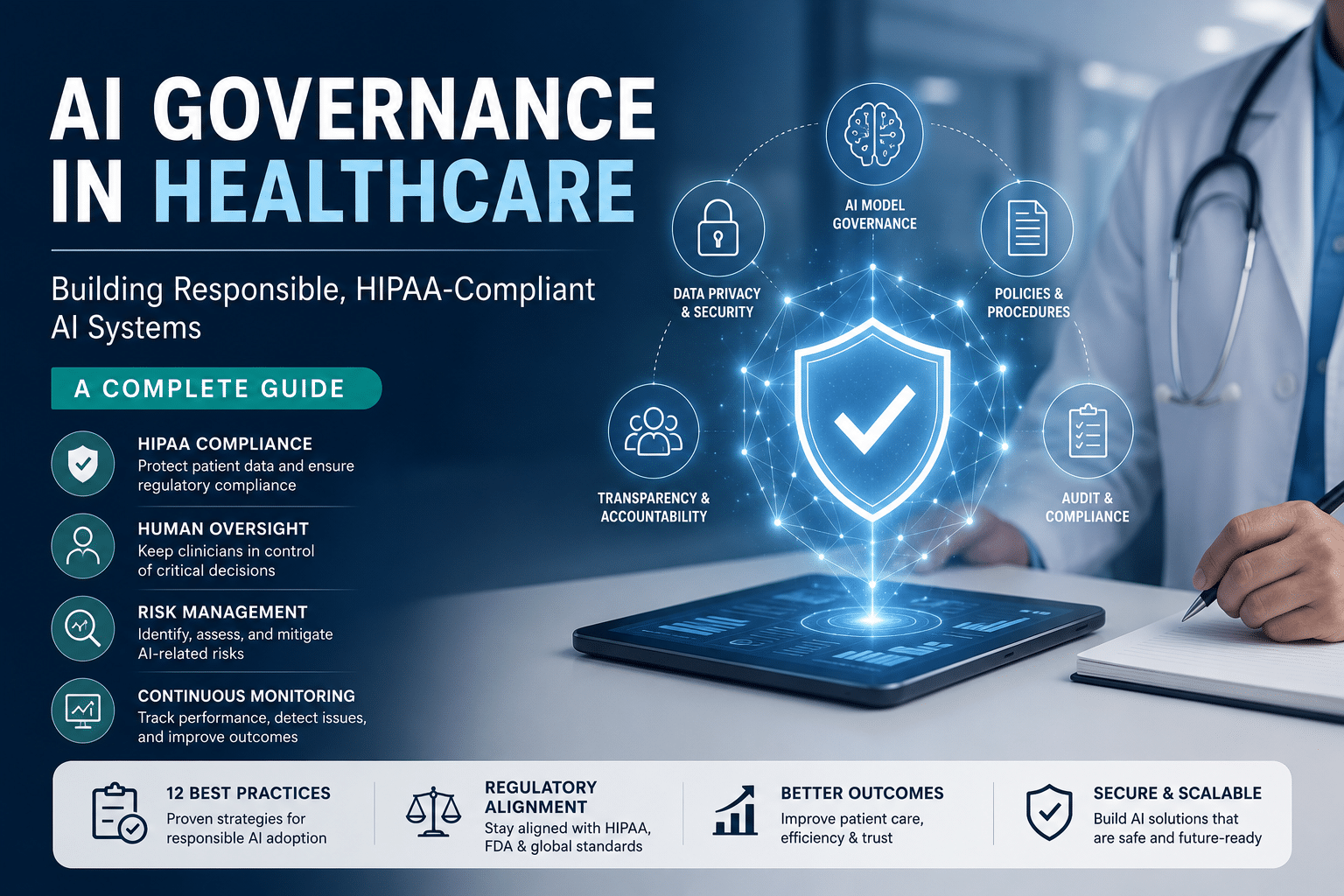
Alongside the FDA path, model governance is its own discipline covering bias evaluation across demographic subgroups, drift monitoring, human oversight design, and explainability. Our AI governance guide for healthcare covers the control framework, and our healthcare AI engineering practice covers the build side.
FDA Readiness Checklist
- [ ] Written intended use statement, reviewed against marketing claims for consistency
- [ ] Documented device determination with reasoning and Cures Act exclusion analysis
- [ ] Risk classification identified, predicate device researched if pursuing 510(k)
- [ ] Quality management system established and operating, not just documented
- [ ] Design history file maintained continuously with full requirement-to-test traceability
- [ ] IEC 62304 software safety classification assigned per software item
- [ ] ISO 14971 risk management file current, with cybersecurity hazards included
- [ ] Human factors and usability engineering evidence per IEC 62366
- [ ] Software Bill of Materials generated automatically in the build pipeline
- [ ] Postmarket surveillance, complaint handling, and vulnerability response procedures defined
- [ ] Predetermined Change Control Plan drafted if the product includes adaptive models
- [ ] Labeling and instructions for use drafted and reviewed
GDPR Compliance for Healthcare Products Serving EU Users
GDPR applies when you process the personal data of people in the EU or EEA, regardless of where your company sits. Offering a service to EU residents or monitoring their behavior is enough to trigger it.
Health Data Is a Special Category
Article 9 prohibits processing health data by default and permits it only under specific conditions: explicit consent, provision of health or social care under contract with a health professional, public health interest, or a small set of others. “We have a privacy policy” is not a lawful basis.
The practical consequence is that consent under GDPR is a much higher bar than a checkbox. Explicit consent must be freely given, specific, informed, unambiguous, separable from other terms, as easy to withdraw as to give, and evidenced. If your product bundles marketing analytics consent into service acceptance, that consent is invalid.
Controller and Processor Roles
Determine whether you are a controller (deciding purposes and means) or a processor (acting on a controller’s instructions). A hospital using your platform is usually the controller; you are usually the processor. The distinction drives your contractual obligations under Article 28, your liability exposure, and who must respond to data subject requests. Get it wrong and your Data Processing Agreements are addressed to the wrong obligations.
Rights You Must Build Into the Product
GDPR rights are engineering requirements with statutory deadlines, generally one month.
Access. Export all personal data held about a subject in a structured, commonly used, machine-readable format. This includes data in logs, backups, and analytics stores, not only the primary database.
Rectification. A correction workflow that propagates to downstream systems and derived datasets.
Erasure. Deletion that actually deletes, including from backups on a defined schedule, and that cascades to processors. Note that erasure rights are limited where retention is legally required, which is common in clinical records; encode the retention rules rather than hard-deleting reflexively.
Restriction and objection. The ability to freeze processing on a record while a dispute is resolved, which usually means a state flag enforced at the data access layer.
Portability. Machine-readable export of data the subject provided, which maps naturally onto FHIR resources for clinical data.
Automated decision-making safeguards. Where a decision with legal or similarly significant effect is made without human involvement, subjects have rights to human review and to an explanation of the logic.
Additional Obligations
Data Protection Impact Assessment. Required for large-scale processing of special category data, which describes most healthcare products. Complete it before processing begins, not after launch.
Records of Processing Activities. A maintained inventory of processing purposes, categories, recipients, transfers, and retention periods.
Breach notification. 72 hours to the supervisory authority from awareness, which is dramatically tighter than HIPAA’s timeline. Your detection and triage capability has to support a same-week determination.
International transfers. Moving EU health data to the U.S. requires a valid mechanism such as Standard Contractual Clauses plus a transfer impact assessment, or reliance on the EU-U.S. Data Privacy Framework where the receiving entity is certified. Many teams simplify this with EU data residency and regional processing rather than managing transfer paperwork indefinitely.
Privacy by design and by default. Article 25 makes data minimization, pseudonymization, and privacy-protective defaults a legal requirement rather than a best practice.
GDPR Engineering Checklist
- [ ] Territorial scope assessed and documented
- [ ] Controller or processor role determined for each processing activity
- [ ] Article 9 lawful basis identified per purpose, with explicit consent implemented where relied upon
- [ ] Consent stored as versioned, granular, timestamped, revocable records
- [ ] Data Protection Impact Assessment completed and retained
- [ ] Records of Processing Activities maintained and current
- [ ] Data subject request workflow built with a one-month SLA and covering logs and backups
- [ ] Retention schedule encoded in the system, with automated expiry
- [ ] Pseudonymization applied wherever the clinical purpose does not require identity
- [ ] Transfer mechanism in place for any data leaving the EEA, with a transfer impact assessment
- [ ] Article 28 Data Processing Agreements executed with every sub-processor
- [ ] 72-hour breach notification runbook tested
- [ ] EU representative and Data Protection Officer appointed where required
Where HIPAA and GDPR Diverge
Dimension | HIPAA | GDPR |
Scope trigger | Covered entity or business associate relationship | Any processing of EU or EEA personal data |
Consent model | Treatment, payment, operations permitted without authorization | Explicit consent or another Article 9 condition required |
Erasure right | No general right to deletion | Right to erasure, subject to legal retention limits |
Portability | Access and electronic copy rights | Structured, machine-readable portability |
Breach clock | Up to 60 days to individuals | 72 hours to the supervisory authority |
Penalty basis | Tiered per violation with annual caps | Up to 4 percent of global annual turnover |
Products serving both markets should build to the stricter requirement per dimension rather than maintaining two systems.
Embedding Compliance Into Every Development Stage
Compliance fails when it is a phase. It works when it is a set of gates that a build cannot pass without producing evidence.
The Compliance Stage-Gate Model
The diagram below maps each lifecycle stage to the compliance activity that runs alongside it and the artifact that gate produces.
Diagram 1: Compliance Stage-Gate Workflow
Sprint-Level Compliance Rituals
Gates at stage boundaries are not enough on their own. Four lightweight practices keep compliance current between them.
Compliance acceptance criteria on every story. If a story touches PHI, it carries explicit criteria: audit event emitted, access control enforced server-side, no PHI in logs, data retention rule applied. Reviewers check these the way they check test coverage.
A definition of done that includes evidence. A story is not done when it works. It is done when the test case is linked to the requirement, the audit event is verifiable, and the change is traceable in version control.
Threat model review on architectural change. Any new external integration, new data store, or new third-party service reopens the threat model. Fifteen minutes at design time is cheaper than a finding.
Quarterly control verification. Sample the controls. Pull an audit log and confirm it captures what it should. Restore a backup. Revoke a test account and confirm access dies. Controls that are never exercised are assumptions, not controls.
Compliance Debt Is Real Debt
Deferred compliance compounds in the same way technical debt does, but with a harder ceiling: you cannot sell to a health system without passing their security review, and you cannot pass it by promising to build audit logging next quarter. The most expensive rework we see is retrofitting an audit trail and tenancy isolation into a product that reached its first enterprise deal without them.
Interoperability Standards: HL7, FHIR, DICOM, and C-CDA
Interoperability is where healthcare products succeed or stall. A product that cannot receive an ADT feed, post a result, or pull a medication list is asking clinicians to work in two systems, and they will not.
Four standards cover the overwhelming majority of real-world exchange. They are not competitors; they occupy different layers and coexist in every large health system.
HL7 v2: The Messaging Backbone
HL7 version 2 is the most widely deployed healthcare data standard in existence, and it will be running in hospitals long after every roadmap in this guide has been rewritten. It is a pipe-delimited, segment-based messaging format carried over MLLP on TCP.
A message is composed of segments. MSH carries the message header, PID the patient identity, PV1 the visit, OBR the order, OBX the observation result. Message types identify the event: ADT for admission, discharge, and transfer; ORM and OML for orders; ORU for results; SIU for scheduling; DFT for financial transactions.
The standard’s defining characteristic is its optionality. HL7 v2 permits so much local variation through Z-segments and optional fields that two conformant implementations frequently cannot exchange data without mapping. This is why interface engines exist.
Implementation tips for HL7 v2
- Never build to the specification alone. Get the counterparty’s interface specification and, more importantly, real sample messages from their production system. The spec describes intent; the samples describe reality.
- Expect Z-segments. Every site has custom segments carrying locally important data, and your parser must tolerate them without failing.
- Handle acknowledgements properly. MLLP is a request-response protocol; an unacknowledged message will be resent, and a naive consumer will duplicate records. Implement idempotency keyed on message control ID.
- Plan for out-of-order and duplicate delivery. Network interruptions produce both. Sequence on the event timestamp in the message, not on arrival order.
- Persist the raw message before parsing. When a mapping bug surfaces six months later, replaying the original messages is the only path to a clean backfill.
- Build a dead-letter queue with alerting. Silent parse failures are how a lab result never reaches a chart.
C-CDA: Document-Level Exchange
Consolidated Clinical Document Architecture is an XML document standard built on HL7 v3’s CDA. Where HL7 v2 moves events, C-CDA moves documents: a Continuity of Care Document, a Discharge Summary, a Referral Note, a Care Plan.
C-CDA remains central because it is what certified EHRs produce for transitions of care and patient record export, and because it carries both structured, coded entries and human-readable narrative in the same artifact. That dual nature is its strength and its difficulty: the narrative block and the structured entries can disagree, and many implementations populate one far more completely than the other.
Implementation tips for C-CDA
- Validate against the implementation guide, not just the XML schema. Schema validity says almost nothing about clinical usability.
- Parse the structured entries, but always retain and display the narrative. Clinicians trust the narrative, and discarding it loses context that no code set captures.
- Expect vocabulary inconsistency across sources. The same medication may arrive as RxNorm from one system and a local code from another. A terminology mapping layer is not optional at scale.
- Deduplicate on ingest. Pulling documents from multiple sources produces heavily overlapping problem lists, allergy lists, and medication lists. Reconciliation logic, ideally with clinician review, is a core feature rather than an edge case.
- Watch document size. Real C-CDAs from long-tenured patients can be tens of megabytes, which breaks naive synchronous processing.
FHIR: API-First Interoperability
Fast Healthcare Interoperability Resources is the modern standard and the direction of regulatory travel. It models healthcare data as discrete resources (Patient, Observation, Encounter, MedicationRequest, Condition, DiagnosticReport, DocumentReference) accessed over REST with JSON or XML payloads and secured with OAuth 2.0.
FHIR’s practical significance is regulatory as much as technical. The ONC Cures Act Final Rule requires certified health IT to expose standardized FHIR APIs, including population-level access, which means the integration path into major EHRs is now specified rather than negotiated per site.
Two profiles matter most in the U.S.: US Core, which defines the constrained resource profiles certified systems must support, and SMART on FHIR, which defines the OAuth 2.0 launch and authorization framework that lets an app launch in context from inside an EHR with the right patient and user already established.
Implementation tips for FHIR
- Build against US Core profiles, not base FHIR. Base FHIR is permissive enough that a technically valid resource may be unusable by a real EHR.
- Pin your version. R4 is the production baseline across the U.S. ecosystem. R5 exists but EHR support is uneven, and a version mismatch surfaces as subtle field-level failures rather than clean errors.
- Implement SMART on FHIR launch contexts properly, both EHR launch and standalone launch, and request the narrowest scopes that satisfy your use case. Broad scope requests fail security review.
- Handle pagination and Bundle traversal from the first implementation. A patient’s Observation history is not one response, and code that assumes it is will silently truncate clinical data.
- Respect rate limits and design for them. Vendor sandboxes are generous; production endpoints are not. Batch, cache with appropriate TTLs, and prefer subscriptions or bulk export to polling.
- Use Bulk Data Access, the Flat FHIR ndjson export, for population-level work. Iterating patient-by-patient across a panel will get your integration throttled or disabled.
- Test in the vendor sandbox, then in a real customer’s non-production environment. Sandboxes are clean and consistent; production data is neither.
For a side-by-side of when to use which, see what is the difference between HL7 and FHIR.
DICOM: Medical Imaging
Digital Imaging and Communications in Medicine governs everything imaging: the file format, the metadata model, and the network protocol. A DICOM object bundles pixel data with an extensive metadata header covering patient identity, study, series, instance, acquisition parameters, and equipment.
The network services are the part integration teams must understand. C-STORE pushes images to a destination. C-FIND queries for studies. C-MOVE requests transfer to a third node. Modality Worklist supplies the scanner with its scheduled procedures. DICOMweb (QIDO-RS for query, WADO-RS for retrieval, STOW-RS for storage) provides RESTful equivalents that are far easier to work with from modern web and mobile applications.
Implementation tips for DICOM
- Prefer DICOMweb for anything new, especially web and mobile clients. Fall back to the classic DIMSE services only where the counterparty requires it.
- Plan storage capacity seriously. A CT or MRI study runs to hundreds of megabytes and a mammography or digital pathology study substantially more. Tiered storage with a hot cache and cold archive is the standard pattern.
- De-identify with care. PHI hides in private tags, in burned-in pixel annotations, and in structured report content. Header stripping alone is not de-identification.
- Match the viewer to the use case. Diagnostic reading requires calibrated displays and regulatory consideration; a clinical review viewer for referring physicians does not carry the same burden, but the distinction must be explicit in your labeling.
- Reconcile patient identity at ingest. Imaging systems and the EHR frequently disagree on identifiers, and an unreconciled study is a study nobody can find.
Choosing the Right Standard
Requirement | Standard | Typical transport |
Real-time clinical events (admissions, orders, results) | HL7 v2 | MLLP over TCP |
Patient summary at a transition of care | C-CDA | Direct messaging, XDS, or REST |
App-to-EHR data access, patient-facing apps | FHIR R4 with US Core | HTTPS REST with OAuth 2.0 |
Launching an app in clinical context inside the EHR | SMART on FHIR | HTTPS with OAuth 2.0 authorization |
Population-level extraction for analytics | FHIR Bulk Data | HTTPS with ndjson export |
Medical images and imaging metadata | DICOM or DICOMweb | DIMSE or HTTPS REST |
Claims and eligibility transactions | X12 EDI | SFTP or clearinghouse |
Most real products use three or four of these simultaneously. A telehealth platform with imaging review might consume ADT over HL7 v2, read the medication list over FHIR, retrieve prior studies over DICOMweb, and export summaries as C-CDA.
How Healthcare Data Actually Moves
The diagram below shows the two dominant exchange patterns side by side: legacy message-based flow through an interface engine, and modern API-based flow via FHIR.
Diagram 2: Healthcare Data Exchange Architecture
Building the Integration Layer
A few architectural decisions determine whether your integration estate stays maintainable as customer count grows.
Isolate integration behind an anti-corruption layer. Your domain model should never contain an HL7 segment or a FHIR resource. Translate at the boundary into an internal canonical model. When a customer’s EHR upgrades or you add a new standard, the change stops at the boundary.
Make every integration observable. Per-interface dashboards showing message volume, latency, error rate, and queue depth. An integration that fails silently is worse than one that fails loudly, because the clinical user assumes the absence of data means the absence of findings.
Version your mappings. Interface mappings are code. They belong in version control with review, tests against sample messages, and a deployment history you can correlate against a data quality incident.
Design for identity, not just data. Cross-system patient matching is the hardest unglamorous problem in healthcare integration. Decide early whether you are consuming an enterprise master patient index or maintaining your own matching logic, and instrument the match confidence so ambiguous cases surface for human review rather than silently merging two patients.
Test with realistic volume and realistic mess. Synthetic clean data will not surface the problems that matter. Use de-identified production-shaped data at production-shaped volume, and include the malformed messages.
Our healthcare integration services team runs Mirth Connect, HL7 v2 and v3, FHIR R4, DICOM, and C-CDA implementations against Epic, Cerner, Allscripts, and other major systems.
Data Security and Privacy Architecture
Compliance defines the floor. Security architecture is what keeps you above it.
Encryption and Key Management
Encrypt at rest with AES-256 and in transit with TLS 1.2 as an absolute floor, TLS 1.3 preferred. The harder problem is key management: keys in a managed KMS or HSM, rotated on a schedule, with access to key material separated from access to data. Field-level encryption on the most sensitive attributes adds defense in depth where a full-database compromise would otherwise expose everything.
Identity and Access
Federate to the customer’s identity provider through SAML or OIDC wherever possible; health systems will require it. Enforce role-based access control on the server for every request, treating client-side gating as a usability feature and never as a control. Scope tokens narrowly and keep lifetimes short. Provide break-glass access for genuine clinical emergencies, and make every use of it generate an immediate alert and a review task.
Audit Logging That Survives Scrutiny
An audit log needs to answer, months later, exactly who accessed which patient record, when, from where, and what they did. That means append-only storage, tamper evidence, retention aligned to the longer of HIPAA’s six years or state law, and crucially, no PHI leaking into application logs, error traces, or APM payloads where it lands outside your audit boundary.
Infrastructure and Supply Chain
Use only HIPAA-eligible cloud services inside the PHI boundary, under a signed BAA. Manage infrastructure as code so every change is reviewed and reversible. Scan dependencies continuously and generate a Software Bill of Materials in the build pipeline, which is now expected in FDA submissions and increasingly in enterprise security reviews. Segment networks so a compromised service cannot reach the PHI datastore directly.
Testing the Controls
Annual penetration testing by an independent firm, continuous automated vulnerability scanning, and periodic tabletop incident response exercises. The distinction that matters is between controls that are configured and controls that are verified. Restore a backup. Revoke an account and confirm access dies. Trigger break-glass and confirm the alert fires.
Tech Stacks for Healthcare Product Engineering in 2026
The right stack for healthcare optimizes for auditability, integration capability, and long-term maintainability, not just development speed.
Frontend
React remains the default for clinical web interfaces, with a mature ecosystem and the component discipline that complex clinical screens require. Next.js adds server-side rendering, which matters for patient-facing properties where performance and search visibility affect acquisition. For mobile, React Native and Flutter both deliver near-native performance from a single codebase, which is usually the right economics for patient apps. Native Swift or Kotlin still wins where you need deep device integration, background health data sync, or tight control over local encryption. Our mobile app development team works across all four.
Backend
Node.js with TypeScript suits real-time features, API gateways, and integration middleware where I/O concurrency dominates. Python with FastAPI or Django is the pragmatic choice when machine learning is central, because the model tooling and the service live in one language. Java with Spring Boot remains the enterprise default for large clinical systems, and it has the deepest HL7 and FHIR library ecosystem, including HAPI FHIR. Go is increasingly used for high-throughput integration services where predictable latency matters.
Data
PostgreSQL is the sensible primary store for structured clinical data: ACID guarantees, strong constraint support, JSONB for semi-structured payloads, row-level security that can back your tenancy model. MongoDB fits document-shaped clinical content such as C-CDA payloads and form submissions. Redis handles session state and caching for real-time dashboards. Object storage with lifecycle policies is the correct home for DICOM studies and document archives. For analytics, a separate warehouse fed by an ETL pipeline keeps reporting load away from the clinical transaction path, an approach covered in our healthcare big data practice.
Interoperability Tooling
Mirth Connect is the most widely deployed open-source interface engine and the practical default for HL7 v2 work. HAPI FHIR is the reference Java implementation for FHIR servers and clients. Firely covers the .NET ecosystem. dcm4che and Orthanc serve DICOM storage and routing. Synthea generates realistic synthetic patient populations for testing without touching PHI.
Cloud and DevOps
AWS, Azure, and Google Cloud all offer HIPAA-eligible service catalogues under a BAA, and all three offer managed FHIR services worth evaluating against building your own. Kubernetes handles orchestration for multi-service platforms, though managed container services are often the better fit for smaller teams. CI/CD with automated security gates, Terraform for infrastructure as code, and observability through Prometheus, Grafana, and OpenTelemetry complete the picture.
Security Tooling
OAuth 2.0 and OpenID Connect for authorization, SAST and dependency scanning in every pipeline run, secrets management through a vault rather than environment variables, and runtime protection at the API gateway.
Case Studies: Healthcare Products in Production
The pattern that separates products that scale from products that stall is rarely the feature set. It is whether compliance and interoperability were architectural decisions or later additions.
The three engagements below span the range of healthcare product work: an enterprise clinical data build inside a revenue cycle operation, a patient-facing regulated mobile product, and a coordination platform for a behavioral health workforce. Each carried a different regulatory profile, and each shows a different part of the problem.
Voyant Health: EHR and EMR Development for a Revenue Cycle Operation
The context
Voyant Health is a US revenue cycle management and medical billing company. Revenue cycle work sits in an unusual position in the healthcare stack: it is commercially oriented, but it depends entirely on clinical data being accurate, structured, and complete. A claim is only as good as the encounter documentation, diagnosis coding, and eligibility data behind it, and every one of those elements originates in a clinical system rather than a billing system.
That makes the data layer the whole problem. Automation and analytics on top of revenue cycle operations only work if what feeds them is structured consistently, and clinical source data rarely arrives that way.
What we built
Taction delivered EHR and EMR development supporting secure, structured health data handling aligned with Voyant Health’s automation and analytics-driven billing operations.
Why this is harder than it sounds
Revenue cycle platforms are a case study in why the interoperability section of this guide matters. The data required to adjudicate a claim is scattered across message types and standards: patient demographics and visit status arrive as HL7 v2 ADT messages, diagnostic results as ORU messages, clinical summaries as C-CDA documents, and problem and medication lists increasingly through FHIR APIs. Each of those speaks a different dialect of the same patient.
Structuring that into something an automation layer can act on is a normalization problem, not a transport problem. Getting the message from A to B is the easy half. Reconciling identity across sources, mapping local codes to standard terminologies, and handling the cases where two systems disagree about the same encounter is where the engineering effort actually goes.
Compliance profile
Revenue cycle data is PHI in full, and a vendor operating on it is a business associate with direct liability. That places the entire architecture inside the PHI boundary: encryption at rest and in transit, role-based access control enforced server-side, and an audit trail capable of reconstructing who accessed which record months later. Taction builds to HIPAA and HITECH with encryption, access control, audit logging, and privacy by design in the architecture rather than added afterward.
Revive Ease by PainKare: AI Chronic Pain Tracking and Coaching
The context
Chronic pain is managed in appointments that happen weeks apart, and clinical decisions get made on what a patient can recall in the room. The information that would actually inform treatment, how pain moved with activity, sleep, and recovery across those weeks, mostly does not survive the gap.
Remote Therapeutic Monitoring exists to close that gap, but it only works if the data a patient generates arrives in a form a provider can use in a short visit. A raw log is not clinically actionable.
What we built
Taction built Revive Ease, an AI-powered chronic pain tracking and coaching app. Patients log pain, activity, sleep, and recovery between visits, and the app generates structured patient-reported summaries that support providers’ RTM workflows.
The design constraint worth naming: the product has two users with opposite needs. The patient needs logging to take seconds, every day, for months, or adherence collapses. The provider needs a synthesized clinical picture in under a minute. Those are different products sharing a data model, and the AI layer exists to bridge them by turning longitudinal patient input into a summary a clinician can act on.
Verified outcomes
- Live on the Apple App Store and Google Play
- FDA registered as a Class I device
Why the regulatory status matters
This is the FDA section of this guide in practice. A pain tracking app is not automatically a medical device, and a coaching app is not automatically outside device regulation. What determines the answer is intended use as expressed in the product’s claims, which is exactly why device determination belongs in discovery rather than in a pre-launch legal review.
Establishing device registration also imposes obligations that shape engineering: quality system requirements, complaint handling, and change control on a product that ships app store updates. Teams that decide to pursue registration after building rarely find the design history they need already in place. Taction builds with FDA SaMD readiness designed into the architecture from day one, alongside HIPAA, HITECH, and GDPR.
CHIPSS: Peer Support Coordination for Behavioral Health
The context
Peer support specialists are a distinct behavioral health workforce: people with lived experience of recovery who support others through it. They coordinate care, they hold sensitive information, and they often work across organizational boundaries rather than inside a single provider’s four walls.
That last part is the hard part. A workforce operating across organizations cannot rely on a single EHR’s access model, and behavioral health information carries confidentiality expectations that in many contexts exceed general medical records.
What we built
Taction developed the CHIPSS platform and companion app, Collaboration Health Information for Peer Support Specialists, a secure system that helps behavioral health peer support specialists coordinate care and share health information.
The design problem underneath it
Any platform whose purpose is sharing health information across boundaries is, architecturally, an access control problem wearing a collaboration interface. The functional requirement is that the right information reaches the right specialist at the right moment. The compliance requirement is minimum necessary: each user sees the least data required for their role and their relationship to that individual.
Those pull in opposite directions, and the resolution is not a permissions screen bolted on at the end. It is a role and relationship model designed before the first feature, with enforcement on the server, plus an audit trail that records every disclosure. Retrofitting an accounting of disclosures into a system that never logged them is close to impossible, which is why it belongs in phase one.
What These Engagements Have in Common
Three different products, three different regulatory profiles, and the same architectural through-line.
The integration layer decided the ceiling. In every case, what the product could eventually do was bounded by how well it moved data. Taction’s healthcare integration work runs on Mirth Connect as the interface engine, HL7 v2 and v3, FHIR, and CCDA, against Epic, Cerner, eClinicalWorks, Athenahealth, NextGen, and Veradigm/Allscripts. The engine choice matters less than the discipline: translate at the boundary, keep the domain model clean, and version your mappings like code.
Compliance shaped the architecture, not the documentation. HIPAA, HITECH, GDPR, FDA SaMD readiness, FISMA, SOC 2, and ISO 27001 are not a checklist applied at the end. Encryption, access control, audit logging, and privacy by design are architectural decisions made in the first weeks, and the cost of making them late is a rewrite rather than a refactor.
The regulatory determination came first. Revive Ease is FDA registered. Voyant Health’s platform sits squarely inside HIPAA as a business associate. CHIPSS handles behavioral health information with its own confidentiality expectations. None of those scopes could have been discovered halfway through the build without material rework, which is the entire argument for the stage-gate model earlier in this guide.
Taction’s healthcare practice has run since 2013, and the credentials behind it are CMMI DEV/3, ISO 9001, and ISO 27001, with a 4.7 rating on both Clutch and GoodFirms.
For more detail on these products and the platforms they integrate with, see our healthcare app development work.
Diagram 3: MVP to Scale Progression
The reason phase one matters disproportionately is visible in the foundation band. Scaling infrastructure is a solvable engineering problem at any stage. Retrofitting an audit trail, a tenancy boundary, or a PHI-free logging discipline into a live system with production data is a rewrite, and it typically arrives exactly when a health system’s security review has blocked the deal that would have funded it.
Cost and Timeline Benchmarks
Estimates depend on integration surface more than on feature count. Two products with identical screens can differ by a factor of three based on how many systems they must speak to.
Engagement type | Typical investment | Typical timeline | What it covers |
Healthcare MVP | $40,000 to $80,000 | 3 to 4 months | One clinical workflow, HIPAA foundations, a single integration, one platform |
Full platform | $80,000 to $200,000 | 5 to 9 months | Multi-role workflows, several integrations, multi-tenancy, web plus mobile |
Enterprise build | $200,000 and above | 9 to 18 months | Deep EHR integration, complex compliance scope, migration, validation evidence |
Cost drivers worth scoping explicitly before you commit to a number: how many external systems and which standards, whether FDA scope applies, whether EU users are in scope, whether an existing system must be migrated, the depth of clinical validation required, and whether the customer’s security review demands third-party attestation.
Startups shipping a first HIPAA-compliant release should look at our healthcare startup MVP development approach. Health systems and enterprise teams should start with the healthcare software development engagement model.
Common Pitfalls and How to Avoid Them
Treating compliance as a phase. It becomes a wall you hit before your first enterprise deal. Build it into the gates.
Underestimating integration. Teams routinely allocate a fraction of what integration actually costs. Inventory every external system in discovery and estimate against real interface specifications, not against the assumption that a documented API means a straightforward integration.
Designing for the buyer instead of the user. The person who signs the contract is rarely the person who uses the product forty times a shift. Products optimized for the demo lose the renewal.
Logging PHI. It appears in error traces, APM payloads, analytics events, and support tooling, and it lands outside the audit boundary you designed. Scrub at the logging layer and test that the scrubbing works.
Building against sandboxes only. EHR sandboxes are clean, consistent, and unrepresentative. Get into a real customer’s non-production environment before you commit to a launch date.
Skipping the master patient index question. Cross-system identity is the problem that silently corrupts data for months. Decide the matching strategy early and instrument confidence scores.
Assuming a wellness label removes regulatory scope. Your marketing claims determine your FDA status, and state privacy laws reach consumer health apps that HIPAA does not. Get the determination in writing.
Working With Taction on Healthcare Product Development
Taction Software has been building software since 2013, with healthcare as a core practice. Our CEO, Arinder Singh Suri, brings more than 20 years of personal experience in software engineering and healthcare IT delivery.
Our healthcare work spans product engineering, HL7 and FHIR integration, DICOM and imaging workflows, Mirth Connect implementation, HIPAA-compliant architecture, and healthcare AI. We work with startups shipping first releases and with health systems modernizing established estates.
Start Here
Scoping a new product. Begin with the healthcare software product development service page for our delivery model, team structure, and engagement options.
Solving an integration problem. Our healthcare integration practice covers interface engine work, EHR connectivity, and standards implementation.
Assessing your compliance position. Run the HIPAA risk assessment template and work through the HIPAA compliance checklist before your next security review.
Schedule a consultation to walk through your product roadmap, regulatory scope, and integration requirements with our healthcare team.
Frequently Asked Questions
What does it cost to develop healthcare software?
A focused MVP covering a single clinical workflow with HIPAA foundations typically runs $40,000 to $80,000 over three to four months. Full platforms with multiple integrations run $80,000 to $200,000. Enterprise builds with deep EHR integration and formal validation start at $200,000. Integration surface drives cost more than feature count.
How long does a healthcare software product take to build?
Three to four months for an MVP, five to nine months for a full platform, and nine to eighteen months for enterprise builds with significant integration and compliance scope. Timelines extend when FDA submission or formal clinical validation is required.
Which compliance requirements apply to my product?
HIPAA applies if you handle PHI as a covered entity or business associate. FDA regulation applies if your product meets the device definition based on its intended use. GDPR applies if you process the personal data of EU or EEA residents. State laws including the Washington My Health My Data Act may apply to consumer health apps outside HIPAA scope. Document a written scope determination before you architect.
What is the difference between HL7 and FHIR?
HL7 v2 is a message-based standard using pipe-delimited segments over MLLP, used for real-time clinical events between hospital systems. FHIR is an API-based standard using REST and JSON with discrete resources, used for application access to clinical data. Most health systems run both. Our detailed comparison covers when each applies.
Do I need FDA clearance for a clinical decision support tool?
It depends on whether your tool falls inside the 21st Century Cures Act carve-out, which generally requires that the software not analyze images or device signals and that the clinician can independently review the basis for its recommendation. Tools producing recommendations a clinician cannot interrogate typically remain regulated devices.
Can you integrate with Epic and Cerner?
Yes. Our integration team works with Epic, Cerner, Allscripts, and other major systems through HL7 v2 and v3, FHIR R4 with US Core profiles, SMART on FHIR app launch, and Mirth Connect interface channels.
How do you keep PHI out of application logs?
Through a structured logging layer that redacts known PHI fields before emission, blanket exclusion of request and response bodies on PHI-carrying endpoints, scrubbing configuration on APM and error tracking tools, and automated tests that assert no PHI appears in log output. It is a design decision, not a code review habit.
Should a startup and an enterprise follow the same process?
No. Startups optimize for speed to a validated MVP with lean scope and managed infrastructure. Enterprises optimize for integration depth, audit-ready evidence, and long-term maintainability. Both need the same foundations: audit logging, encryption, access control, and a current risk analysis. Those cannot be deferred at either scale.
Do you build healthcare AI applications?
Yes. Our healthcare AI work covers predictive analytics, clinical documentation tooling, medical image analysis, and triage systems, delivered alongside the governance framework covering bias evaluation, drift monitoring, and human oversight.