If your software touches substance use disorder (SUD) treatment records, HIPAA may not be the whole story. A separate federal rule — 42 CFR Part 2 — imposes additional, historically stricter confidentiality protections on SUD records from certain federally assisted programs, and building software that handles this data means designing for Part 2’s requirements, not just HIPAA’s. This guide explains what Part 2 is, what changed in the 2024 rulemaking, and the specific capabilities software needs to support it — written for engineering and product teams.
This is a focused companion to our telepsychiatry app development and compliance article and our behavioral health software development practice. An important scope note, more than usual here: this is an educational overview for software teams, not legal advice. Whether Part 2 applies to your organization, and exactly how to implement its requirements, are legal and compliance determinations that rest with your counsel and compliance team. Software supports those requirements; it does not make those determinations.
What 42 CFR Part 2 Is
42 CFR Part 2 is the federal regulation governing the confidentiality of substance use disorder treatment records created by certain federally assisted programs that provide SUD diagnosis, treatment, or referral. Its purpose is to protect people seeking SUD treatment from the stigma and potential consequences of disclosure, and it has historically gone further than HIPAA in important respects — most notably by requiring patient consent for many disclosures that HIPAA would permit without it. The practical point for builders: SUD data covered by Part 2 is not “just PHI.” It carries an additional regulatory layer, and software that handles it has to account for that layer or risk non-compliant disclosures.
What Changed in 2024
Part 2 was significantly updated by a 2024 final rule that worked to align it more closely with HIPAA in several ways — including moving toward a single patient consent that can cover treatment, payment, and health care operations (rather than requiring consent for each disclosure), and aligning aspects of breach notification and penalties with the HIPAA framework. This alignment eased some long-standing friction between Part 2 and HIPAA. But — and this matters — the special protections did not disappear. Part 2 still imposes requirements beyond HIPAA, and the consent and re-disclosure considerations remain central. Because this area changed recently and continues to be interpreted, confirm the current requirements with your compliance team rather than relying on older descriptions of Part 2, which may predate the 2024 changes.
What Software Handling SUD Data Must Support
Translating Part 2 into software capabilities, several things matter:
Consent Management
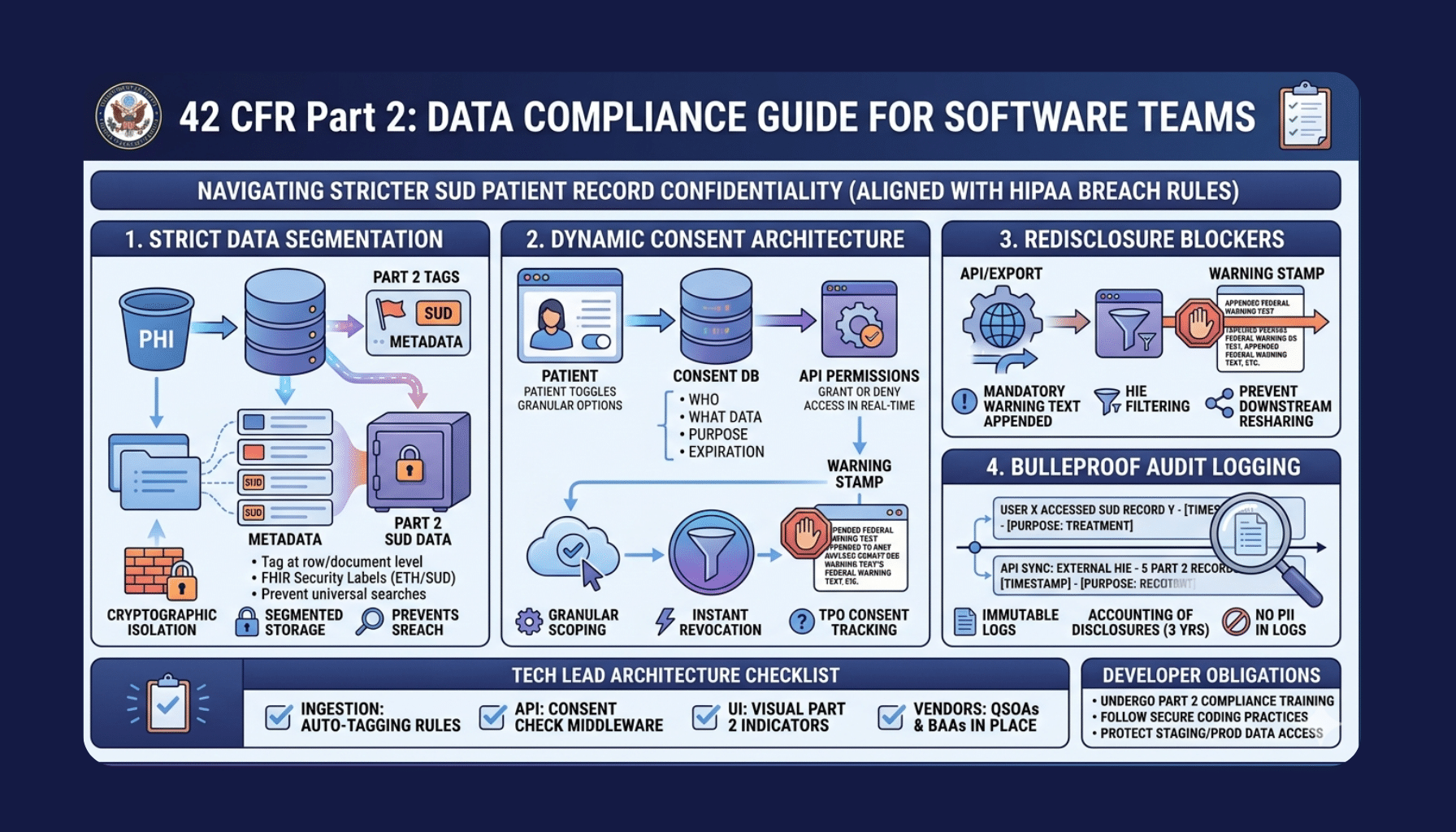
Part 2 centers on consent. Software handling SUD data typically needs to capture, store, enforce, and track patient consent for disclosures, with the specific elements a valid consent requires, and honor the scope of what the patient consented to. Under the 2024 rule’s single-consent approach for treatment, payment, and operations, the consent model is more workable than before, but consent remains the gate — your software has to actually enforce it, not just record it.
Data Segmentation and Flagging
When Part 2 data lives alongside other health information in an integrated record, software needs to segment or flag it so it is not improperly disclosed along with non-Part 2 data. This is the domain of data segmentation for privacy — the ability to identify Part 2-protected data and handle it differently from ordinary PHI. Without segmentation, an otherwise permitted disclosure of a record can inadvertently include protected SUD information.
Re-Disclosure Restrictions
Part 2 restricts re-disclosure: records disclosed under Part 2 generally must carry a notice prohibiting further re-disclosure without consent, and recipients are bound by it. Software that discloses Part 2 data needs to propagate that prohibition with the data, so the restriction travels with the record rather than being lost at the boundary.
Access Controls, Audit, and Accounting
As with all sensitive health data, Part 2 data needs tight access controls and thorough audit logging, and software may need to support an accounting of disclosures. These overlap with HIPAA’s safeguards but apply with the heightened sensitivity Part 2 data warrants — see our HIPAA technical safeguards explainer and our data security practice.
Who Is a Part 2 Program?
A recurring question is whether Part 2 even applies. Broadly, Part 2 covers federally assisted programs that hold themselves out as providing, and do provide, SUD diagnosis, treatment, or referral for treatment. The full definition has nuances, and whether a particular organization or data set falls under Part 2 is exactly the kind of determination that belongs with legal and compliance experts — not something to infer from a blog. The software-team takeaway is to ask the question early: if there is any chance your product handles Part 2-covered SUD data, get that determination made before you design, because it changes the requirements.
A Practical Approach for Software Teams
Get the Applicability Determination First
Work with the organization’s compliance team and counsel to determine whether Part 2 applies to your data and use case — before designing, since it shapes the requirements.
Design Consent Into the Core
Build consent capture, storage, enforcement, and tracking as a first-class part of the system, honoring the scope of patient consent for disclosures.
Segment and Flag Part 2 Data
Implement the ability to identify and segment Part 2-protected data so it can be handled differently from ordinary PHI within an integrated record.
Propagate Re-Disclosure Restrictions
Ensure that disclosures of Part 2 data carry the prohibition on re-disclosure with them, so the restriction travels with the record.
Apply Heightened Safeguards and Auditing
Implement strong access controls, thorough audit logging, and accounting-of-disclosures capability appropriate to the sensitivity of SUD data.
Validate With Compliance
Have the compliance team and counsel review the implementation against current Part 2 requirements, since the legal interpretation — not the engineering alone — is what determines compliance.
The Honest Boundary
It bears repeating because it is the most important point: software is a tool that supports Part 2 compliance, but compliance itself depends on the organization’s legal interpretation, policies, consent practices, and broader compliance program. Building good consent, segmentation, and audit capabilities is necessary, but it does not by itself make an organization Part 2-compliant, and no vendor can promise that it does. The determinations — does Part 2 apply, what does a valid consent require here, how should an edge case be handled — rest with counsel and compliance. We build to those determinations; we do not replace them.
How Taction Helps
We build behavioral health and SUD-related software with Part 2 requirements designed in — consent management that captures, enforces, and tracks patient consent; data segmentation and flagging so Part 2 data is handled distinctly within an integrated record; propagation of re-disclosure restrictions; and the access controls, audit logging, and accounting-of-disclosures capabilities the sensitivity demands. We work alongside your compliance team and counsel, who own the legal determinations, and we build to current Part 2 requirements. With healthcare engineering depth, ISO 27001-certified security, and PHI handled under a signed BAA, we make sensitive software dependable. Our behavioral health software and HIPAA-compliant development practices, within our healthcare software work, cover the full scope. For compliance guidance specifically, HIPAA compliance consulting can help frame the requirements with your team.
Related reading: Telepsychiatry App Development & Compliance · HIPAA Security Rule Technical Safeguards Explained
Frequently Asked Questions
What is 42 CFR Part 2?
It is the federal regulation governing the confidentiality of substance use disorder treatment records from certain federally assisted programs. It aims to protect people seeking SUD treatment from the consequences of disclosure and has historically gone further than HIPAA — notably by requiring patient consent for many disclosures HIPAA would permit without it. SUD data under Part 2 is not “just PHI”; it carries an additional regulatory layer.
Did the 2024 rule change Part 2?
Yes. A 2024 final rule aligned Part 2 more closely with HIPAA in several ways — including a single patient consent covering treatment, payment, and operations, and alignment of aspects of breach notification and penalties. This eased friction with HIPAA, but the special protections remain, and consent and re-disclosure considerations are still central. Confirm current requirements with compliance, as this area changed recently.
Does Part 2 apply to my software?
That depends on whether your data comes from a federally assisted program providing SUD diagnosis, treatment, or referral — a determination that belongs with legal and compliance experts, not a blog. The software-team takeaway is to ask early: if there is any chance your product handles Part 2-covered SUD data, get that determination before designing, because it changes the requirements.
What capabilities does Part 2 require in software?
Centrally, consent management — capturing, enforcing, and tracking patient consent for disclosures. Also data segmentation and flagging so Part 2 data is handled distinctly within an integrated record, propagation of re-disclosure restrictions with disclosed data, and heightened access controls, audit logging, and accounting of disclosures appropriate to the sensitivity.
What is the re-disclosure restriction?
Part 2 generally requires that records disclosed under it carry a notice prohibiting further re-disclosure without consent, and recipients are bound by it. Software that discloses Part 2 data needs to propagate that prohibition with the data, so the restriction travels with the record rather than being lost at the boundary.
Does building these features make us Part 2-compliant?
No. Software supports Part 2 compliance, but compliance depends on the organization’s legal interpretation, policies, consent practices, and broader compliance program. Good consent, segmentation, and audit capabilities are necessary but not sufficient, and no vendor can promise compliance. The determinations rest with counsel and compliance; software is built to those determinations.
Building software that handles SUD data? Schedule a free consultation →
This article is an educational overview for software teams, not legal advice. Whether 42 CFR Part 2 applies and how to implement it are determinations for your counsel and compliance team. Reviewed by Taction Software’s healthcare engineering team. ISO 27001-certified information security management. SUD data is protected under a signed BAA.