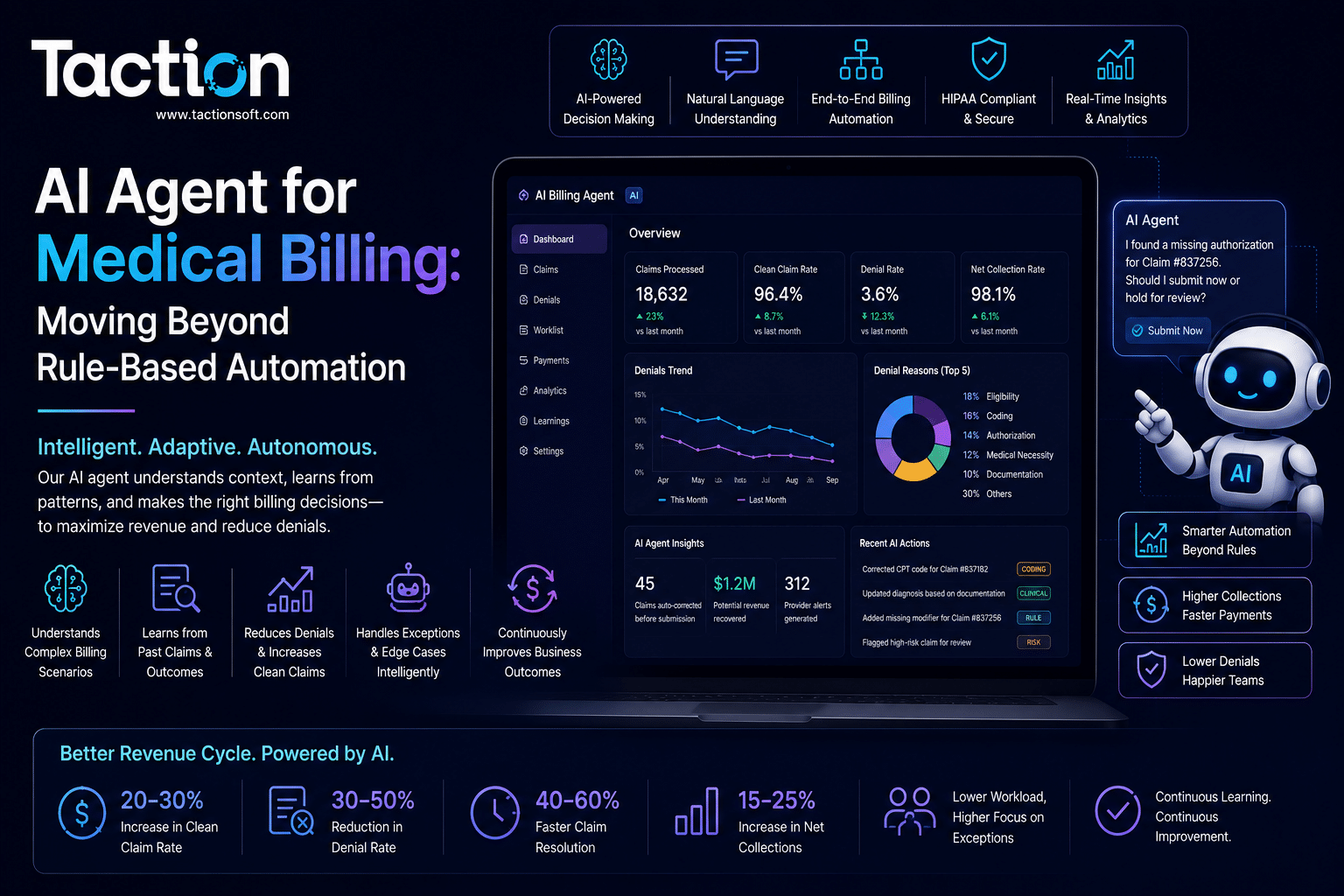
An AI agent for medical billing goes beyond static rule-based automation by autonomously working through multi-step billing tasks, checking eligibility, applying the correct codes, flagging likely denials before submission, and following up on outstanding claims, in a way that adapts to context rather than simply executing a fixed script. Most billing departments already run some form of automation, claim scrubbing rules, eligibility checks triggered at scheduling, but these tools generally handle one discrete step and stop the moment something falls outside their defined rules. An agentic approach is built specifically to handle that fallout, reasoning through exceptions and taking the next appropriate action rather than routing everything exceptional straight to a human queue. This page explains how billing agents differ from traditional RPA, where they add the most value across the billing cycle, integration considerations with existing billing systems, and what to evaluate before adopting one.
How AI Billing Agents Differ From Traditional Automation
The distinction between an AI agent and standard billing automation is not just marketing language, it reflects a real architectural difference in how the software behaves.
Rule-Based RPA Versus Reasoning Agents
Traditional robotic process automation in billing follows explicit, pre-programmed steps, if a claim matches condition A, apply action B. It works well for predictable, high-volume tasks but breaks down immediately when it encounters a case outside its defined rules. An AI agent, built on large language models with access to billing rules, payer policies, and claim history, can reason through a novel situation and decide on an appropriate next step, rather than simply failing or escalating by default.
Multi-Step Task Execution
A billing agent can chain together multiple steps autonomously, verifying eligibility, checking whether a procedure requires prior authorization, applying appropriate modifiers, and flagging any documentation gaps, executing this sequence as a single coordinated task rather than requiring a human to manually move a claim between separate automated tools at each stage.
Where AI Billing Agents Add the Most Value
The value of an agentic approach concentrates in specific parts of the billing cycle where exceptions and judgment calls are common, not just in the high-volume, low-complexity transactions traditional automation already handles well.
Pre-Submission Denial Risk Assessment
Before a claim is submitted, a billing agent can cross-reference the claim against payer-specific rules and historical denial patterns to flag claims likely to be rejected, catching issues that a static rules engine would miss because the pattern is contextual rather than a simple rule violation. This connects directly to the broader denial prevention approach covered in our page on AI claim denials prevention, where catching issues before submission is consistently more cost-effective than managing denials after the fact.
Eligibility and Authorization Verification
Agents can autonomously check patient eligibility and determine whether a specific procedure requires prior authorization based on the patient’s specific payer and plan, adapting to the frequent rule changes payers make rather than relying on a manually maintained rules table that quickly falls out of date. Our work on AI insurance eligibility verification covers this specific function in more depth.
Working Denials and Appeals
When a claim is denied, an agent can analyze the specific denial reason, determine whether an appeal is warranted based on the clinical documentation and payer policy, and draft the appeal submission for staff review, significantly reducing the manual research time billing staff currently spend chasing down denial reasoning and payer-specific appeal requirements.
Coding Support and Documentation Gap Detection
Billing agents can flag documentation gaps that would prevent accurate coding before a claim is even generated, cross-referencing the clinical note against coding requirements. This overlaps meaningfully with the work covered in our page on AI medical coding software, where catching documentation gaps upstream reduces both coding errors and the volume of claims that need correction after submission.
Integration Considerations With Existing Billing Systems
Deploying a billing agent requires connecting it into practice management and billing systems that were generally not designed with autonomous agents in mind.
API Access to Practice Management and Clearinghouse Systems
The agent needs programmatic access to claim data, eligibility verification systems, and clearinghouse submission pipelines, which means older billing systems without modern API support may require a middleware layer to bridge the gap before an agent can operate effectively.
Human Oversight and Approval Checkpoints
Even a sophisticated billing agent should operate with defined checkpoints where a human reviews and approves specific categories of decisions, particularly around claim submission and appeal filing, rather than operating with full autonomous authority from day one. Trust in agentic systems builds over a track record, and most billing departments are better served by expanding autonomy gradually as the agent demonstrates consistent accuracy.
Evaluating a Billing Agent Before Adoption
Billing leaders considering an agentic solution should look past the demo and into how the system actually performs on their specific payer mix and claim volume.
Testing Against Your Own Historical Claims
Before committing, run the agent against a sample of your own historical claims and denials to see how its recommendations compare to what actually happened, rather than relying solely on vendor-reported benchmarks from a different payer mix or specialty.
Understanding the Underlying Cost Structure
Agentic billing tools are frequently priced differently than traditional per-claim automation fees, and billing leaders should model the total cost against current denial rates and staff time spent on manual follow-up to understand the real return, a calculation covered more broadly in our overview of AI implementation costs in healthcare.
Key Takeaways
An AI agent for medical billing goes beyond static rule-based automation by reasoning through multi-step billing tasks, eligibility checks, denial risk assessment, appeals, and coding gap detection, in a way that adapts to context rather than failing outside a fixed rule set. Successful adoption depends on connecting the agent to your existing practice management and clearinghouse systems, defining clear human approval checkpoints, and testing performance against your own historical claims before expanding autonomy. If your billing department is exploring this technology, talk to our team about your current billing workflow and payer mix.
Frequently Asked Questions
How is an AI billing agent different from RPA billing automation?
RPA follows fixed, pre-programmed rules and fails outside them. An AI agent reasons through novel situations using billing rules and historical claim context, adapting its actions rather than simply escalating anything unexpected to a human queue.
Can an AI billing agent submit claims without human review?
Most well-designed deployments include human approval checkpoints for claim submission and appeal filing, with the level of autonomy expanding gradually as the agent demonstrates consistent accuracy on your specific claim volume and payer mix.
Does a billing agent replace billing staff?
It is designed to reduce manual research and follow-up time on exception cases, letting billing staff focus on higher-judgment tasks and oversight rather than repetitive claim chasing, not to eliminate the billing team entirely.
How do we know if an AI billing agent will work with our payer mix?
The best way to know is to test the agent against a sample of your own historical claims and denial patterns before full deployment, since performance can vary meaningfully depending on your specific payer relationships and specialty.
What billing systems does an AI agent need to integrate with?
It typically needs programmatic access to your practice management system, eligibility verification tools, and clearinghouse submission pipeline. Older systems without modern API support may need a middleware layer to enable this integration.