

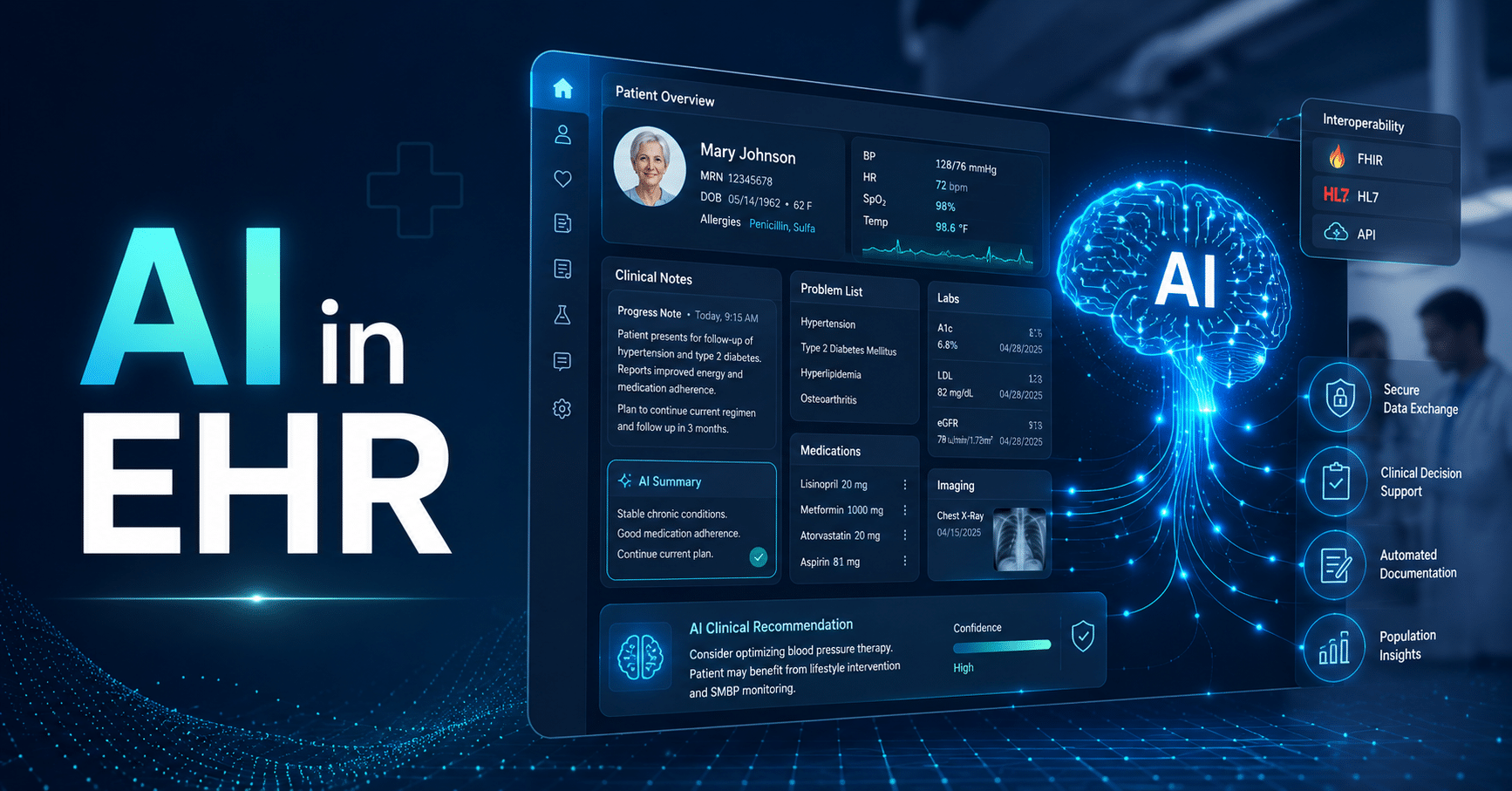
Artificial intelligence is changing what an electronic health record can do. An EHR was once mainly a digital filing cabinet, a place to store and retrieve patient information. When AI is applied to the data inside it, the EHR becomes an active system that can surface patterns, support clinical decisions, reduce administrative burden, and help deliver more accurate and personalized care.
This guide gives a complete, practical overview of AI in EHR systems: the data involved, the AI technologies in play, the main use cases, how integration and architecture actually work, what it costs, the compliance and risk picture, and how to roll it out without failing midway. It is written for healthcare leaders, product teams, and developers who want a grounded view rather than hype.
Quick reference: the decisions that shape an EHR AI project
Before going deep, here is a summary of the decisions that determine whether an AI-in-EHR project succeeds.
| Decision area | What it means for your EHR AI project |
| Best starting point | Clinical documentation, inbox and message triage, scheduling, lab and imaging workflows, billing and coding checks, and patient outreach |
| Required foundation | FHIR APIs, HL7 interfaces, secure patient data exchange, role-based access, audit logging, and clean data mapping |
| Biggest risk | AI that gives confident answers built on incomplete, outdated, or poorly contextualized EHR data |
| Most useful architecture | A layered design: data layer, interoperability layer, AI orchestration layer, model layer, workflow layer, and governance layer |
| Typical cost range | Roughly $40,000 for a controlled pilot to $1.5 million or more for enterprise-scale AI and EHR/EMR integration |
| Must-have controls | HIPAA safeguards, bias checks, explainability, human approval, model monitoring, source tracking, and incident response |
| Best rollout pattern | Start with one workflow, prove safety and adoption, then expand across departments |
The rest of this guide explains each of these in depth.
What an EHR contains, and why data type matters for AI
An electronic health record is a comprehensive, patient-centered digital record that provides information securely to authorized providers and organizations. The data inside it falls into three broad categories, and the category shapes what AI can do with it.
Structured data is well organized and easily quantifiable, stored in a predefined format. It includes demographics, vital signs such as height, weight, heart rate, and blood pressure, laboratory results, medication records, diagnoses and procedure codes, immunization records, and allergies. Structured data is the easiest for AI to analyze directly.
Semi-structured data is more flexible, often short text describing things like smoking status, chronic conditions, or examination results.
Unstructured data is the most detailed and the hardest to use. It includes clinical notes, surgical and radiology reports, and audio or video recordings. Much of the most clinically valuable information lives here, which is why natural language processing has become central to healthcare AI.
Understanding these categories matters because the value of AI in an EHR depends heavily on how well it can extract meaning from all three, especially the unstructured portion that traditional systems struggle to use. A model that can only read structured fields leaves most of the clinical story untouched.
The AI technologies behind EHR intelligence
Several distinct branches of artificial intelligence power EHR use cases. Choosing the right one for each task is part of what separates a working system from a demo.
Machine learning is the foundation. By learning patterns from large volumes of historical EHR data, machine learning models classify, predict, and rank outcomes, such as estimating readmission risk or flagging patients who may be deteriorating.
Natural language processing addresses the unstructured text that makes up a large share of clinical data. NLP reads physician notes, discharge summaries, and reports, turning free text into structured, usable information. It underpins automated coding, documentation improvement, and the extraction of insights that would otherwise stay locked in narrative form.
Large language models can summarize long patient histories, draft patient-friendly explanations, and power internal copilots that help staff find information across a record.
Retrieval-augmented generation grounds language-model answers in approved EHR data rather than letting the model rely on its own training. This matters in healthcare, because retrieval quality is what keeps an answer tied to the real patient record instead of a plausible-sounding guess.
Predictive machine learning forecasts likely outcomes such as no-show risk, readmission, sepsis, and disease progression, helping teams intervene earlier.
Speech recognition and ambient AI transcribe clinical encounters and draft notes automatically, reducing the documentation load that contributes heavily to clinician burnout. For a deeper look, see our guide to healthcare voice AI and ambient clinical documentation.
Computer vision assists with imaging review, wound tracking, and extracting structured data from documents.
OCR and document AI pull data from referrals, prior authorizations, faxed documents, and scanned charts, a large and often manual burden in real practice.
Rules engines handle eligibility checks, medical necessity rules, and order validation, where deterministic logic is safer and more auditable than a learned model.
Agentic AI workflows chain steps together to handle multi-step administrative tasks such as referral routing, scheduling, and status checks.
The table below maps these technologies to where they fit and what to watch for.
| Technology | Best-fit EHR use cases | What to watch |
| Natural language processing | Extracting symptoms, history, medications, and social factors from clinical notes | Accuracy can drop when notes are inconsistent or heavy with abbreviations |
| Large language models | Summaries, draft messages, documentation support, internal copilots | Needs retrieval controls, PHI protection, source citation, and human review |
| Retrieval-augmented generation | Grounding AI answers in approved EHR data, policies, and clinical references | Retrieval quality matters more than prompt style |
| Predictive machine learning | No-show prediction, readmission risk, sepsis risk, disease progression | Requires bias testing, drift monitoring, and ongoing validation |
| Speech recognition and ambient AI | Visit transcription, SOAP notes, follow-up instructions | Consent, recording policies, noise handling, and clinician approval are essential |
| Computer vision | Imaging support, wound and pathology tracking, document data extraction | May trigger medical-device and safety review requirements |
| OCR and document AI | Extracting data from referrals, prior authorizations, faxes, and scanned charts | Needs confidence scoring and a manual review queue |
| Rules engines | Eligibility, medical-necessity checks, payer rules, order validation | Must be versioned and maintained |
| Agentic AI workflows | Multi-step administrative tasks such as referral routing, scheduling, and status checks | Needs strict permissions, approval gates, and rollback paths |
The safest approach is usually hybrid. Use deterministic rules for compliance-heavy checks, machine learning for pattern detection, and language models for language-heavy work where outputs can be reviewed.
AI use cases in the EHR
AI improves the EHR across many functions. The most valuable starting points are the ones with high volume and clear, measurable benefit.
| Use case | What AI does | Why it matters | Integration requirements |
| Clinical documentation | Converts encounter conversations, dictation, or rough notes into structured drafts | Reduces after-hours documentation and burnout | Ambient AI, speech recognition, NLP, write-back controls to the chart |
| Chart summarization | Pulls key diagnoses, medications, labs, imaging, allergies, and recent history into one view | Helps clinicians avoid hunting through long records | FHIR resources, clinical-note access, retrieval controls, source attribution |
| Lab and imaging integration | Validates lab orders, flags medical necessity, and routes results | Reduces order errors and missed follow-ups | HL7, FHIR, LOINC, DICOM metadata, order reconciliation |
| Patient outreach | Automates appointment reminders, follow-up nudges, and review requests | Cuts front-desk load and improves attendance | Patient communication platform, scheduling sync, consent rules, message logging |
| Revenue cycle and coding | Flags missing codes, checks eligibility, and surfaces claim issues | Reduces denials and reimbursement delay | Billing software, payer rules, CPT and ICD-10 code sets, audit trail |
| Risk prediction | Identifies patients at risk for readmission, deterioration, care gaps, or no-shows | Helps care teams intervene earlier | Structured EHR data, model validation, bias checks, governance |
| Inbox and referral triage | Sorts messages, referrals, refill requests, and patient notes | Reduces response time | FHIR messaging, intent detection, escalation rules, human review |
| Clinical decision support | Suggests next steps based on guidelines, history, and current data | Supports faster, more consistent decisions | CDS Hooks, SMART on FHIR, model cards, governance |
| Population health analytics | Spots cohorts for chronic care, preventive care, or risk-based programs | Supports value-based care and reporting | Data warehouse, EHR extracts, reporting workflows |
A practical rule: begin where the work is repetitive, high volume, and low risk, such as documentation support, inbox triage, or medical coding automation, then move toward higher-stakes clinical decision support once trust and infrastructure are established.
Impact across healthcare stakeholders
The effects of AI-powered EHRs reach a range of stakeholders.
Patients benefit from improved diagnosis and treatment, faster service, fewer errors, and better engagement in their own care.
Clinicians benefit from a reduced administrative burden, clinical decision support, and optimized workflows that free time for direct patient care.
Hospital and clinic administrators benefit from improved operational efficiency, stronger financial performance, and better quality metrics.
EHR software developers carry the responsibility of building, maintaining, and integrating these systems while ensuring regulatory compliance, which makes their engineering and integration choices central to whether AI in the EHR succeeds.
How AI is integrated into an EHR: architecture and workflow
Adding AI to an EHR is an architecture problem before it is a modeling problem. The hidden challenge is rarely the model itself. It is mapping the clinical data, connecting to the right systems, and delivering the result inside the workflow. A sound design separates concerns into clear layers.
| Layer | What it does | Key design choices |
| Source systems | EHR, labs, imaging centers, billing software, patient portals, scheduling, communication platforms, and post-acute systems | Map data ownership, access limits, and workflow dependencies early |
| Interoperability layer | Moves data through FHIR APIs, HL7 v2, CDA, DICOM, flat files, and approved connections | Use FHIR where possible, but plan for legacy interfaces where reality demands them |
| Data normalization layer | Converts records into consistent dataset, encounter, observation, medication, order, and result structures | Standardize codes with SNOMED CT, LOINC, RxNorm, ICD-10, and CPT |
| Security and consent layer | Controls PHI access, encryption, consent, minimum-necessary use, and audit logging | Apply role-based access, tokenized access, logging, and data-retention rules |
| AI orchestration layer | Decides what data the AI can retrieve, what the model can call, and what guardrails apply | Use retrieval-augmented generation, prompt policies, model routing, and source filters |
| Model layer | Runs LLMs, machine learning models, NLP tools, computer-vision models, or rules engines | Match model type to risk level, latency needs, data type, and explainability |
| Workflow layer | Places AI output inside clinician, front-office, billing, or patient workflows | Avoid separate screens wherever possible |
| Governance layer | Tracks accuracy, bias, drift, safety, escalation, and audit evidence | Use model cards, source attribution, monitoring, and human-approval checkpoints |
Two principles run through all of it. First, build for bidirectional data flow, since a useful system both reads from the chart for context and writes back to it. Second, treat security and compliance as part of the architecture, designed in rather than added later. Deep integration experience matters here, because connecting cleanly to platforms such as Epic, Cerner, and Athenahealth involves platform-specific patterns, sandbox testing, and approval processes that take real time to navigate. For a closer look at the standards involved, see EHR integration services.
Interoperability and standards: the real foundation
AI in the EHR only works when data can move cleanly between systems, and that depends on interoperability standards.
HL7 version 2 remains the most widely used messaging standard for real-time clinical events, despite being decades old. It is everywhere in hospital environments and is not going away soon. (See our overview of HL7 integration for more.)
FHIR, Fast Healthcare Interoperability Resources, is the modern, API-first standard built for web and mobile access to clinical data. It models information as resources such as Patient, Observation, and MedicationRequest, exposed over RESTful APIs. FHIR is the preferred choice for new AI features because it is portable across platforms. (For a fuller comparison, see FHIR vs HL7.)
SMART on FHIR adds a standardized, OAuth 2.0 based authorization flow so an app can request scoped, secure access to specific data.
CCDA supports structured clinical document exchange during transitions of care.
Integration engines such as Mirth Connect route, filter, and transform messages between systems, often translating legacy HL7 v2 feeds into formats a modern FHIR-based application can use.
A common and effective pattern is to use FHIR for structured data queries and HL7 v2 for real-time event-driven messaging, bridging older systems through middleware where needed.
Platform-specific integration notes
The major EHRs differ in operational detail, and those differences shape engineering decisions.
Epic holds a large share of the US hospital market and offers FHIR R4 APIs, HL7 v2 messaging, CCDA, and proprietary web services, with a marketplace and app-review process. Integration is not plug and play. It involves sandbox testing, security validation, and go-live approval at each customer site. (See our Epic EHR integration guide for the technical detail.)
Cerner-Oracle Health is widely deployed across community health systems, federal healthcare, and academic centers. It supports SMART on FHIR with platform-specific implementation details, a certification and marketplace path, and Oracle Cloud Infrastructure considerations for AI workloads. Federal deployments add compliance layers on top of HIPAA. (Our Cerner-Oracle Health AI integration guide goes deeper.)
Athenahealth, NextGen, and Veradigm/Allscripts each provide their own API programs and marketplace relationships, with their own onboarding and approval steps.
The practical takeaway is that AI-in-EHR work benefits enormously from hands-on experience with the specific platform, because the standards are learnable but the operational reality of each vendor takes practice.
A phased roadmap for adopting AI in the EHR
Organizations that succeed tend to move in deliberate phases rather than attempting everything at once.
Phase one, discovery and use-case selection. Identify a specific, high-value problem, confirm the data exists and is of adequate quality, and define what success looks like. A narrow first use case is far more likely to succeed than a broad ambition.
Phase two, data readiness. Assess and improve the quality, completeness, and accessibility of the relevant data. This phase often surfaces interoperability gaps that must be closed before AI can deliver value.
Phase three, prototype or pilot. Build a working version against de-identified or synthetic data, validate it with clinical input, and produce a clear go or no-go for production. Test the integration edges hard, since unexpected data shapes from external systems are a common source of failure.
Phase four, integration and deployment. Connect the validated solution through the appropriate standards, embed it in the clinical workflow, and roll it out with security and compliance controls fully in place.
Phase five, monitoring and improvement. Track performance over time, watch for drift, retrain as needed, and gather clinician feedback. AI in healthcare is an ongoing commitment to accuracy and safety, not a one-time deployment.
Cost considerations for AI in EHR
The cost of adding AI to an EHR varies widely and depends on factors rather than a single price. The main drivers are the complexity of the use case, the number and difficulty of integrations, the quality and availability of data, the regulatory scope, and the level of ongoing monitoring and retraining required.
| Stage | Typical investment | What it includes |
| Controlled pilot | Around $40,000 to $95,000 | One narrow use case, prototype, validation against de-identified or synthetic data |
| Production feature | Around $120,000 to $300,000 | A deployed AI capability integrated into one or two systems with compliance controls |
| Enterprise AI and EHR integration | $500,000 to $1.5 million or more | Multiple integrations, broad rollout, strict regulatory scope, ongoing monitoring |
Two costs are consistently underestimated. Data preparation is the first, since poor data quality can require significant cleanup before any model performs reliably. Integration is the second, because each connection to an EHR or related system adds engineering and testing effort. The most useful way to think about cost is in terms of value: a well-targeted capability that reduces documentation time, prevents avoidable readmissions, or recovers revenue through more accurate coding can justify its investment, while a broad, poorly scoped effort tends to consume resources without a clear return.
Compliance and security: non-negotiable foundations
In healthcare, security and compliance are not features added near the end. They are properties of the system, reflected in how data is stored, who can access it, and how every action is logged.
Depending on the use case, an AI-in-EHR system may need to align with HIPAA and HITECH for protected health information in the United States, GDPR for users in the European Union, FDA Software as a Medical Device expectations where the software functions as a medical device, and standards such as SOC 2 and ISO 27001 for security management. In practice this means encryption in transit and at rest, role-based access control, audit logging of every access to PHI, data minimization, and secure handling of authorization tokens.
Generative AI adds specific obligations. Business associate agreements should be in place with any model provider before PHI enters a prompt, prompt and inference logs must be protected so they do not leak PHI, and outputs that influence care should be reviewed. Treating these as design requirements from the first decision is far cheaper and safer than retrofitting them later.
Real-world application areas
AI applied to EHR data is being used and studied across many areas of medicine.
In cardiology, models using EHR data have been studied for cardiovascular risk assessment, ECG interpretation, and prediction of conditions such as heart failure and atrial fibrillation, supporting earlier intervention.
In oncology, AI and NLP applied to EHRs and clinical notes support patient categorization, risk identification, and matching patients to clinical trials, which can speed access to new therapies.
In sepsis care, machine learning models drawing on EHR clinical data have been studied for predicting onset before symptoms appear, supporting earlier detection and treatment.
In rare diseases, AI applied to the broad information in EHRs can help with earlier and more accurate detection, personalized treatment, and faster referral to specialists.
The common thread is that the EHR is a rich, longitudinal source of patient information, and AI is the layer that turns that information into earlier, more precise, and more personalized action.
Challenges, risks, and how to manage them
Despite the benefits, several challenges continue to limit adoption.
Data privacy and security. EHRs hold sensitive information that must be protected under regulations such as HIPAA and GDPR, requiring strong encryption, access control, and audit logging.
Interoperability. Integrating AI with existing systems often requires substantial technical work that can be expensive and time consuming.
Bias in AI models. A model trained on incomplete or non-representative data can produce skewed results that affect clinical decisions, so the quality and representativeness of training data are critical.
Hallucination and context errors. The single biggest risk with language-model features is confident answers built on incomplete or poorly contextualized data. Retrieval grounding, source attribution, and human review are the defenses.
Trust, training, and adaptation. Clinical staff need user-friendly tools, adequate training, and confidence that AI supports rather than replaces them. Transparency about how AI reaches its conclusions is necessary for adoption.
Regulatory and validation demands. Systems that influence clinical decisions may face expectations around validation, transparency, and in some cases regulatory review.
To move past these barriers, the pattern is consistent: choose narrow, high-value use cases, invest in data quality and interoperability early, design security and compliance into the architecture, validate carefully with clinical input, and keep humans in the loop.
How to choose an AI and EHR development partner
Because the hard part is integration and compliance rather than the model, the choice of partner matters more than it first appears. A few questions cut through quickly.
Does the team have real healthcare experience measured in years, not quarters? Can they show hands-on FHIR R4 and SMART on FHIR integration work, not just claim it? Do they treat HIPAA and compliance as architecture rather than paperwork? Can they sign business associate agreements, including with the model providers they use? And can they point to real, verifiable products they have shipped? A team that has navigated Epic, Cerner, and Athenahealth integrations before will avoid mistakes that a general AI shop discovers the expensive way on a live project. (You can see how we approach this in our AI healthcare engineering work.)
The future of AI in EHRs
The direction of travel is toward AI that is more deeply embedded and less visible. Rather than separate tools, AI capabilities are increasingly built directly into the EHR workflow, surfacing insight at the moment of care. Ambient documentation, where a system listens to an encounter and drafts the note, is a clear example of AI reducing burden without adding steps.
Several themes will shape the next few years. Generative AI and clinical copilots will take on more documentation and summarization work, provided safety and governance are managed. Interoperability will continue to standardize around FHIR, making AI features more portable. Predictive and preventive applications will expand as data quality improves. And attention to fairness, transparency, and oversight will grow, since trust is the precondition for adoption at scale.
What will not change is the underlying principle: AI in the EHR delivers value only when it is built on clean, interoperable data, embedded in real workflows, and governed with care.
Frequently asked questions
What is AI in EHR?
AI in EHR is the use of artificial intelligence, including machine learning, natural language processing, and large language models, to analyze and act on the data in an electronic health record, supporting documentation, decision support, prediction, coding, and patient engagement.
What is the most common first use case?
Clinical documentation support, inbox and message triage, and coding or eligibility checks are common starting points because they are high volume, repetitive, and relatively low risk.
Which standards are used to integrate AI with an EHR?
HL7 v2 for real-time messaging, FHIR and SMART on FHIR for modern API access, CCDA for clinical documents, and integration engines such as Mirth Connect to route and transform data.
How much does AI in EHR cost?
A controlled pilot can start around the tens of thousands of dollars, while enterprise-scale AI and EHR integration can reach $1.5 million or more, depending on integrations, data quality, and regulatory scope.
What is the biggest risk?
AI that produces confident answers based on incomplete, outdated, or poorly contextualized EHR data. Retrieval grounding, source attribution, and human review reduce this risk.
Does AI replace clinicians?
No. The effective pattern keeps humans in the loop, with AI supporting documentation, surfacing information, and flagging risk, while clinical judgment stays with the clinician.
Key capabilities of an AI-powered EHR
When AI is layered onto an EHR thoughtfully, a set of capabilities tends to define the better systems. These are worth using as a checklist when scoping a project or evaluating a vendor.
Ambient and assisted documentation. The system captures the encounter and produces a structured draft note, which the clinician reviews and signs. Done well, this returns meaningful time to the clinician and reduces after-hours charting.
Context-aware summarization. Instead of forcing a clinician to scroll a long record, the system assembles the relevant history, medications, results, and recent events into a concise, sourced summary. The sourcing is important, because a summary a clinician cannot trace back to the chart is hard to trust.
Decision support inside the workflow. Recommendations, alerts, and risk scores appear where the clinician already works, not in a separate application. Integration through standards such as CDS Hooks and SMART on FHIR is what makes this possible.
Coding and revenue accuracy. The system reviews documentation against code sets and payer rules, flags gaps, and reduces denials, with a clear audit trail.
Predictive flags with explanation. Risk predictions are most useful when they come with the factors behind them, so a care team understands why a patient was flagged and can act with judgment.
Patient-facing intelligence. Reminders, education, and conversational support extend engagement beyond the visit, with consent and privacy controls in place.
Governance and oversight built in. Model performance, drift, source attribution, and human-approval checkpoints are part of the product, not an afterthought. This is what allows an organization to trust the system over time.
A capable AI-in-EHR system is rarely a single feature. It is a coordinated set of these capabilities, each integrated into the workflow and each governed for safety.
Common mistakes that derail AI-in-EHR projects
Many AI-in-EHR efforts fail for predictable reasons. Knowing them in advance is the cheapest way to avoid them.
Starting too broad. Teams that try to transform everything at once usually stall. The projects that succeed pick one narrow, high-value workflow, prove it, and expand from there.
Underestimating data quality. Models are only as good as the data feeding them. Skipping the work of cleaning, normalizing, and standardizing data is one of the most common causes of disappointing results.
Treating integration as an afterthought. A model that cannot connect cleanly to the EHR becomes an island. Integration is core engineering work, not a final step, and it deserves planning from the start.
Retrofitting compliance. Bolting HIPAA controls onto a finished system often means rebuilding core parts. Designing for compliance from the first decision is far cheaper and safer.
Ignoring the workflow. A feature that forces clinicians into a separate screen or extra clicks will not be adopted, no matter how accurate the model is. Embedding output in the existing workflow is essential.
No monitoring after launch. Models drift as data and practice change. A system without ongoing monitoring and retraining quietly loses accuracy. Treating deployment as the finish line is a mistake.
Skipping human oversight. For anything that influences care, removing the human from the loop introduces unacceptable risk. The reliable pattern keeps clinicians in control, with AI as support.
Avoiding these is less about advanced technology and more about discipline: scope narrowly, respect the data, integrate properly, design for compliance, fit the workflow, and keep monitoring.
More frequently asked questions
Can AI be added to an existing EHR, or does it require a new system? In most cases AI is added to an existing EHR through integration rather than replacement. Standards such as FHIR and HL7 allow new AI capabilities to connect to the systems already in place.
How long does an AI-in-EHR project take? A focused pilot can take a few weeks to a few months, while a production deployment integrated across systems and subject to compliance review typically takes several months or more, depending on scope.
What data is needed to train healthcare AI safely? Models should be developed and tested with de-identified or synthetic data, never live PHI, and the data should be representative enough to reduce bias.
Who owns the AI system and the data? Ownership terms vary by engagement, but the healthcare organization should retain ownership of its data, and intellectual-property terms for the software should be agreed clearly at the outset.
How is patient consent handled with AI features? Consent is managed within the EHR and communication workflows, with clear records, and certain features such as ambient recording require specific consent and recording policies.
Conclusion
Artificial intelligence is reshaping the electronic health record, turning a system of record into a system that actively supports better clinical practice and patient outcomes. The most meaningful gains come not from any single feature but from the combination of clean, interoperable data, well-chosen use cases, sound architecture, and careful attention to privacy, fairness, and clinician trust. Organizations that treat those foundations as seriously as the models themselves are the ones that will see lasting benefit.
This overview was prepared by Taction Software, a healthcare IT company building HIPAA-compliant healthcare applications and EHR integrations since 2013, with experience across HL7, FHIR, CCDA, and Mirth Connect. For related reading, see our work on healthcare app development.
References
- HL7 International. HL7 FHIR (Fast Healthcare Interoperability Resources) Specification. https://hl7.org/fhir/
- Office of the National Coordinator for Health Information Technology (ONC). HealthIT.gov: Electronic Health Records and Interoperability. https://www.healthit.gov/
- U.S. Department of Health and Human Services. HIPAA for Professionals. https://www.hhs.gov/hipaa/for-professionals/
- HIMSS (Healthcare Information and Management Systems Society). Interoperability and Health Information Exchange Resources. https://www.himss.org/
- SMART Health IT. SMART on FHIR. https://smarthealthit.org/
- SNOMED International. SNOMED CT. https://www.snomed.org/
- Regenstrief Institute. LOINC (Logical Observation Identifiers Names and Codes). https://loinc.org/
- Stankovic S. Leveraging AI to Enhance Electronic Health Records. EJIFCC. 2025;36(4):618-623. PMCID: PMC12743341. https://pmc.ncbi.nlm.nih.gov/articles/PMC12743341/
- Dolin RH, et al. vcf2fhir: a utility to convert VCF files into HL7 FHIR format for genomics-EHR integration. BMC Bioinformatics. 2021. doi:10.1186/s12859-021-04039-1. https://www.ncbi.nlm.nih.gov/pmc/articles/PMC7923512/
- HL7 FHIR with SNOMED-CT to Achieve Semantic and Structural Interoperability in Personal Health Data: A Proof-of-Concept Study. PMCID: PMC9147872. https://www.ncbi.nlm.nih.gov/pmc/articles/PMC9147872/