
Most of the attention in an EHR data migration goes to the mapping and the move — but the phase that actually determines success or disaster is the one at the end: validation and cutover. This is where you prove the migrated data is complete and correct, decide whether to go live, flip the switch, and support the organization through the first hours and days on the new system. Get it right and the migration is a non-event; get it wrong and clinicians can’t find the records they need on day one. This guide focuses specifically on that make-or-break phase.
For the broader migration picture, see our EHR data migration services overview and our legacy-to-cloud migration guide; this article goes deep on validation and cutover specifically. A scope note: this is a technical guide, not legal advice — compliance determinations rest with your team — and migrated data is PHI to be protected throughout.
Why Validation and Cutover Are the Make-or-Break Phase
Mapping data from a legacy EHR to a new one is necessary, but mapping that looks correct on paper can still produce a migration that is incomplete or subtly wrong in practice. Validation is how you find that out before go-live rather than after. And cutover — the actual transition to the new system — is a high-stakes, time-boxed event where a clinical organization stops using one system and starts using another, often with patients being cared for the whole time. The cost of a bad cutover is immediate and visible: missing histories, orphaned results, clinicians unable to work. That is why disciplined teams spend disproportionate effort here, rehearsing and verifying rather than hoping.
Data Validation: Proving the Migration Is Correct
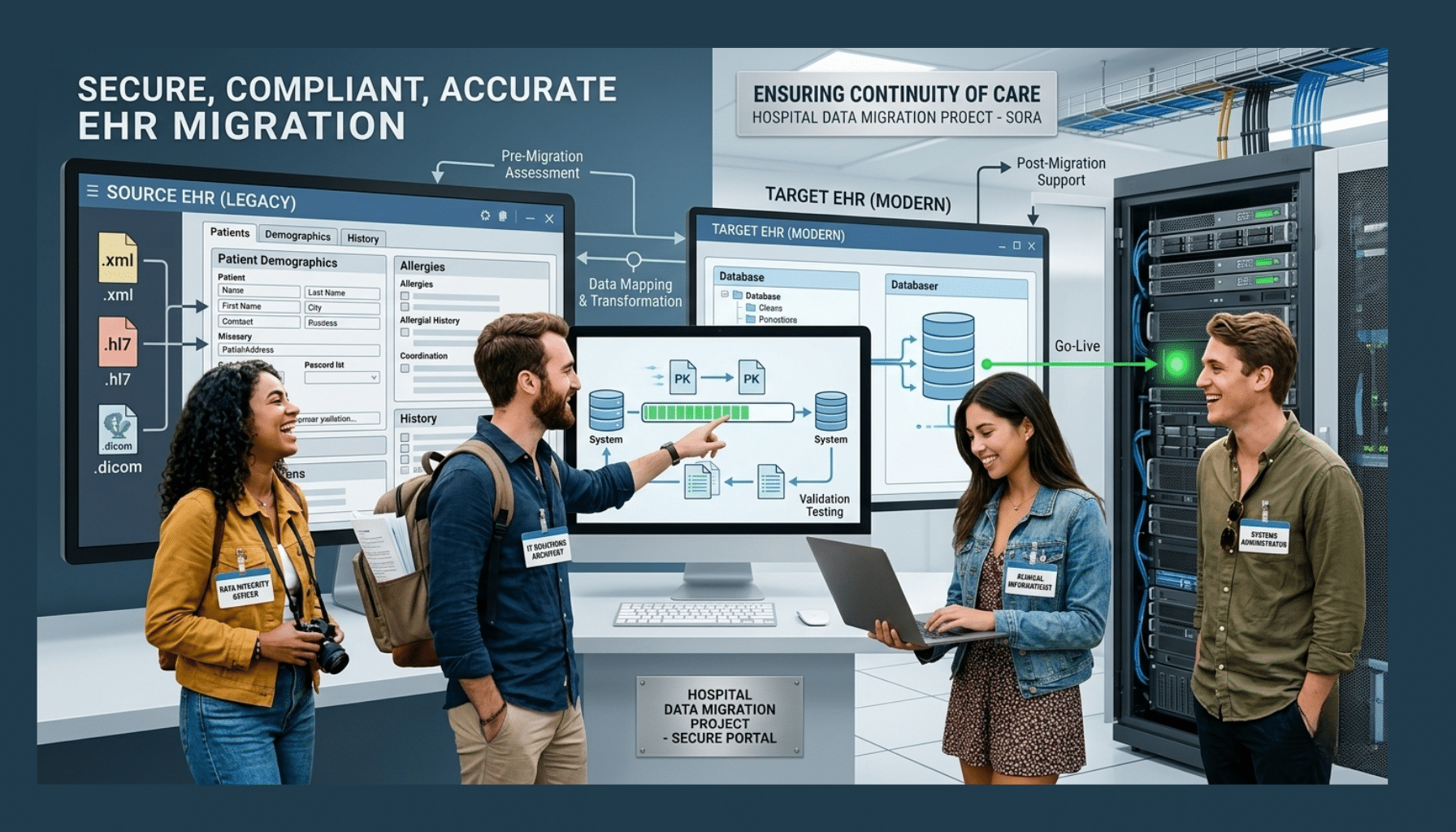
Validation operates on several levels, and a thorough migration checks all of them. Completeness confirms the right volume of data arrived — record counts reconcile between source and target, and nothing was silently dropped. Accuracy confirms the data is correct at the field level — values landed in the right places with the right content, verified through sampling and field-level comparison. Integrity confirms the data hangs together — referential relationships hold, so results still link to the right patients and encounters, and nothing is orphaned. And clinical validation confirms the data is usable for care — clinicians review migrated charts in the new system and verify that records look right and complete from a clinical perspective, which catches problems that purely technical checks miss. Skipping clinical validation is a common and costly mistake, because clinicians notice things that record counts never will.
Reconciliation: Source-to-Target Verification
At the heart of validation is reconciliation — systematically comparing the source and target to prove they match. This includes reconciling record counts by type (patients, encounters, results, medications), comparing field-level values on sampled records, and using checksums or other comparison techniques to confirm fidelity at scale. Reconciliation should be documented and repeatable, producing evidence you can point to — “we migrated X records, reconciled X in the target, with sampled accuracy verified” — rather than a vague assurance that it worked. This evidence is also what supports a confident go/no-go decision at cutover.
Dry Runs: Rehearse Before You Perform
You should never let a production cutover be the first time you run the migration end to end. Mock or test migrations — full dry runs into a test environment — surface mapping errors, performance problems, and data issues while there is still time to fix them. The best teams rehearse the migration multiple times, refining each pass, so that by the real cutover the process is well understood and timed. Dry runs also let you measure how long the migration actually takes, which is essential for planning the cutover window. Treat rehearsal as mandatory, not optional; the migrations that go badly are almost always the ones that were never fully rehearsed.
Cutover Strategy: Big-Bang vs Phased
There are two broad cutover approaches, and the right one depends on the organization. A big-bang cutover transitions everything to the new system at a single point in time — simpler conceptually and avoids running two systems in parallel, but concentrates risk into one event and usually requires a downtime window. A phased cutover transitions in stages — by department, facility, or data domain — spreading risk and allowing lessons from early phases, but requiring the two systems to coexist for a period, which adds its own complexity. Neither is universally right; the choice follows the organization’s size, risk tolerance, and operational constraints. Many large migrations lean phased to limit blast radius; smaller, simpler ones often go big-bang.
The Cutover Plan
A cutover is run from a detailed, sequenced plan. The typical shape: freeze changes in the legacy system at a defined cutoff; perform the final delta migration to capture everything changed since the last full migration; validate and reconcile the migrated data in the new system; make a go/no-go decision against predefined criteria; switch over to the new system; and enter hypercare. A clear go/no-go gate — with explicit criteria for what “ready” means — is what keeps a cutover from proceeding on optimism. Every step should have an owner, a time estimate (from your dry runs), and a verification check.
Rollback Planning
Hope for a clean cutover, but plan for the alternative. A rollback plan defines how you revert to the legacy system if the cutover fails its go/no-go criteria or something goes seriously wrong after switchover. Knowing in advance how you would back out — and confirming the legacy system remains available and usable during the transition — removes the worst pressure from the go/no-go decision, because “no-go” is a safe choice rather than a catastrophe. A cutover without a rollback plan is a bet you cannot afford to lose.
Go-Live Hypercare
The migration is not done when the switch is flipped — it is done when the organization is stable on the new system. Hypercare is the intensive support period immediately after go-live: heightened support staffing, rapid triage of issues, close monitoring, and quick fixes for the data and workflow problems that inevitably surface when real users hit the system at scale. Plan hypercare explicitly, with the right people available, because the first hours and days are when issues concentrate and when fast response protects both operations and clinician confidence in the new system.
How Taction Helps
We run the validation and cutover phase of EHR data migrations with the rigor it demands — multi-level validation (completeness, accuracy, integrity, and clinical review), documented source-to-target reconciliation, repeated dry runs, a sequenced cutover plan with a clear go/no-go gate, a rollback plan, and hypercare support through go-live. We handle the riskiest part of a migration so the transition is a non-event. With healthcare engineering depth, ISO 27001-certified security, and PHI protected throughout under a signed BAA, we make cutover dependable. Our EHR migration and healthcare data migration practices, within our healthcare software work, cover the full scope.
Related reading: EHR Data Migration Services · Healthcare Data Migration: Legacy to Cloud
Frequently Asked Questions
What is the most critical phase of an EHR data migration?
Validation and cutover. Mapping and moving data are necessary, but validation is how you prove the migrated data is complete and correct before go-live, and cutover is the high-stakes transition to the new system. The cost of getting this phase wrong is immediate and visible — missing records, orphaned data, clinicians unable to work.
What does data validation involve?
Several levels: completeness (record counts reconcile, nothing dropped), accuracy (field-level values are correct, verified by sampling), integrity (referential relationships hold, nothing orphaned), and clinical validation (clinicians review migrated charts in the new system). Clinical validation is essential because clinicians catch problems that purely technical checks miss.
What is reconciliation in a migration?
Reconciliation is systematically comparing source and target to prove they match — reconciling record counts by type, comparing field-level values on samples, and using checksums to confirm fidelity at scale. It should be documented and repeatable, producing evidence that supports a confident go/no-go decision rather than a vague assurance.
Should we do a big-bang or phased cutover?
It depends on the organization. Big-bang transitions everything at once — simpler but concentrates risk and usually needs downtime. Phased transitions in stages by department, facility, or domain — spreading risk but requiring the systems to coexist temporarily. Larger migrations often lean phased to limit blast radius; smaller ones often go big-bang.
Why do we need dry runs?
Because a production cutover should never be the first end-to-end run of the migration. Mock migrations into a test environment surface mapping errors, performance issues, and data problems while there is time to fix them, and they let you measure how long the migration takes for cutover planning. Migrations that go badly are usually the ones never fully rehearsed.
What is hypercare?
Hypercare is the intensive support period right after go-live — heightened staffing, rapid issue triage, close monitoring, and quick fixes for the problems that surface when real users hit the new system at scale. The migration is done when the organization is stable on the new system, not when the switch is flipped, so hypercare is planned explicitly.
Planning an EHR migration cutover? Schedule a free consultation →
This article is a technical guide, not legal advice. Reviewed by Taction Software’s healthcare engineering team. ISO 27001-certified information security management. Migrated data is PHI, protected under a signed BAA.