“NextGen Connect vs Mirth Connect” is one of the most confused questions in healthcare integration, and the reason is simple: they are largely the same product. The confusion is real and worth clearing up, though, because while the engine is one and the same, there are genuine distinctions — in naming, in licensing, and in commercial support — that actually matter when you are choosing what to build on. This article explains why the two names refer to the same thing, the history behind the rename, and the real differences you should understand.
A scope note: licensing is a legal matter, and license terms can change and vary by version. This article explains the landscape, but you should verify the current license for the specific version you intend to use and involve counsel for commercial decisions.
The Short Answer: Same Engine, Different Name
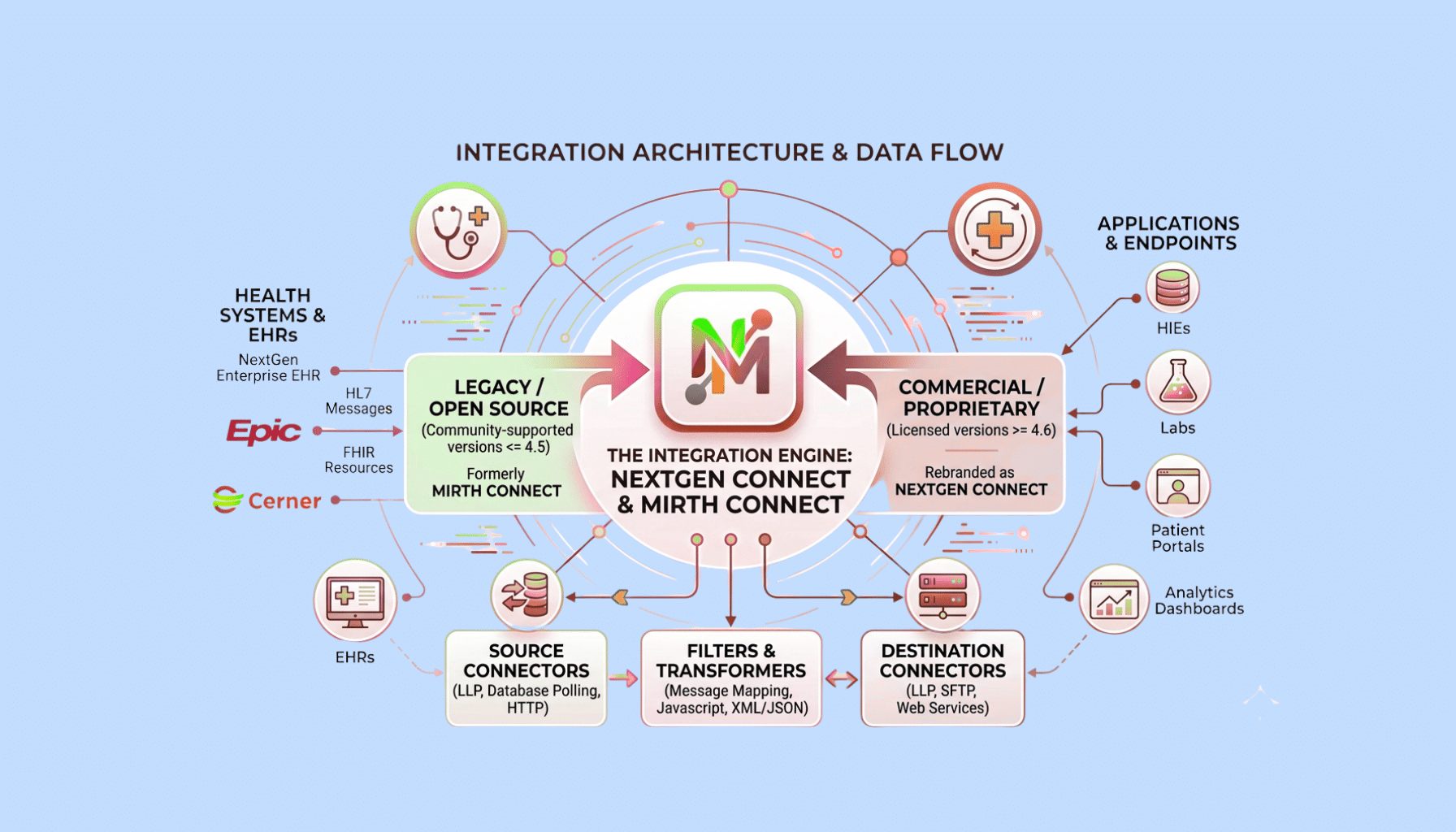
NextGen Connect and Mirth Connect are the same integration engine. “Mirth Connect” is the original and still-most-common name; “NextGen Connect Integration Engine” is the official name it was given after NextGen Healthcare came to own it. When someone says “Mirth” and someone else says “NextGen Connect,” they are almost always talking about the same software. So if your question is “which one should I use, NextGen Connect or Mirth Connect,” the honest answer is that they are not two competing products to choose between — they are one product under two names.
The History Behind the Rename
The lineage explains the two names. Mirth Connect was created by Mirth Corporation. Mirth was acquired by Quality Systems, Inc. (QSI), the company that later rebranded itself as NextGen Healthcare. Under NextGen, the product was rebranded from “Mirth Connect” to the NextGen Connect Integration Engine. The engineering lineage is continuous — the same codebase and the same core product carried through the ownership and naming changes. The community, however, has largely kept calling it “Mirth,” partly out of habit and partly because the name is deeply established in healthcare integration. So the dual naming is a branding artifact of an acquisition, not a sign of two different tools.
So What’s Actually Different?
If they are the same engine, where do real differences come in? Three places.
1. Naming and Branding
This is the most superficial distinction and the source of most confusion: the official product name is NextGen Connect, while the colloquial and historically dominant name is Mirth Connect. Same product, two labels. Recognizing this resolves most of the “versus” confusion immediately.
2. Licensing — The Distinction That Actually Matters
This is the substantive one. Mirth Connect was historically open source, with its core released under the Mozilla Public License (MPL 2.0) — genuinely open, including for commercial use. However, NextGen changed the licensing of newer versions: reports indicate that starting around version 4.5 (in 2023), the engine moved from the open-source MPL to a more restrictive source-available license that places limits on certain commercial and competitive uses. Older versions (those released under MPL 2.0) remain under that open-source license, while newer versions fall under the newer, more restrictive terms.
The practical upshot is important: “is Mirth Connect open source?” no longer has a single yes-or-no answer — it depends on the version. If you are building on Mirth/NextGen Connect, especially for a commercial product, the version you choose determines your license obligations, and you should verify the exact current license for that version and have counsel review it. Do not assume the engine is freely usable for any purpose without checking, because the relicensing changed that for newer releases.
3. Commercial Support and Edition
Beyond the free/source-available engine, NextGen offers commercial support — paid support, service-level agreements, and the backing of the vendor, potentially alongside additional capabilities or hosting options. So another real “difference” people are sometimes asking about is community/self-supported use of the engine versus a commercially supported relationship with NextGen. That is a genuine choice with real implications for risk, reliability, and cost, even though the underlying engine is the same.
What This Means in Practice
A few takeaways follow from all this. First, don’t overthink the name — if you or a colleague says “Mirth,” you almost certainly mean the same engine NextGen calls NextGen Connect, and channel development and integration work are identical regardless of which name is used. Second, do take the licensing seriously, because it genuinely varies by version: confirm the license for the version you plan to use, particularly if you are embedding it in a commercial product or offering, and get legal review. Third, decide deliberately between self-supported and commercially supported use based on your reliability needs, internal expertise, and risk tolerance. The name is trivial; the license and support model are not.
Does the Rename Change How You Build Channels?
No. The way you build and operate the engine — channels, source and destination connectors, filters, transformers, JavaScript, deployment, and monitoring — is the same whether you call it Mirth Connect or NextGen Connect. If you want a practical walkthrough of building channels, our Mirth Connect channel development tutorial applies equally under either name, and our HL7 ADT messages explainer covers the kind of feed you will commonly route through it. The skills, patterns, and tooling carry across the rename unchanged.
Choosing Your Path
Putting the real distinctions together, your decision is less “NextGen Connect or Mirth Connect” and more a set of practical choices about the same engine. Which version will you use, and what license does it carry — open-source MPL (older versions) or the newer source-available terms — and does that license fit your intended use, especially commercially? Will you run it self-supported using community knowledge and your own expertise, or take commercial support from NextGen for SLAs and vendor backing? These questions — license fit and support model — are what actually shape the decision, and they should be answered against your use case, risk tolerance, and resources, with legal review of the license for commercial uses. For how the engine compares to other integration approaches entirely, see our Mirth vs Redox comparison.
The Honest Take
Do not let the naming confusion distract you, and do not let it obscure the one thing that genuinely matters: the licensing. The rename from Mirth Connect to NextGen Connect is branding, and it changes nothing about how you build. The relicensing of newer versions, on the other hand, is substantive — it changed what “open source” means for this engine depending on the version, and getting that wrong can create real legal exposure if you build a commercial product on terms you did not actually verify. So: treat the names as interchangeable, treat the license as version-specific and worth checking, and bring in counsel when commercial use is on the table.
How Taction Helps
We work with Mirth Connect / NextGen Connect across versions and editions, and we help you navigate exactly the choices this article describes — which version and license fit your use case, whether self-supported or commercial support makes sense, and how to build and maintain reliable channels either way. We design, build, and operate integration environments on the engine, handle HL7 v2, FHIR, and other formats, and bring deep integration-engine experience and ISO 27001-certified security, with PHI handled under a signed BAA. License determinations for your specific situation are made with your counsel; we handle the engineering and the practical guidance. Our Mirth Connect integration and HL7 integration practices, within our healthcare software work, cover the full scope.
Related reading: Mirth Connect Channel Development Tutorial · HL7 ADT Messages Explained
Frequently Asked Questions
Are NextGen Connect and Mirth Connect the same thing?
Yes, essentially. They are the same integration engine — “Mirth Connect” is the original and still-common name, and “NextGen Connect Integration Engine” is the official name after NextGen Healthcare came to own it. They are not two competing products; they are one product under two names.
Why did the name change?
Mirth Connect was created by Mirth Corporation, which was acquired by Quality Systems, Inc. (QSI), later rebranded as NextGen Healthcare. Under NextGen, the product was renamed from Mirth Connect to the NextGen Connect Integration Engine. The codebase and core product carried through continuously; the community largely kept using the name “Mirth.”
Is Mirth Connect still open source?
It depends on the version. Mirth Connect was historically open source under the Mozilla Public License (MPL 2.0), but reports indicate newer versions (starting around version 4.5 in 2023) moved to a more restrictive source-available license with limits on certain commercial uses. Older MPL versions remain open source. Verify the license for your specific version, and involve counsel for commercial use.
Does the licensing change affect commercial use?
Potentially yes, which is why it matters. The newer source-available license places restrictions that the older open-source MPL did not, so if you are embedding the engine in a commercial product, the version you choose determines your obligations. Confirm the exact current license for that version and have counsel review it before building.
Is channel development different between the two?
No. Building and operating the engine — channels, connectors, filters, transformers, JavaScript, deployment, and monitoring — is identical regardless of which name you use. The rename does not change the engineering at all.
Should we use the free engine or pay for NextGen support?
That is a genuine choice. Self-supported use relies on community knowledge and your own expertise; commercial support from NextGen provides SLAs and vendor backing, at a cost. Decide based on your reliability needs, internal expertise, and risk tolerance — and, separately, confirm the license terms for your chosen version regardless of the support model.
Working with Mirth Connect or NextGen Connect? Schedule a free consultation →
This article explains the licensing landscape but is not legal advice; verify the license for your version and involve counsel for commercial decisions. Reviewed by Taction Software’s healthcare integration engineering team. ISO 27001-certified information security management.