

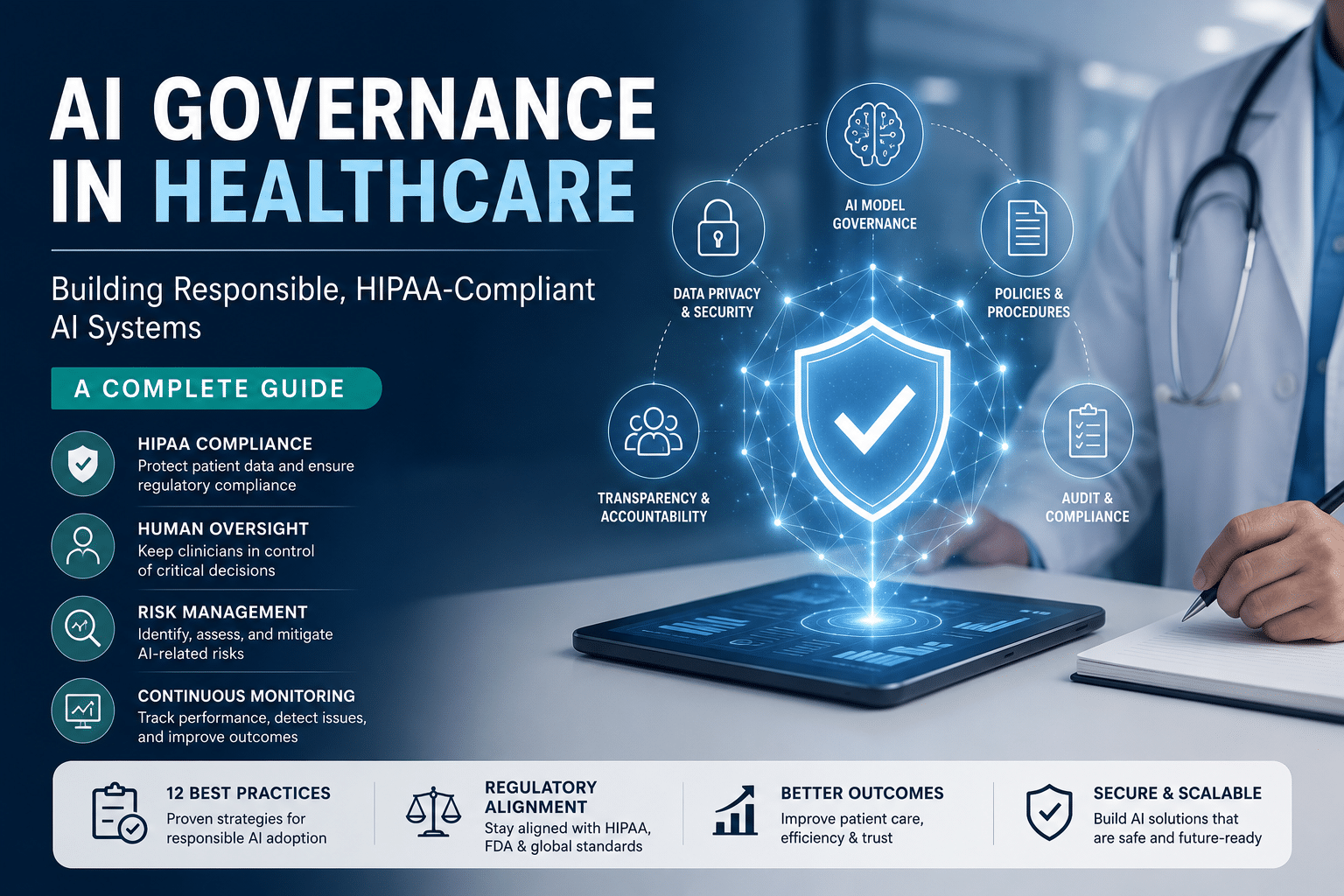
Artificial intelligence is rapidly reshaping healthcare. From automating clinical documentation and medical coding to supporting radiology, pathology, revenue cycle management, and patient engagement, AI has become an essential technology for improving operational efficiency and clinical outcomes. However, successful AI adoption requires more than selecting the right model—it demands a structured governance framework that prioritizes patient safety, regulatory compliance, transparency, and accountability.
Healthcare organizations operate in one of the most regulated industries in the world. Every AI solution that processes Protected Health Information (PHI) or influences clinical decision-making must comply with strict security, privacy, and ethical standards. Without proper governance, organizations expose themselves to security vulnerabilities, compliance violations, inaccurate AI outputs, and a loss of clinician trust.
At Taction Software, we help healthcare providers, digital health companies, payers, and healthcare startups design, develop, and deploy secure AI solutions that align with HIPAA, FDA expectations, and emerging AI governance standards. Through our Healthcare AI Solutions and Healthcare Software Development Company services, we enable organizations to accelerate innovation while maintaining compliance, transparency, and patient safety.
This comprehensive guide explains AI governance in healthcare, why it matters, and how healthcare organizations can establish a practical governance framework for responsible AI adoption.
Why AI Governance Matters in Healthcare
Healthcare AI is fundamentally different from AI used in retail, marketing, or finance. AI systems in healthcare directly affect patient care, clinical decisions, operational workflows, reimbursement, and regulatory compliance. Even minor AI errors can result in delayed diagnoses, incorrect recommendations, privacy violations, or financial penalties.
AI governance establishes clear policies and operational controls that ensure AI systems remain reliable, secure, explainable, and compliant throughout their lifecycle. Rather than limiting innovation, governance creates a structured environment where organizations can confidently scale AI initiatives while minimizing operational and regulatory risks.
Organizations that invest in AI governance experience several long-term benefits, including:
- Improved clinician confidence in AI-assisted workflows
- Stronger HIPAA compliance and data security
- Reduced operational and regulatory risk
- Better audit readiness
- Increased transparency and explainability
- Higher AI adoption across departments
- Consistent monitoring of AI performance
- Better patient outcomes through safer AI implementation
Organizations implementing enterprise AI should combine governance with robust Healthcare AI Guardrails Development and continuous Healthcare AI Observability to ensure AI models remain secure, accurate, and compliant after deployment.
What Is AI Governance?
AI governance is the combination of policies, processes, technologies, and organizational oversight that ensure artificial intelligence systems operate safely, ethically, securely, and in compliance with healthcare regulations.
Rather than focusing only on model accuracy, AI governance addresses the entire AI lifecycle—from planning and data collection to deployment, monitoring, updates, and retirement.
An effective governance program helps organizations answer critical questions such as:
- Is patient data adequately protected?
- Who approves AI-generated recommendations?
- Can AI decisions be explained?
- How are AI models monitored after deployment?
- How frequently are models validated?
- What happens if an AI model begins producing inaccurate results?
- Who is accountable for AI decisions?
- How are security risks identified and mitigated?
Healthcare organizations adopting AI should integrate governance from the beginning of every project rather than treating compliance as a final step. Teams building enterprise-grade AI applications often incorporate governance into their Enterprise AI Development Services strategy to ensure every stage of development follows healthcare best practices.
Core Components of AI Governance
Successful AI governance requires more than written policies. It combines people, technology, documentation, and continuous oversight to ensure AI systems remain trustworthy over time.
The foundation of every healthcare AI governance framework includes:
Human Oversight
Healthcare AI should support clinicians—not replace them. Every AI-assisted recommendation that may influence diagnosis, treatment, or patient care should include appropriate human review before final decisions are made. Human oversight improves patient safety while reducing the risks associated with AI hallucinations and inaccurate predictions.
Privacy and Security
Healthcare AI systems frequently process sensitive patient information. Organizations must implement strong encryption, role-based access controls, audit logging, secure authentication, and continuous monitoring to protect PHI. Deploying AI using HIPAA Compliant AI Hosting further strengthens security while helping organizations meet regulatory requirements.
Transparency
Healthcare professionals should understand when AI has been used, how recommendations are generated, and what limitations exist. Transparent AI systems improve clinician confidence while supporting regulatory audits and compliance reviews.
Risk Management
Before deploying AI into production, healthcare organizations should conduct a formal risk analysis. The U.S. Department of Health and Human Services explains this process in its Guidance on Risk Analysis, which recommends identifying vulnerabilities, evaluating potential threats, and implementing appropriate safeguards before handling electronic protected health information.
Continuous Monitoring
AI governance does not end after deployment. Models should be continuously monitored for accuracy, bias, drift, security vulnerabilities, and regulatory compliance. Combining governance with Healthcare AI Managed Services enables organizations to proactively maintain AI performance while reducing operational risks.
Download the AI Governance Guide
Building trustworthy AI begins with a well-defined governance strategy. Whether you’re implementing clinical decision support, medical imaging AI, AI agents, or revenue cycle automation, governance ensures your AI solutions remain secure, compliant, and reliable.
Download our free AI Governance Guide to access practical checklists, implementation frameworks, and healthcare-specific best practices for responsible AI adoption.
HIPAA Compliance and AI Governance
Protecting patient information is one of the primary responsibilities of every healthcare organization implementing artificial intelligence. While AI can improve efficiency and clinical outcomes, it also introduces new privacy and security challenges. Every AI application that accesses, processes, stores, or transmits Protected Health Information (PHI) must comply with HIPAA regulations and follow industry best practices for cybersecurity.
Healthcare organizations should treat AI governance as an extension of their existing HIPAA compliance program rather than as a separate initiative. This means every AI model, workflow, and integration should undergo security reviews before deployment. The U.S. Department of Health and Human Services (HHS) also provides detailed HIPAA Security Rule Guidance that outlines the administrative, physical, and technical safeguards required to protect electronic protected health information (ePHI).
An effective AI governance framework should include:
- HIPAA risk assessments before implementation
- Business Associate Agreements (BAAs) with AI vendors
- Encryption for data at rest and in transit
- Role-based access controls
- Multi-factor authentication
- Comprehensive audit logging
- Secure API integrations
- Regular penetration testing
- Continuous compliance monitoring
Organizations planning enterprise AI deployments should build these controls into their infrastructure from the beginning by using HIPAA Compliant AI Hosting and secure Healthcare API Security Services.
AI Lifecycle Governance
AI governance should cover every stage of an AI system’s lifecycle—not just production deployment.
A structured governance lifecycle helps organizations maintain consistency, security, and accountability throughout the project.
1. Planning and Business Objectives
Every AI initiative should begin by identifying a clear business problem. Organizations should define measurable objectives, expected outcomes, compliance requirements, stakeholders, and success metrics before development begins.
Many organizations validate project feasibility through a Healthcare AI Proof of Concept before investing in full-scale implementation.
2. Data Collection and Preparation
High-quality AI depends on high-quality healthcare data.
Organizations should establish governance policies covering:
- Data ownership
- Data quality standards
- Patient consent
- PHI protection
- Data retention
- Secure storage
- Data lineage
- Data validation
Healthcare organizations integrating multiple systems should ensure governance extends across EHRs, imaging systems, laboratory platforms, and third-party healthcare applications.
3. Model Development
Governance during model development includes documenting:
- Training datasets
- Feature engineering
- Model architecture
- Performance metrics
- Clinical validation
- Security testing
- Bias testing
- Explainability methods
Organizations building enterprise-grade AI often work with experienced teams providing Enterprise AI Development Services to establish governance throughout model development.
4. Validation Before Production
No healthcare AI system should enter production without comprehensive validation.
Validation should include:
- Clinical accuracy testing
- False positive analysis
- False negative analysis
- Performance benchmarking
- Security assessment
- Penetration testing
- Compliance review
- Human review workflows
Clinical subject matter experts should participate in validation before deployment.
5. Deployment Governance
Deployment introduces new operational risks.
Healthcare organizations should establish deployment policies covering:
- Version control
- Change management
- Rollback procedures
- Monitoring dashboards
- User permissions
- Production approvals
- Security reviews
Organizations implementing Generative AI should also establish centralized prompt governance using a Healthcare Prompt Management Platform to control prompts, permissions, and model behavior.
6. Continuous Monitoring
AI governance continues long after deployment.
Continuous monitoring should evaluate:
- Model drift
- Accuracy degradation
- User feedback
- Security events
- Compliance violations
- Infrastructure performance
- API failures
- Data quality
Organizations using Healthcare AI Observability gain real-time visibility into AI performance while identifying issues before they affect patient care.
Human Oversight Remains Essential
Artificial intelligence should augment clinical expertise—not replace it.
Healthcare organizations should establish governance policies defining when human review is mandatory.
Examples include:
- Diagnostic recommendations
- Medication suggestions
- Clinical documentation approval
- Treatment planning
- Patient risk scoring
- Revenue cycle decisions
- Prior authorization recommendations
Clinicians should always retain final decision-making authority for patient care.
Human oversight also improves clinician trust by ensuring AI remains a decision-support tool rather than an autonomous decision-maker.
AI Guardrails for Safe Healthcare AI
AI guardrails are technical and operational controls that prevent AI systems from producing unsafe, biased, or non-compliant outputs.
Effective guardrails help organizations reduce hallucinations, prevent prompt injection attacks, protect sensitive patient information, and maintain compliance.
Healthcare AI guardrails typically include:
Prompt Filtering
Prevent unsafe or unauthorized prompts before they reach AI models.
Output Validation
Review AI-generated responses for completeness, accuracy, and policy compliance.
PHI Detection
Automatically identify and protect Protected Health Information during AI interactions.
Role-Based Permissions
Restrict AI capabilities based on user roles and responsibilities.
Policy Enforcement
Ensure AI responses comply with organizational policies and healthcare regulations.
Organizations implementing enterprise AI should combine governance with Healthcare AI Guardrails Development to strengthen security while improving AI reliability.
Preparing for FDA and Emerging AI Regulations
Although regulatory requirements continue to evolve, healthcare organizations should prepare for increased oversight of AI systems.
Organizations should maintain documentation covering:
- Intended use
- Clinical validation
- Risk assessments
- Version history
- Human oversight policies
- Bias mitigation strategies
- Security controls
- Performance monitoring
Aligning governance with internationally recognized frameworks such as the NIST AI Risk Management Framework (AI RMF 1.0) helps healthcare organizations establish trustworthy AI practices, improve transparency, strengthen risk management, and remain adaptable as regulations continue to evolve. Organizations can further support responsible AI adoption through our NIST AI RMF for Healthcare and WHO AI Health Ethics Compliance resources.
Governance Committees and Organizational Accountability
Technology alone cannot govern AI.
Healthcare organizations should establish multidisciplinary AI governance committees responsible for reviewing AI initiatives throughout their lifecycle.
These committees often include:
- Clinical leadership
- Compliance officers
- Privacy officers
- Security teams
- Legal advisors
- Data scientists
- Healthcare IT leaders
- Executive sponsors
The committee should define governance policies, approve high-risk AI implementations, monitor compliance, and review AI performance on an ongoing basis.
Organizations seeking long-term AI success often supplement internal governance with Healthcare AI Managed Services to provide continuous monitoring, optimization, and expert guidance.
AI Governance Implementation Roadmap
Establishing AI governance is not a one-time compliance exercise—it is an ongoing process that evolves as your AI capabilities grow. Organizations that implement governance early are better positioned to scale AI initiatives securely while maintaining regulatory compliance and clinician confidence.
The following roadmap can help healthcare organizations establish a practical AI governance framework.
Step 1: Assess Organizational Readiness
Before implementing AI, evaluate your organization’s current capabilities, infrastructure, security controls, and compliance maturity.
This assessment should identify:
- Existing AI initiatives
- Available healthcare data
- Security gaps
- HIPAA compliance status
- Infrastructure readiness
- Clinical stakeholder involvement
- Governance ownership
Organizations beginning their AI journey often start with a Healthcare AI Proof of Concept to validate feasibility before enterprise-wide implementation.
Step 2: Define Governance Policies
Create documented governance policies covering:
- AI approval processes
- Data governance
- Security standards
- Human oversight
- Vendor management
- Model validation
- Documentation requirements
- Incident response
- AI monitoring
Governance documentation should be reviewed regularly as regulations and organizational requirements evolve.
Step 3: Build Secure Infrastructure
AI governance cannot succeed without secure infrastructure.
Healthcare organizations should implement:
- Secure cloud environments
- Encryption
- Identity and access management
- API security
- Audit logging
- Disaster recovery
- Continuous backups
- Threat monitoring
Organizations processing PHI should combine governance with HIPAA Compliant AI Hosting and Healthcare Identity and Access Management to strengthen security across AI environments.
Step 4: Deploy AI Responsibly
Production deployment should follow structured approval workflows.
Before deployment, organizations should verify:
- Clinical validation completed
- Security testing passed
- Compliance approved
- Human oversight configured
- Monitoring dashboards active
- Audit logging enabled
- Rollback plans documented
Using Healthcare AI Guardrails Development alongside production deployment reduces operational risk while improving AI reliability.
Step 5: Continuously Improve
Governance should be reviewed continuously.
Healthcare organizations should regularly evaluate:
- Model performance
- User adoption
- Security incidents
- Regulatory updates
- Bias monitoring
- Clinical outcomes
- Compliance audits
Organizations using Healthcare AI Observability can proactively identify performance degradation before it affects patient care.
AI Governance Checklist
Before deploying any healthcare AI application, verify that your organization has completed the following:
✔ AI governance committee established
✔ HIPAA risk assessment completed
✔ Business Associate Agreements signed where required
✔ Clinical validation performed
✔ Human oversight implemented
✔ Security assessment completed
✔ PHI protection controls enabled
✔ Audit logging configured
✔ AI guardrails implemented
✔ Prompt management policies documented
✔ Continuous monitoring enabled
✔ Incident response procedures defined
✔ Model retraining process documented
✔ Compliance reviews scheduled
✔ Governance documentation maintained
Completing this checklist significantly reduces implementation risk while improving long-term AI success.
Common AI Governance Mistakes
Many healthcare organizations focus heavily on AI development but underestimate governance requirements. Avoiding these common mistakes can save significant time, cost, and compliance effort.
Treating Governance as an Afterthought
Governance should begin before the first AI model is trained—not after deployment.
Ignoring Human Oversight
AI should assist clinicians, not replace their judgment.
Poor Documentation
Lack of documentation makes audits, troubleshooting, and regulatory reviews significantly more difficult.
Inadequate Monitoring
Even highly accurate models can drift over time. Continuous monitoring is essential.
Weak Security Controls
AI systems handling PHI require the same level of protection as every other healthcare application.
Choosing Technology Before Strategy
Organizations should define governance, business objectives, and compliance requirements before selecting AI technologies.
Working with experienced partners providing Enterprise AI Development Services helps organizations avoid these common implementation challenges.
Why Choose Taction Software for Healthcare AI Governance
Healthcare AI requires more than technical expertise—it requires deep knowledge of healthcare regulations, interoperability standards, cybersecurity, and clinical workflows.
Taction Software helps healthcare organizations build AI solutions that are secure, scalable, and compliant from day one.
Our expertise includes:
- Healthcare AI Solutions
- HIPAA-compliant AI development
- AI governance consulting
- Clinical AI applications
- AI guardrails implementation
- Healthcare AI observability
- Healthcare prompt management
- Healthcare software development
- AI security architecture
- AI integration with EHRs and healthcare systems
Whether you’re developing an AI medical scribe, clinical decision support system, healthcare chatbot, revenue cycle automation platform, or diagnostic AI application, our team helps you implement governance throughout the entire AI lifecycle.
Build Responsible Healthcare AI with Confidence
Artificial intelligence is transforming healthcare, but long-term success depends on responsible governance. Organizations that prioritize transparency, security, compliance, and human oversight can adopt AI with greater confidence while reducing operational and regulatory risks.
Whether you’re building your first AI-powered healthcare application or scaling enterprise AI across multiple departments, governance should be embedded into every stage of the AI lifecycle.
At Taction Software, we combine healthcare domain expertise with modern AI engineering to help organizations deploy secure, compliant, and scalable AI solutions. Explore our Healthcare AI Solutions to see how we help healthcare providers, payers, and digital health companies accelerate innovation without compromising compliance or patient trust.
Ready to Start Your Healthcare AI Journey?
Download our AI Governance Guide for Healthcare or contact our team to discuss your AI strategy, governance framework, and implementation roadmap. Together, we can help you build AI solutions that are not only intelligent—but also trustworthy, compliant, and built for the future of healthcare.
Frequently Asked Questions
AI governance is the framework of policies, processes, security controls, and oversight that ensures healthcare AI systems remain safe, compliant, transparent, and accountable throughout their lifecycle.
AI governance protects patient privacy, improves clinician trust, reduces regulatory risk, and ensures AI systems continue operating safely after deployment.
Yes. Any AI application that creates, receives, stores, or processes Protected Health Information (PHI) must comply with applicable HIPAA Privacy and Security Rule requirements.
Healthcare organizations should continuously monitor AI performance and perform periodic validation whenever models are updated, retrained, or integrated into new workflows.
AI security protects AI systems from cyber threats, while AI governance provides the broader framework covering compliance, ethics, transparency, risk management, human oversight, documentation, and ongoing monitoring.
Taction Software helps healthcare organizations design, develop, deploy, and manage secure AI solutions through our Healthcare AI Solutions , Healthcare Software Development Company , and AI governance consulting services.