Introduction to Electric Vehicle Software Development
Modern enterprises across automotive, healthcare, logistics, finance, and manufacturing are accelerating their digital transformation journeys. Software now drives product innovation, operational efficiency, regulatory compliance, customer engagement, and competitive differentiation.
This guide provides a comprehensive, cross-industry perspective on how organizations can architect and deploy scalable, secure, and future-ready software systems. While we highlight Electric Vehicle (EV) Software Development, the principles and strategies covered extend to all mission-critical enterprise applications—mobile, cloud, AI, healthcare, and more.
1. DIGITAL TRANSFORMATION: THE FOUNDATION OF MODERN ENTERPRISES
Organizations are moving rapidly toward:
Data-driven decision-making
Real-time connectivity (IoT, telematics, cloud)
Automation and AI integration
Compliance-focused digital ecosystems
Seamless customer experiences
Cloud-native system modernization
This shift has created demand for robust, scalable, and industry-specific software solutions that can handle complex workflows, interoperability, security, and compliance requirements.
This guide explores how enterprises can navigate this transformation effectively.
2. OVERVIEW OF ENTERPRISE SOFTWARE DEVELOPMENT
A modern enterprise software ecosystem requires:
2.1 Scalable Architecture
Microservices, containerization, and cloud infrastructure allow businesses to grow and adapt.
2.2 Secure Development
SOC 2, HIPAA, CPRA, GDPR, NIST, automotive cybersecurity, data encryption, and zero-trust architecture.
2.3 Interoperability & Integrations
APIs, middleware, EHR/EMR links, telematics devices, sensors, CRM/ERP systems, billing engines, etc.
2.4 User-Centered Design
High adoption relies on intuitive interfaces and frictionless workflows.
2.5 AI & Automation
Predictive insights, automated tasks, and intelligent workflows enhance scalability and efficiency.
Drive innovation with tailored EV solutions. Get started with Taction Software now!
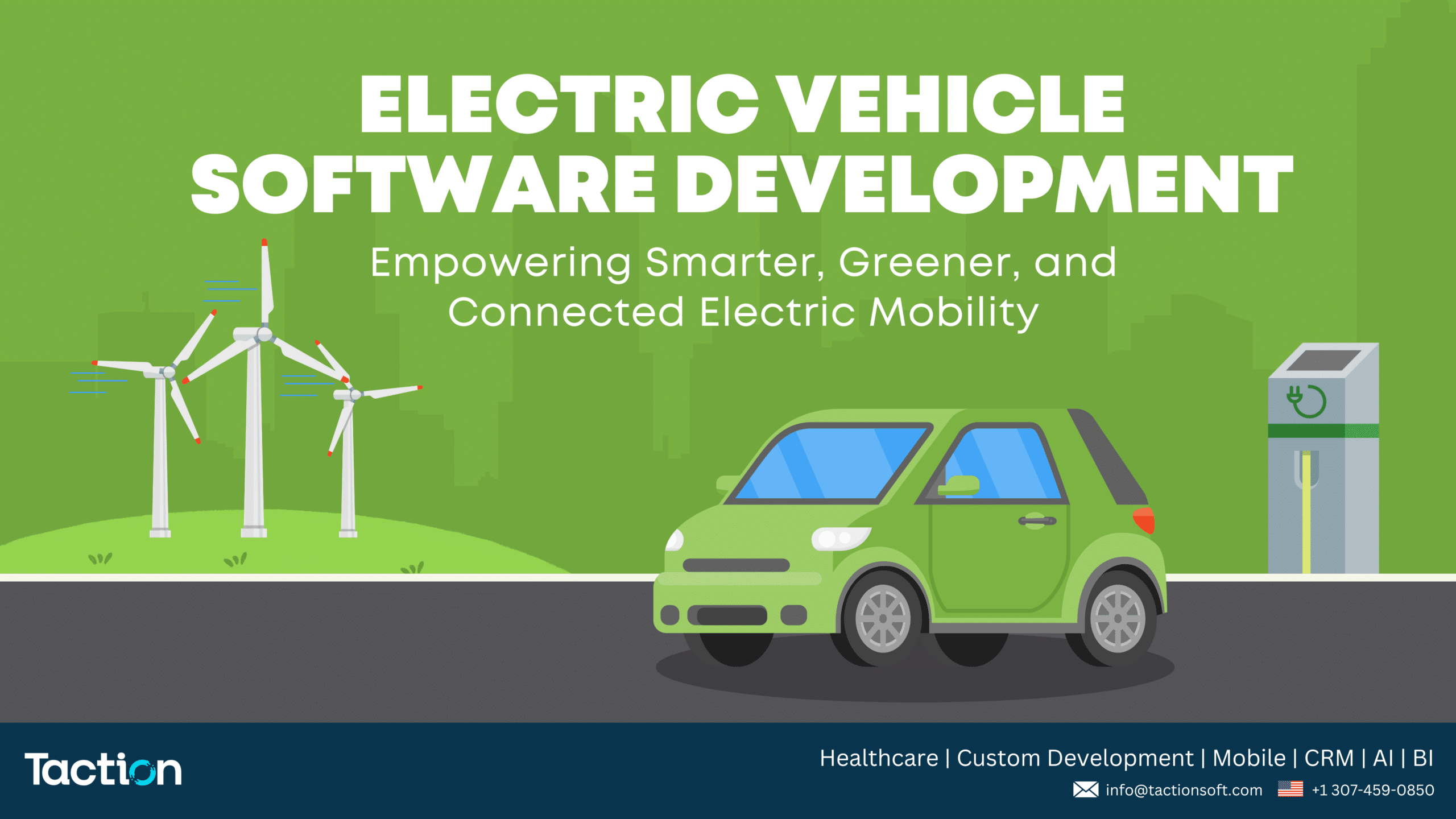
3. ELECTRIC VEHICLE SOFTWARE DEVELOPMENT
While this guide covers multi-domain software, EV software remains a core section for SEO & ad relevance.
3.1 EV Charging Management Systems
A complete charging ecosystem includes:
Charging station control software
OCPP 1.6 / 2.0.1 protocol implementation
Energy optimization algorithms
Mobile charging apps
Billing, payments & user authentication
Charger network monitoring dashboards
3.2 Battery Management & Analytics
EV battery performance depends on:
Real-time health monitoring
AI-driven predictive maintenance
Thermal optimization
Charge/discharge pattern analysis
3.3 Telematics & Connected Vehicle Apps
EV telematics systems enable:
GPS tracking
Vehicle diagnostics
OTA updates
Driver behavior analytics
IoT sensor data collection
3.4 Fleet & Mobility Solutions
Digitizing fleet operations using:
Route optimization algorithms
Vehicle utilization analytics
Maintenance scheduling
Energy efficiency dashboards
3.5 Automotive Cybersecurity
Essential for all EV systems:
Secure OTA updates
Data encryption
Vulnerability scanning
Hardware–software security alignment
4. HEALTHCARE SOFTWARE DEVELOPMENT
Taction Software is known for deep healthcare expertise. This guide expands beyond EV to highlight:
4.1 HIPAA-Compliant Application Development
Applications must meet HIPAA, HITECH, SOC-2, CPRA.
4.2 FHIR, HL7 & Mirth Connect Integrations
Robust interoperability ensures:
Patient data exchange
EHR/EMR integration
Clinical workflow automation
4.3 Telehealth & Remote Patient Monitoring
Virtual care solutions include:
Video consultations
IoT medical devices
Vitals streaming
Patient engagement modules
4.4 AI in Healthcare
AI enables:
Diagnostic imaging
Risk prediction
Care coordination automation
Medical chatbots
5. AI, DATA, & MACHINE LEARNING ECOSYSTEM
5.1 Predictive Analytics
Used across healthcare, EV, logistics, fintech for forecasting and risk scoring.
5.2 Intelligent Automation
AI copilots, RPA bots, NLP workflows, and ML-based automation.
5.3 Data Engineering
Data lakes, ETL pipelines, data warehouses, and real-time analytics.
5.4 Computer Vision
Image processing for healthcare diagnostics, EV sensor analytics, manufacturing quality control.
6. MOBILE APPLICATION DEVELOPMENT
Mobile remains a dominant channel for EV drivers, patients, field operators, and customers.
6.1 Native (iOS & Android)
High-performance apps with secure frameworks.
6.2 Cross-Platform (Flutter, React Native)
Efficient multi-device development.
6.3 Enterprise Mobility Apps
Field workforce, tracking, asset management.
6.4 Device Connectivity & IoT Apps
BLE, NFC, GPS, smart chargers, sensors, wearables.
Transform your EV business with cutting-edge software. Reach out to Taction today!
7. CLOUD ENGINEERING & DEVOPS
Modern software relies on cloud-native infrastructure:
7.1 Cloud Migration & Modernization
Re-platforming legacy systems to AWS, Azure, GCP.
7.2 CI/CD Automation
Fast, reliable releases with automated pipelines.
7.3 Containerization & Kubernetes
Scalable deployment environments.
7.4 Observability & Monitoring
Infrastructure analytics, telemetry, logging.
Start Your Digital Transformation Journey With Taction Software
8. CRM, ERP & ENTERPRISE INTEGRATIONS
8.1 CRM Customization (SuiteCRM Expertise)
Workflows, modules, automation, and custom interfaces.
8.2 ERP Implementation
Inventory, billing, HR, finance, supply chain.
8.3 API Development & Middleware Integration
Including FHIR, HL7, telematics, IoT, payment gateways.
9. INDUSTRY USE CASES
Healthcare & Life Sciences
Interoperability, telehealth, AI imaging, CRM, RCM.
Automotive & EV
Charging infra, telematics, OTA updates, fleet systems.
Manufacturing
IoT dashboards, digital twins, automation.
Logistics & Supply Chain
Tracking, fleet management, predictive delays.
FinTech
Digital wallets, fraud engines, loan platforms.
Retail & eCommerce
POS, personalization engines, inventory apps.
10. THE SOFTWARE DEVELOPMENT LIFECYCLE
10.1 Discovery & Architecture Blueprint
Understanding workflows, compliance, security, and integration needs.
10.2 UI/UX Design
User-centered design for optimal usability.
10.3 Agile Development
Incremental delivery with bi-weekly sprints.
10.4 Testing & Quality Assurance
Functional, performance, security, automation testing.
10.5 Compliance Assurance
HIPAA, HITECH, CPRA, SOC2, GDPR, automotive cybersecurity.
10.6 Deployment & Cloud Operations
Monitoring, analytics, scaling, continuous delivery.
10.7 Post-Launch Support & Enhancements
Feature updates, optimization, and long-term maintenance.
11. WHY ENTERPRISES CHOOSE TACTION SOFTWARE
20+ years enterprise & healthcare IT experience
EV & automotive-grade software engineering
HIPAA, SOC-2, CPRA, cybersecurity expertise
AI, IoT, data engineering specialization
Global delivery with U.S. leadership
400+ engineers and technical experts
Proven track record in regulated industries
Strong integration capabilities (FHIR, HL7, IoT, CRM, ERP)
12. CONCLUSION
Software has become the defining competitive advantage across industries. Whether you are building next-generation EV platforms, healthcare applications, AI systems, enterprise mobility apps, or cloud-native digital solutions, success depends on partnering with a team that understands compliance, scalability, security, and user experience.
Taction Software empowers enterprises to innovate faster, operate smarter, and scale confidently.
Does this guide still focus on EV software development?
Yes. EV remains the core theme to match the existing URL and maintain SEO integrity.
Why does the guide discuss healthcare and enterprise software?
Because the same technologies used in EV development—AI, IoT, cloud, interoperability—power enterprise software across industries.
Do you build HIPAA-compliant applications?
Yes. We specialize in compliant healthcare systems with FHIR/HL7/Mirth Connect integrations.
Can you integrate hardware, telematics devices, or IoT sensors?
Absolutely. EV systems depend on IoT connectivity, which we apply across multiple industries.
Do you offer mobile app development?
Yes—Flutter, React Native, iOS, Android.