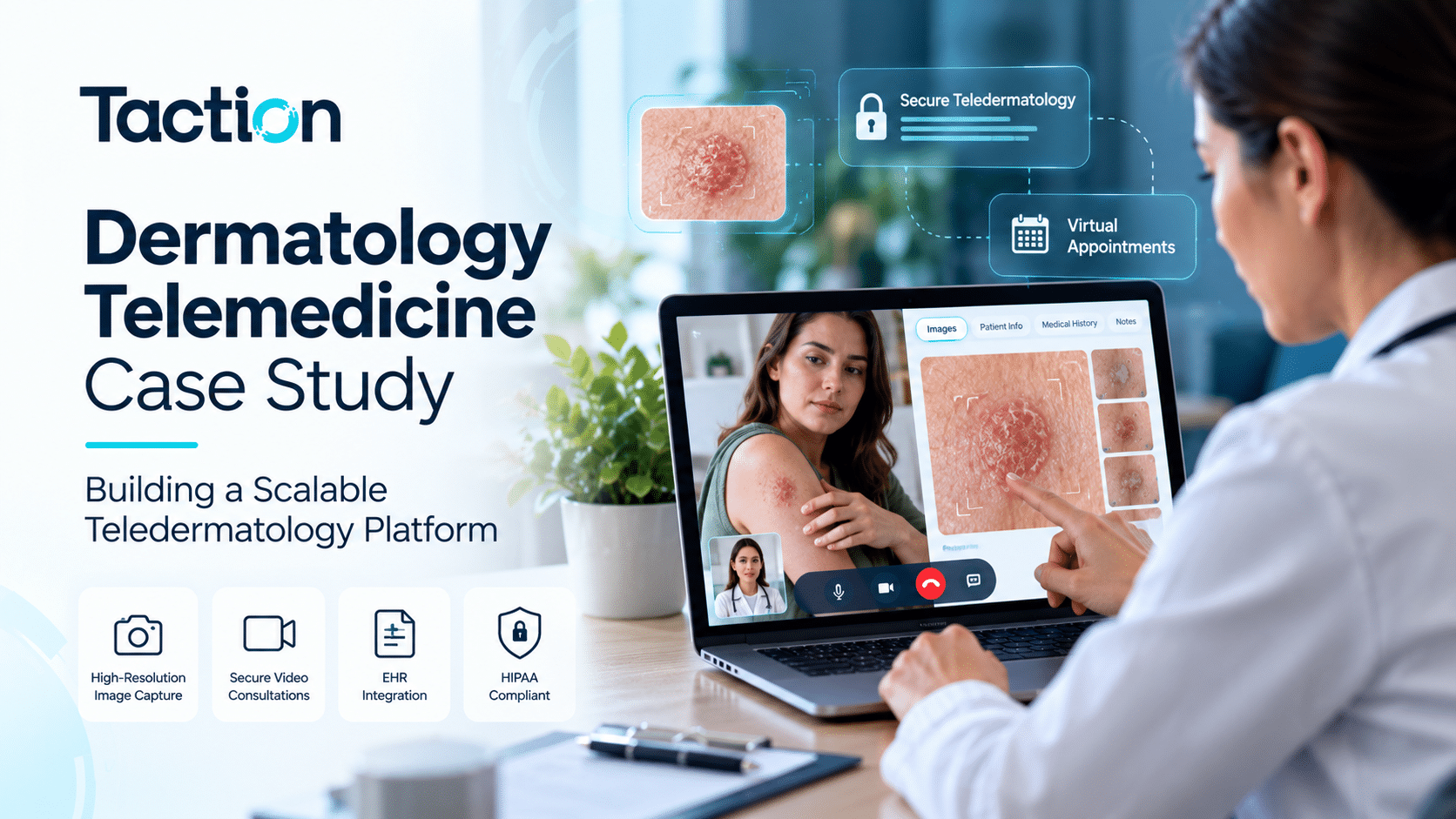
Dermatology Telemedicine Case Study: Building a Scalable Teledermatology Platform
What Is a Teledermatology Platform? A teledermatology platform enables dermatologists to assess and manage appropriate skin conditions remotely using live video or asynchronous image review while s...
Frequently Asked Questions About Teledermatology Platforms
What Is a Teledermatology Platform?
A teledermatology platform enables dermatologists to assess and manage appropriate skin conditions remotely using live video or asynchronous image review while supporting patient intake, documentation, secure communication and clinical follow-up.
What Is Store-and-Forward Teledermatology?
Store-and-forward teledermatology allows a patient or referring clinician to securely submit skin images and clinical information. A dermatologist reviews the case asynchronously rather than requiring both parties to attend a scheduled live consultation simultaneously.
Can Teledermatology Integrate With Epic?
Yes. Taction’s published multi-specialty implementation integrated its telemedicine platform with Epic using Open Epic FHIR APIs, HL7v2 and Mirth Connect, including access to clinical information and documentation write-back.
Is Teledermatology HIPAA Compliant?
A teledermatology platform can be designed to support HIPAA requirements through appropriate encryption, authentication, access controls, audit logging, secure infrastructure and BAAs with applicable vendors handling PHI.
Can Teledermatology Replace In-Person Dermatology?
Not completely. Virtual dermatology is appropriate for many consultations, follow-ups and triage scenarios, while some conditions still require physical examination, dermoscopy, biopsy, procedures or other forms of direct clinical evaluation.
Can Taction Build a Custom Teledermatology Platform?
Yes. Taction develops custom teledermatology platforms incorporating store-and-forward image review, video consultations, clinical documentation, patient and provider applications, EHR integration, imaging workflows, scheduling and healthcare security.
Building Dermatology-Specific Clinical Workflows
Teledermatology requires workflows designed around the visual nature of dermatologic care.
Taction’s teledermatology platform development model supports asynchronous image review and live consultations while connecting patient information, clinical documentation and follow-up decisions.
Structured Patient Intake
Structured intake captures symptoms, lesion history, duration, previous treatment and other relevant information before specialist review. Providing this context alongside images helps dermatologists evaluate cases more efficiently than receiving unstructured photographs alone.
High-Resolution Image Review
Secure imaging workflows allow dermatologists to review submitted photographs and, where supported, dermoscopic images. Maintaining useful image quality is particularly important because image detail can directly affect whether a case is suitable for remote assessment.
Dermatology Case Triage
Cases can be organized according to clinical urgency and appropriate specialty pathways. This helps virtual dermatology function as a triage mechanism while ensuring patients requiring direct examination can be routed toward appropriate in-person follow-up.
Structured Clinical Documentation
Clinical findings, diagnoses and treatment plans can be captured through structured documentation rather than isolated telemedicine notes. Integration allows virtual-care information to remain part of the patient’s broader longitudinal healthcare record.
Follow-Up Care
Virtual follow-ups can reduce unnecessary travel for patients whose progress can be assessed remotely. Dermatologists can review treatment response, discuss symptoms and determine whether continued virtual management or an in-person appointment is appropriate.
Epic EHR Integration and Dermatology Data Exchange
One of the health system’s non-negotiable requirements was EHR integration.
Providers did not want to document care twice or constantly switch between the virtual-care platform and Epic. Taction therefore incorporated Epic integration directly into the architecture.
Patient Information Inside the Workflow
Providers could access relevant patient information, including demographics, problem lists, medications, allergies and recent results, from the telemedicine interface rather than repeatedly moving between separate applications during virtual appointments.
Epic FHIR Integration
Open Epic FHIR APIs supported structured healthcare data exchange between Epic and the telemedicine environment, allowing virtual-care workflows to remain connected with the health system’s primary clinical record.
HL7v2 Through Mirth Connect
Mirth Connect and HL7v2 interfaces complemented FHIR-based integration for workflows requiring established healthcare messaging patterns, providing an interoperability layer between the virtual-care environment and existing health system infrastructure.
Clinical Documentation Write-Back
Visit documentation could be written back to the Epic encounter using FHIR DocumentReference resources, helping prevent virtual visits from becoming isolated records requiring clinicians to manually reproduce documentation in the EHR.
Integrated Scheduling
Virtual and in-person appointment slots were incorporated into the scheduling workflow, helping providers manage both types of encounters without maintaining separate calendars for conventional and telemedicine appointments.
Organizations facing similar interoperability requirements can explore Taction’s telemedicine app development capabilities covering EHR integration, clinical documentation, virtual visits, scheduling, billing and patient engagement.
HIPAA and Security for Teledermatology
Teledermatology introduces sensitive information beyond conventional patient records because clinical photographs themselves can constitute protected health information.
Security therefore needed to extend across video, images, messages, clinical records and integrations.
Encrypted Video Communication
The platform used SRTP and DTLS protection for video transmission, helping secure real-time consultations between patients and providers while allowing WebRTC to support adaptive communication across different connection conditions.
Encrypted Healthcare Data
Stored healthcare information was protected using AES-256 encryption. Encryption controls were part of a broader security model covering application infrastructure, data transmission, authentication and access to sensitive healthcare information.
Multi-Factor Authentication
MFA was implemented for platform users as part of the authentication architecture, adding protection beyond passwords for accounts capable of accessing clinical information, virtual-care functionality and other sensitive system resources.
Comprehensive Audit Logging
Audit logging captured important system activity so access and actions involving healthcare information could be monitored and investigated. Auditability was treated as an operational security requirement rather than simply an application feature.
Business Associate Agreements
Taction’s published implementation included BAAs with infrastructure and service providers handling relevant healthcare information, including AWS, Twilio, Surescripts and Stripe, supporting the broader HIPAA compliance architecture.
What This Dermatology Telemedicine Case Study Demonstrates
Teledermatology is most effective when technology is designed around dermatology itself rather than adding a dermatologist to a generic video-call platform.
Several lessons from the implementation are particularly relevant to healthcare organizations planning virtual dermatology services.
Video Alone Is Not Teledermatology
Dermatology depends heavily on visual clinical information. Successful platforms therefore need workflows for high-quality image capture, structured history, asynchronous review and documentation alongside live video consultations.
Store-and-Forward Can Expand Access
Not every case requires a scheduled video appointment. Asynchronous workflows allow appropriate images and clinical information to reach dermatologists for review, improving specialist capacity and potentially shortening time to assessment.
EHR Integration Drives Clinical Adoption
Providers are less likely to adopt virtual care when it creates duplicate documentation. Connecting teledermatology with existing EHR workflows helps make remote consultations part of routine clinical care rather than another administrative system.
Know When Virtual Care Is Not Enough
A teledermatology platform should help clinicians determine when an in-person examination, biopsy, procedure or further diagnostic evaluation is necessary rather than attempting to force every dermatology encounter into a virtual workflow.
Build Specialty Workflows on Shared Infrastructure
Health systems can use common infrastructure for identity, security, interoperability, scheduling and communication while building dermatology-specific workflows on top, reducing duplication without sacrificing specialty requirements.
Why Taction Software for Teledermatology Development?
Teledermatology sits at the intersection of virtual care, medical imaging, clinical workflow, interoperability and healthcare security.
Taction combines these capabilities within one healthcare-focused engineering practice.
Teledermatology Expertise
Our teledermatology platform development services cover store-and-forward workflows, live consultations, high-resolution imaging, dermoscopy support, referral workflows and structured clinical documentation.
Telemedicine Engineering
Taction’s telemedicine app development experience covers secure video, virtual waiting rooms, scheduling, clinical documentation, e-prescribing, billing and multi-specialty virtual-care environments.
Healthcare Interoperability
Our teams work with FHIR, HL7 and Mirth Connect to connect virtual-care applications with EHR and healthcare infrastructure, helping providers access and document information without creating disconnected clinical records.
Patient-Focused Healthcare Software
Taction also develops patient software for scheduling, secure communication, patient portals and telemedicine access, allowing virtual-care experiences to extend beyond the provider-facing clinical platform.
The Challenge: Expanding Dermatology Access Through Virtual Care
Dermatology presented a different virtual-care challenge from general telemedicine. Skin conditions are highly visual, so clinicians needed more than standard video conferencing. The workflow had to support images, clinical context, documentation and appropriate escalation to in-person care.
Limited Access to Dermatologists
Specialist availability can create long waits, particularly outside major healthcare centers. Virtual dermatology offered the health system a way to extend specialist access without requiring every patient to travel for an initial assessment or routine follow-up.
Visual Information Was Critical
Dermatologists rely heavily on visual evidence. A conventional telemedicine application designed primarily around video conversations would not adequately address dermatology workflows requiring high-quality images, lesion history and structured clinical information.
Existing Clinical Workflows Could Not Be Duplicated
Providers were resistant to documenting patient encounters in separate systems. The telemedicine environment therefore needed to connect with Epic so clinicians could access relevant information without creating a second disconnected documentation workflow.
Virtual and In-Person Care Needed to Work Together
Not every dermatology condition is suitable for remote diagnosis. The platform therefore needed to support virtual assessment while preserving a clear pathway for patients requiring physical examination, procedures, biopsy or additional testing.
Patient Experience Had to Remain Simple
Patients needed straightforward ways to schedule consultations, provide clinical information and participate remotely. Adding complex technical requirements for photographs, appointments or communication could reduce adoption and undermine the accessibility benefits of teledermatology.
Taction approached these challenges as specialty-care workflow problems rather than simply adding dermatology to a generic video application.
The Solution: A Telemedicine Platform Adapted for Dermatology
The health system’s platform was built as a multi-specialty virtual-care environment rather than separate applications for every department.
This provided shared infrastructure for security, scheduling, video, EHR integration and billing while allowing specialty-specific workflows to be incorporated where required.
Live Dermatology Consultations
WebRTC-based HD video allowed patients and providers to meet remotely, with adaptive bitrate support for varying network conditions. Video consultations were particularly useful for follow-ups and cases requiring real-time discussion between patient and dermatologist.
Store-and-Forward Workflows
Teledermatology can use asynchronous workflows where patients or referring clinicians submit images and clinical history for later specialist review, allowing dermatologists to evaluate appropriate cases without requiring every patient and clinician to be available simultaneously.
Dermatology Image Capture
High-resolution image workflows support remote dermatology by giving clinicians visual information required for assessment. Taction’s teledermatology architecture includes secure image capture, upload, compression, storage and quality checks before cases reach dermatologists.
Virtual Waiting Room
Patients attending live appointments could enter a virtual waiting room before their consultation. Providers received a patient queue and daily schedule, helping virtual dermatology visits fit more naturally into existing clinical operations.
Secure Patient Communication
Secure in-visit messaging enabled providers and patients to exchange relevant information, documents and links during consultations while keeping communication inside the healthcare platform instead of relying on unapproved consumer communication channels.
Multi-Participant Consultations
The platform supported sessions involving patients, providers and additional participants such as family members or interpreters, an important capability when patients required assistance understanding treatment plans or communicating effectively during remote consultations.
Technology Architecture Behind the Platform
The platform had to support multiple specialties, hundreds of providers and growing virtual-visit volumes without sacrificing performance.
Taction selected a technology stack capable of supporting real-time communication, clinical interoperability and scalable patient-facing applications.
React and React Native
React powered the provider web experience while React Native supported patient applications on iOS and Android. This allowed interfaces to be optimized separately around desktop clinical workflows and mobile patient experiences.
Node.js Backend
Node.js provided backend application services connecting scheduling, virtual visits, patient workflows, clinical functionality and external integrations while supporting the real-time requirements associated with a large telemedicine environment.
PostgreSQL and Redis
PostgreSQL provided structured data storage while Redis supported real-time session management. WebSocket connections enabled live waiting-room status and in-visit messaging without relying on repeated manual page refreshes.
WebRTC Video
WebRTC supported HD virtual consultations with adaptive bitrate streaming and audio fallback for lower-bandwidth connections. Screen sharing also enabled clinicians to review relevant results and information with patients during appointments.
Mirth Connect, FHIR and HL7
Mirth Connect, FHIR R4 and HL7v2 formed the interoperability foundation connecting telemedicine workflows with Epic and other health system components rather than allowing virtual-care information to remain in an isolated database.
AWS Cloud Infrastructure
AWS provided the cloud infrastructure supporting the platform, with HIPAA BAA coverage incorporated into the broader compliance strategy. The architecture was designed to support increasing utilization as virtual-care adoption expanded.
Published technology stack: WebRTC | React | React Native | Node.js | PostgreSQL | Redis | Mirth Connect | FHIR R4 | HL7v2 | Surescripts | AWS | Stripe | Twilio.
Build a Teledermatology Platform Around Real Clinical Workflows
A successful dermatology telemedicine platform requires more than secure video.
Image quality, specialist triage, store-and-forward review, patient intake, clinical documentation, EHR interoperability, security and in-person escalation all need to work as parts of the same clinical workflow.
Taction Software builds custom teledermatology and virtual-care platforms for health systems, dermatology practices, digital health companies and healthcare startups.
CTA: Discuss Your Teledermatology Project
Teledermatology-Specific Impact
Taction has also published results from a specialty telehealth implementation involving teledermatology, pediatric telehealth and chronic disease management.
That program provides additional evidence for the operational value of specialty-specific virtual care.
Dermatology Wait Time Reduced to 48 Hours
In the specialty telehealth implementation, store-and-forward teledermatology reduced dermatology wait time from 45 days to 48 hours, allowing appropriate cases to reach specialist review without waiting for a conventional clinic appointment.
Faster Specialist Triage
Asynchronous image submission enabled dermatologists to review appropriate cases without requiring simultaneous patient appointments, creating an efficient route for initial assessment and helping identify cases requiring faster in-person evaluation.
Better Access for Remote Patients
Specialty telehealth extended access to patients in rural service areas who otherwise faced longer travel and specialist wait times, helping the health system use virtual care as an access strategy rather than simply a convenience feature.
Improved Specialist Efficiency
Store-and-forward workflows allow dermatologists to review structured cases in focused batches. This can reduce scheduling overhead while reserving live or in-person appointments for patients whose conditions require direct interaction or physical examination.
Connected Care Delivery
The implementation used shared telehealth infrastructure rather than creating isolated specialty applications, allowing dermatology to operate alongside other virtual-care services while maintaining specialty-specific clinical requirements.