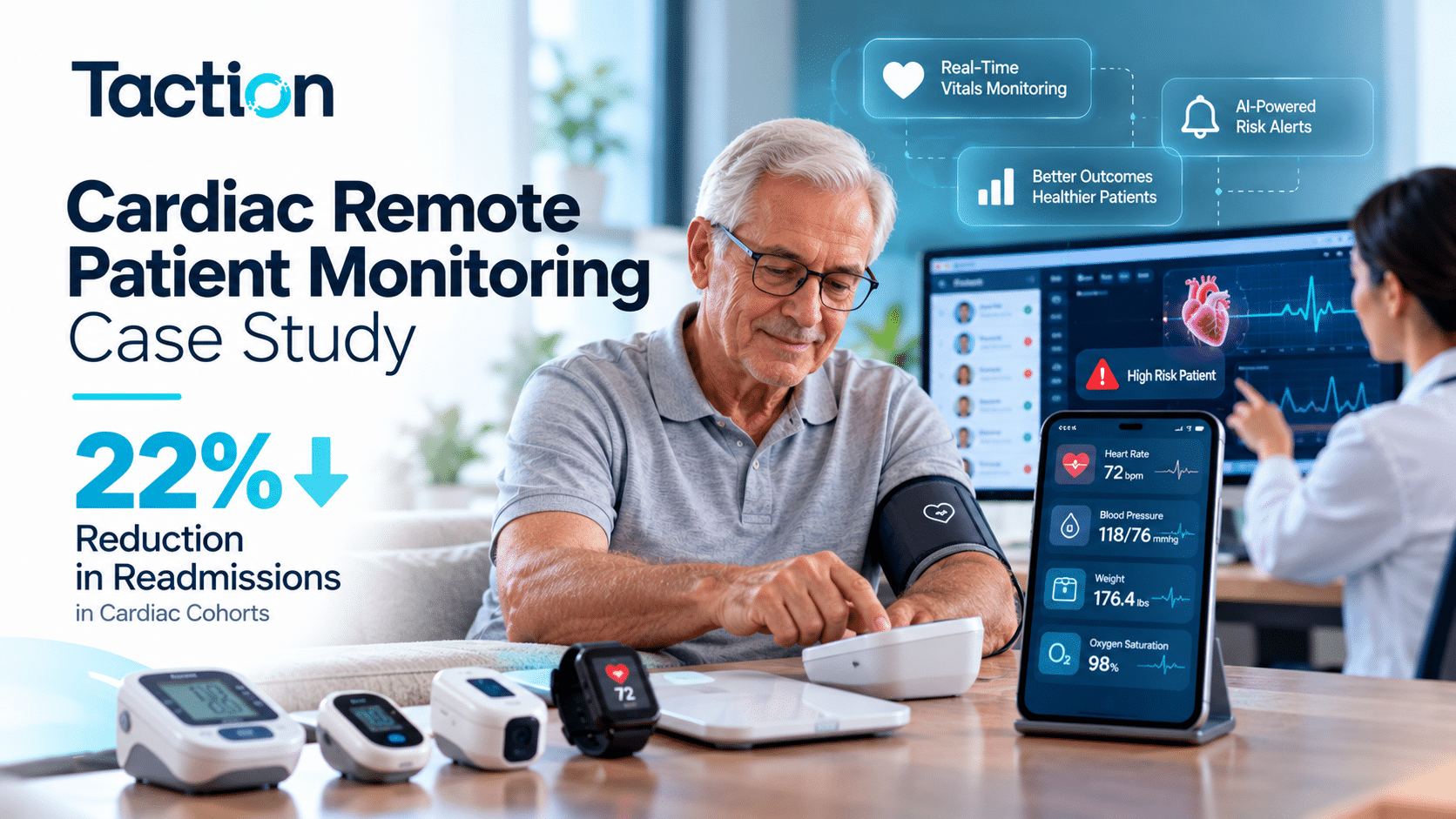
Cardiac Remote Patient Monitoring Case Study: 22% Reduction in Readmissions
What Is Cardiac Remote Patient Monitoring? Cardiac RPM uses connected devices and software to monitor physiological information such as weight, blood pressure, heart rate, rhythm and oxygen saturat...
Frequently Asked Questions About Cardiac RPM
What Is Cardiac Remote Patient Monitoring?
Cardiac RPM uses connected devices and software to monitor physiological information such as weight, blood pressure, heart rate, rhythm and oxygen saturation while patients are outside traditional clinical environments.
How Can RPM Help Reduce Cardiac Readmissions?
RPM can give care teams earlier visibility into changing physiological trends and symptoms. When meaningful deterioration is identified and reviewed promptly, clinicians have an opportunity to intervene before some conditions become acute.
What Devices Can Be Integrated With Cardiac RPM?
Typical integrations include blood pressure monitors, connected weight scales, pulse oximeters, ECG devices and cardiac wearables. Taction also supports multi-vendor medical-device environments through Bluetooth, cellular connectivity and APIs.
Can Cardiac RPM Integrate With an EHR?
Does Predictive RPM Replace Clinicians?
No. Predictive RPM should identify patterns and prioritize potential risks for clinical review. Nurses and physicians remain responsible for interpreting information within the patient’s clinical context and determining appropriate interventions.
Can Taction Build a Custom Cardiac RPM Platform?
Yes. Taction builds cardiac RPM platforms incorporating connected devices, patient applications, clinician dashboards, risk detection, alert workflows, EHR interoperability, security, adherence support and RPM billing capabilities.
Predictive Intelligence and Early Deterioration Detection
The objective was not to replace clinical judgment.
Predictive intelligence was used to help clinicians find meaningful patterns inside large volumes of RPM data and direct their attention toward patients who may require intervention.
Longitudinal Trend Analysis
Rather than evaluating every measurement independently, the system can examine how physiological values change over time. This provides more context for distinguishing ordinary fluctuations from sustained patterns that may indicate increasing clinical risk.
Multi-Signal Risk Detection
Weight gain may become more meaningful when accompanied by blood-pressure changes, increasing heart rate and worsening symptoms. Combining signals allows deterioration detection to consider the patient’s broader physiological pattern.
Risk-Based Patient Queues
Clinical dashboards can prioritize patients according to risk signals instead of displaying patients alphabetically or by most recent reading, helping monitoring teams decide where to begin their daily review.
Clinician-in-the-Loop Decisions
Predictive output supports rather than replaces clinicians. Nurses and physicians review alerts within the patient’s clinical context and determine whether outreach, medication review, appointment scheduling or another intervention is appropriate.
Earlier Opportunity to Intervene
Taction’s published predictive cardiac RPM guidance describes deterioration prediction using weight, blood pressure, heart rate, heart-rate variability, symptoms, medication adherence and activity patterns, with the goal of detecting decompensation before symptoms become acute.
Designing Alerts Without Creating Alert Fatigue
Alert design is one of the most important parts of a production RPM system.
If almost every measurement generates a warning, clinicians eventually stop treating warnings as meaningful. The workflow therefore needs prioritization, context and escalation logic.
Clinically Meaningful Thresholds
Thresholds should reflect the condition, patient population and clinical protocol rather than arbitrary numerical limits. This allows alerts to represent situations where clinical review may actually be warranted.
Trend-Based Alerts
A series of gradually changing measurements may be more important than one isolated abnormal value. Trend-based logic helps the system recognize deterioration patterns that simple upper-and-lower thresholds can miss.
Severity-Based Prioritization
Alerts can be classified by urgency so monitoring teams can distinguish routine exceptions from higher-risk events requiring faster review, reducing the cognitive burden of treating every notification equally.
Escalation Workflows
Higher-risk events can move through defined escalation paths, from monitoring staff to nurses or physicians as appropriate, helping organizations establish clear responsibility for reviewing and acting on important signals.
Alert Documentation
Recording alert generation, review and subsequent actions creates an operational history that can support care coordination, quality improvement, auditing and analysis of whether alert rules are producing clinically useful results.
Taction’s cardiology AI development work includes predictive cardiac RPM, ECG analysis and heart-failure deterioration models built around time-series physiological data and clinical workflows.
Clinician Dashboard and Care-Team Workflow
Predictive accuracy alone does not create a useful RPM program.
The information must reach clinicians in a form that supports rapid review and action. The dashboard was therefore designed around monitoring and intervention rather than simply visualizing device data.
Prioritized Patient List
The care-team view surfaces patients requiring attention based on risk, alerts and recent changes, allowing clinicians to begin with potentially higher-risk cases rather than manually reviewing every enrolled patient.
Longitudinal Vital Trends
Clinicians can review historical measurements and trends to understand how weight, blood pressure, heart rate and other signals have changed rather than making decisions from a single measurement.
Patient Clinical Context
Risk signals are more useful when viewed alongside relevant patient information. Providing context helps clinicians determine whether an alert reflects meaningful deterioration or an expected variation for that individual.
Intervention Tracking
Care teams can document outreach, review, escalation and interventions, creating continuity between detection and clinical action while making it easier for other authorized team members to understand what has already occurred.
Care-Team Collaboration
RPM programs frequently involve nurses, care coordinators and supervising physicians. Shared workflows help each role understand which patients require attention and what actions have already been taken.
Connected Medical Device Integration
Cardiac RPM depends on reliable data arriving from patients’ homes.
Taction’s RPM platforms support integration with medical devices and wearables so readings can flow into monitoring workflows without requiring patients to manually transcribe every measurement.
Blood Pressure Monitors
Bluetooth or cellular blood pressure devices can transmit readings directly to the RPM environment, reducing manual entry and providing clinicians with consistent longitudinal measurements for hypertension and cardiac management.
Connected Weight Scales
Smart scales enable daily weight measurements to reach care teams automatically. For heart-failure programs, this creates a consistent data source for detecting weight changes associated with possible fluid accumulation.
Pulse Oximeters
Connected pulse oximeters capture oxygen saturation and pulse data, giving monitoring teams additional physiological information for patients with cardiac or overlapping respiratory conditions.
ECG and Cardiac Wearables
ECG devices and cardiac wearables can provide rhythm and heart-rate information, extending monitoring beyond intermittent measurements and supporting workflows for patients with arrhythmias and other cardiac conditions.
Multi-Vendor Device Support
Taction’s RPM engineering supports devices from manufacturers including iHealth, Omron, Withings, Biobeat and BioIntelliSense, allowing organizations to build programs around multiple device types rather than a single proprietary hardware ecosystem.
EHR Integration and Healthcare Interoperability
Remote monitoring should not create a second disconnected clinical record.
Taction’s RPM architecture supports integration with EHR environments using FHIR APIs, HL7 and integration technologies so relevant monitoring information can become part of existing clinical workflows.
FHIR-Based Data Exchange
FHIR can structure RPM observations for exchange with healthcare systems, giving applications a standards-based method for representing blood pressure, weight, heart rate, oxygen saturation and other monitored information.
HL7 Integration
HL7 interfaces remain important across many provider environments. Integration engines such as Mirth Connect can route and transform messages between the RPM platform and existing healthcare infrastructure.
EHR Workflow Integration
Taction’s RPM capabilities include integrations with systems such as Epic, Oracle Health, Allscripts and athenahealth, helping care teams avoid unnecessary switching between disconnected monitoring and clinical systems.
Clinical Documentation
Monitoring activities, alerts and interventions can be incorporated into clinical documentation workflows so the RPM program contributes to the longitudinal patient record rather than maintaining an isolated history.
Reduced Duplicate Work
Interoperability helps reduce repeated manual entry by allowing appropriate patient, observation and monitoring information to move between systems, improving usability for clinicians responsible for large monitored populations.
HIPAA and Security Architecture
Cardiac RPM platforms continuously process sensitive patient information across connected devices, mobile applications, cloud infrastructure, APIs and healthcare systems.
Security therefore has to protect the entire data path rather than focusing only on database storage.
Encryption in Transit
Physiological and patient data transmitted between devices, applications, backend services and connected healthcare systems should use encrypted communication channels to reduce exposure while information moves across networks.
Encryption at Rest
Stored patient and monitoring information requires encryption alongside appropriate key management and infrastructure controls, helping protect sensitive healthcare data if storage systems or underlying infrastructure are accessed improperly.
Role-Based Access
Nurses, physicians, care coordinators, administrators and patients require different information and capabilities. Role-based access controls restrict users to functions and records appropriate to their responsibilities.
Audit Logging
Security-sensitive activity can be logged so organizations can monitor patient-record access, administrative actions, authentication events and other interactions important for operational oversight and compliance investigations.
HIPAA-Focused Infrastructure
Infrastructure, vendors and integrations processing PHI need to be evaluated for healthcare requirements, including appropriate safeguards and Business Associate Agreements where applicable rather than relying solely on application-level security.
What This Cardiac RPM Case Study Demonstrates
The project highlights an important difference between collecting remote patient data and building a clinically useful RPM program.
Devices provide measurements. The engineering challenge is converting those measurements into timely, manageable clinical workflows.
More Data Is Not the Goal
A successful RPM platform should not maximize the number of readings shown to clinicians. It should help care teams determine which information matters and which patients require attention.
Trends Matter More Than Isolated Readings
Cardiac deterioration can emerge across multiple measurements over time. Longitudinal and multi-signal analysis provides more context than treating every abnormal reading as an independent clinical event.
Alert Quality Determines Adoption
If alerts are consistently irrelevant, clinicians stop trusting the monitoring system. Prioritization, thresholds and escalation logic therefore have a direct impact on whether an RPM platform remains useful in production.
Integration Is Part of Clinical Safety
RPM information disconnected from the EHR increases context switching and can fragment patient information. Interoperability should be considered a core clinical workflow requirement rather than an optional technical enhancement.
Clinicians Remain the Decision Makers
Predictive models can surface risk, but clinical teams determine what action is appropriate. Production cardiac RPM should support clinical judgment rather than attempting to replace it with automated decisions.
Why Taction Software for Cardiac RPM Development?
Taction develops remote patient monitoring software across the full data path, from connected devices and patient applications to predictive intelligence, clinician workflows, EHR integration and healthcare security.
Cardiac RPM Engineering
Our cardiac RPM platform development capabilities cover connected devices, reliable data ingestion, threshold alerts, care-team dashboards, adherence support and RPM reimbursement workflows.
Production RPM Experience
Taction has also built the RPM SaaS platform for Rhythm, spanning patient enrollment, device logistics, monitoring, alerting and EHR integrations, demonstrating experience beyond proof-of-concept remote monitoring systems.
Predictive Healthcare AI
Our AI remote patient monitoring engineering combines monitoring data with predictive analytics, anomaly detection and alert triage to make high-volume physiological data more actionable.
Healthcare Interoperability
Taction works with FHIR, HL7, APIs and Mirth Connect to connect RPM platforms with provider infrastructure, reducing the likelihood that remote monitoring becomes another disconnected clinical data silo.
Dedicated RPM Engineering
Organizations expanding an existing product can also hire RPM developers with experience across BLE device integration, FHIR write-back, cardiac monitoring and CMS RPM workflows.
The Challenge: Turning Cardiac RPM Data Into Earlier Intervention
Traditional remote patient monitoring can collect thousands of measurements without clearly identifying which patients need attention first.
For cardiac care teams, the challenge was turning continuous physiological information into clinically useful signals without overwhelming clinicians with unnecessary alerts.
High Risk of Cardiac Readmission
Heart failure and other cardiac conditions can deteriorate between scheduled encounters. Changes may begin at home days before acute symptoms lead patients back to the emergency department or hospital.
Too Much Monitoring Data
Connected devices continuously generate weight, blood pressure, pulse, oxygen saturation and other readings. Without effective prioritization, care teams must manually review large volumes of data to identify patients showing meaningful deterioration.
Subtle Deterioration Patterns
A single abnormal reading may not indicate an emergency. The more useful signal can emerge from combinations and trends across weight, blood pressure, heart rate, symptoms, medication adherence and activity over time.
Alert Fatigue
Static thresholds can create large numbers of alerts, many of which require no intervention. Excessive notifications increase workload and make it more difficult for clinicians to recognize genuinely high-risk patients quickly.
Disconnected Clinical Workflows
RPM loses value when clinicians must constantly switch between a monitoring dashboard and the EHR. Relevant alerts and patient context need to reach care teams within workflows they already use.
Taction’s broader remote patient monitoring software development practice addresses these challenges through connected-device integration, clinical dashboards, patient applications, alerts, billing workflows, and EHR interoperability.
The Solution: Predictive Cardiac Remote Patient Monitoring
The solution was designed to move beyond simple threshold-based monitoring.
Instead of treating every abnormal measurement equally, the architecture combined longitudinal data and deterioration signals to help clinicians determine which patients required closer review.
Continuous Physiological Monitoring
The platform could ingest cardiac-related measurements including blood pressure, weight, heart rate, oxygen saturation and connected-device data, providing care teams with longitudinal information rather than relying exclusively on measurements collected during clinic visits.
Predictive Deterioration Detection
Predictive analysis evaluates changes across multiple physiological and behavioral signals to identify patterns associated with deterioration, helping move the monitoring workflow from reacting to isolated abnormal values toward recognizing developing risk.
Patient Risk Prioritization
Patients could be organized according to changing risk rather than presented as an undifferentiated monitoring list. This helped clinical teams focus limited attention on patients whose recent data indicated greater need for review.
Tiered Clinical Alerts
Alerts were designed around severity and clinical relevance so every deviation did not receive identical urgency. Tiered escalation helped distinguish routine monitoring events from situations requiring faster nurse or physician intervention.
Care-Team Escalation
When deterioration signals crossed defined clinical criteria, the workflow supported escalation to the appropriate care-team member for review, patient outreach, care-plan adjustment or other clinically determined intervention.
Taction’s AI remote patient monitoring approach similarly emphasizes reliable ingestion, signal quality, predictive intelligence, alert triage and EHR workflow integration rather than adding AI to an isolated monitoring dashboard.
Cardiac Data Captured by the RPM Platform
Predictive cardiac monitoring becomes more useful when clinical decisions are based on multiple longitudinal signals rather than a single device reading.
The architecture can combine connected-device measurements with symptoms and patient behavior to establish a more complete picture of changing cardiac risk.
Daily Weight
Rapid weight gain can be clinically relevant for heart-failure patients because it may indicate fluid retention. Connected scales allow changes to be captured remotely and evaluated alongside other physiological and symptom data.
Blood Pressure
Connected blood pressure monitors provide systolic and diastolic measurements outside clinical settings. Longitudinal readings help care teams identify patterns that may not be visible from occasional measurements taken during office appointments.
Heart Rate and Rhythm
Cardiac wearables and ECG-capable devices can provide heart-rate and rhythm information. These signals add important context when monitoring patients with heart failure, hypertension, arrhythmias or recent cardiac events.
Oxygen Saturation
Pulse oximeter data can contribute additional context for patients whose cardiac condition affects oxygenation or who have overlapping cardiopulmonary conditions requiring closer monitoring outside traditional care settings.
Patient-Reported Symptoms
Symptoms such as shortness of breath, swelling, fatigue and dizziness provide context that device readings alone cannot capture. Combining reported symptoms with physiological trends can strengthen deterioration assessment.
Activity and Adherence
Changes in activity, medication adherence or measurement compliance may provide additional warning signals. A patient who suddenly becomes less active or stops submitting readings may require different follow-up from a stable, adherent patient.
Build a Cardiac RPM Platform That Makes Monitoring Data Actionable
Collecting cardiac data is only the first step.
A production RPM platform needs to reliably ingest device readings, identify meaningful trends, prioritize risk, control alert fatigue, fit existing clinical workflows and give clinicians enough context to decide when intervention is necessary.
Taction Software builds custom cardiac RPM platforms for hospitals, cardiology groups, digital health companies and healthcare technology organizations.
Results: 22% Reduction in Cardiac Readmissions
The project’s most important outcome was not the amount of data collected.
It was whether that information helped support earlier recognition of patient deterioration and improve downstream outcomes.
22% Readmission Reduction
Earlier Risk Visibility
Combining longitudinal device readings with deterioration analysis gave monitoring teams a way to identify changing patient risk before relying solely on acute symptoms or the patient’s next scheduled clinical encounter.
Better Clinical Prioritization
Risk-based queues and alert triage helped focus clinician attention on patients whose data indicated greater concern instead of requiring monitoring teams to treat every measurement and every patient equally.
More Actionable RPM Data
The platform transformed device measurements from passive dashboard information into structured monitoring workflows connecting data ingestion, risk detection, alert review, escalation and documented clinical intervention.
Foundation for Scalable Cardiac Monitoring
The architecture established reusable capabilities for device integration, data normalization, alerts, clinician dashboards and EHR interoperability that can support larger cardiac populations and additional remote-monitoring use cases.