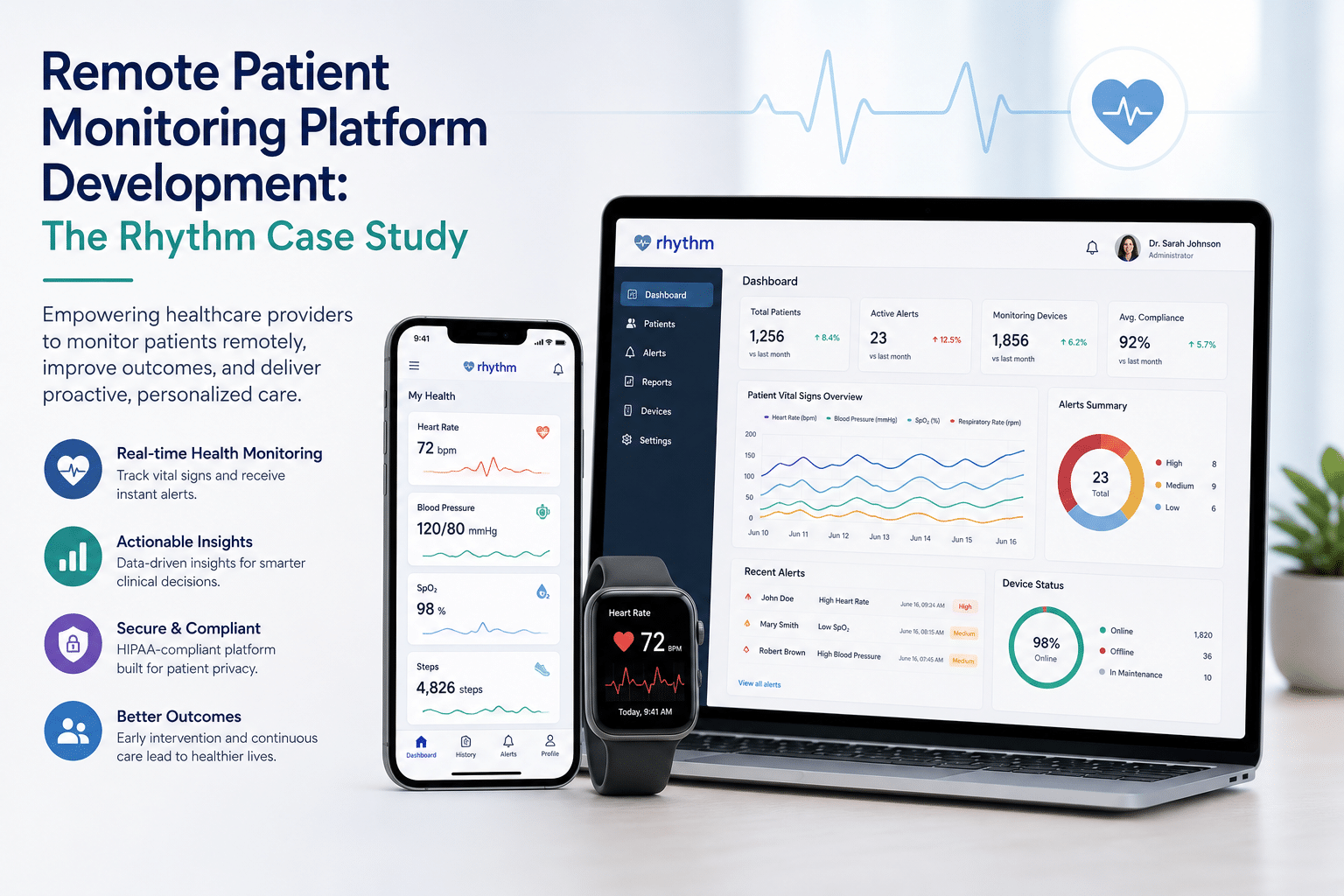
Remote Patient Monitoring Platform Development: The Rhythm Case Study
Rhythm is a proven leader in remote monitoring with a track record of delivering innovative technology and unmatched service. Its remote monitoring solutions are built so clinical teams can focus on p...
Client Overview
Rhythm is a proven leader in remote monitoring with a track record of delivering innovative technology and unmatched service. Its remote monitoring solutions are built so clinical teams can focus on patient care rather than on program administration.
Taction Software was engaged to build the SaaS platform underneath that operation, spanning the patient-facing experience, the clinic-facing monitoring and alerting interface, device logistics, and the integrations connecting both to provider EHR systems.
Key Features
SaaS solutions for patients and clinics. One platform serving both user groups with role-appropriate interfaces.
Patient enrollment and insurance verification. Coverage established at intake, before device fulfilment cost is committed.
Remote patient monitoring solution. Continuous collection and processing of patient vitals and device data.
Patient identification, engagement, and onboarding. Identity resolution and structured onboarding that carries patients through to active monitoring.
Device ordering, direct-to-patient shipping, and training. Hardware logistics handled inside the platform, including patient training on device use.
Resolution of device problems. Support workflows for device failures, so hardware issues do not land on clinic staff.
Ongoing monitoring. Continuous oversight of enrolled patients rather than point-in-time measurement.
Real-time triaged alerts. Alerts prioritized before reaching clinicians, protecting clinical attention.
Billing expertise and guidance. Reimbursement support built into the operational workflow.
Bi-directional EHR integration. Monitoring data into the EHR, patient context back out.
Investment Ranges
Where a project lands depends on device integration count, alerting complexity, EHR systems in scope, and whether patient data needs migrating from an existing program.
What Clients Say About Us
“Internal stakeholders are impressed with the quality of Taction’s deliverables and customer service. The team is extremely dedicated to the project, working around the clock to provide the best possible end product. Customers can expect a professional, well-managed, and effective partner.”
Carlin Lee, Rhythm Management Group
| Scope | Investment |
| MVP: enrollment, single device type, basic monitoring and alerts | $40,000 to $80,000 |
| Full platform: adds multi-device support, triaged alerting, EHR integration, billing workflow | $80,000 to $200,000 |
| Enterprise: large patient populations, multi-provider, extensive device and payer integrations | $200,000 and up |
Related Services
- 1Remote patient monitoring development
- 2RPM app development
- 3Healthcare integrations and interoperability
- 4HIPAA-compliant software development
- 5Healthcare software development services
- 6Dedicated healthcare development team
Frequently Asked Questions
What is a remote patient monitoring platform?
Software that collects patient health data from devices outside a clinical setting, processes it, alerts clinicians to concerning readings, and supports the documentation needed for reimbursement. A complete platform also handles patient enrollment, insurance verification, device fulfilment, and EHR integration.
Why does device logistics belong in the software platform?
Because someone has to order devices, ship them to patients, train patients to use them, and fix them when they fail. If the platform does not handle it, a clinic does, and that cost usually goes unbudgeted until the program stalls.
What are triaged alerts and why do they matter?
Triaged alerts pass through prioritization logic before reaching clinical staff, so clinicians see what needs action rather than every reading. Untriaged alerting causes alert fatigue, which is one of the most common reasons RPM programs lose clinical buy-in.
What does bi-directional EHR integration mean?
Monitoring data flows into the provider’s EHR, and patient context flows back into the monitoring platform. One-way integration leaves clinicians maintaining two records and reconciling between them.
How long does an RPM platform build take?
An MVP covering enrollment, one device type, and basic monitoring typically runs three to five months. Timeline scales with device integration count and the number of EHR systems in scope.
Will the platform be HIPAA compliant?
We build to HIPAA administrative and technical safeguards: encryption in transit and at rest, role-based access control, and audit logging. Full compliance also depends on your internal policies and business associate agreements, which we help scope.
Can you integrate with the devices we already use?
Device integration count is one of the main cost drivers, so bring your device list to the scoping call.
Why Node.js, AngularJS, and MongoDB for this platform?
The combination suits continuous device data ingestion, real-time alert processing, and varied device payload structures. If your organization has an existing stack, we build in that instead.
Who owns the code?
You do.
The Challenge
Most remote patient monitoring programs do not fail on the monitoring. They fail on everything around it.
A patient has to be enrolled, verified for insurance coverage, identified correctly in the system, onboarded, sent a device, taught to use it, and supported when the device stops working. Only then does monitoring begin. Then the data has to reach clinicians in a form they can act on, flow into the EHR, and support a billable claim.
Rhythm needed four things solved together.
The full lifecycle in one system. Enrollment, verification, device fulfilment, monitoring, alerting, and billing handled across separate tools means every patient is touched manually at multiple points, and the program cost per patient never comes down.
Physical logistics inside a software platform. RPM is one of the few healthcare software categories with a shipping and hardware support problem attached. Devices have to reach patients, patients have to be trained, and failures have to be resolved without a clinic absorbing the support load.
Alert volume that does not overwhelm clinicians. Continuous monitoring generates continuous data. Passing all of it to clinical staff produces alert fatigue, which is the failure mode that quietly ends RPM programs.
Bi-directional EHR integration. One-way data push leaves clinicians reconciling two records. Real integration means monitoring data lands in the EHR and patient context flows back into the monitoring platform.
Our Solution
A single SaaS platform where the patient journey, the device, the monitoring data, and the reimbursement record are all connected.
Enrollment and insurance verification feed onboarding. Onboarding triggers device ordering and shipping. Devices report into ongoing monitoring. Monitoring produces triaged alerts. Alerts and monitoring time support billing. The EHR stays synchronized throughout. This is the architecture behind our remote patient monitoring development work.
Technology Stack
The stack was chosen for the ingestion pattern. RPM platforms take constant small writes from many devices, which is a different load profile from transactional clinical software. If your organization already runs a stack, we build in it.
| Layer | Technology | Engineering rationale |
| Backend | Node.js | Event-driven, non-blocking model suits continuous inbound device data and real-time alert processing |
| Frontend | AngularJS | Structured data binding suits the form-heavy enrollment, verification, and clinical dashboard interfaces |
| Database | MongoDB | Document model handles varied device payload structures and time-series monitoring data without rigid schema migration per device type |
| Delivery | SaaS | Serves patients and clinics from one platform |
Ready to Build a Remote Monitoring Platform
Quick Results
| Outcome | Detail |
| Lifecycle coverage | Enrollment through monitoring, alerting, and billing in one platform |
| User groups served | Patients and clinics on a single SaaS system |
| Device logistics | Ordering, direct-to-patient shipping, patient training, and problem resolution built in |
| Alerting model | Real-time alerts triaged before reaching clinical staff |
| EHR connectivity | Bi-directional integration, data flowing both ways |
| Reimbursement support | Billing expertise and guidance embedded in the workflow |
Results and Business Impact
One platform instead of a stitched-together program. Enrollment, verification, logistics, monitoring, alerting, and billing operate on shared data, which is what makes cost per monitored patient controllable as a program scales.
Coverage confirmed before hardware ships. Insurance verification ahead of device fulfilment addresses one of the most common sources of unrecoverable RPM program cost.
Clinical attention protected. Triaged alerting means clinicians receive prioritized signals rather than raw data volume, which is the difference between a program clinicians adopt and one they route to a folder.
Device support removed from the clinic. Ordering, shipping, training, and problem resolution sit with the platform, so participating clinics are not absorbing hardware support as an unfunded cost.
Clinicians work in one record. Bi-directional EHR integration removes the reconciliation work that one-way data feeds create.
Reimbursement supported by the workflow itself. Billing guidance inside the platform means the documentation needed for claims is a byproduct of normal operation rather than a separate exercise.