Unified Healthcare Platform Development: The Xoomia Case Study
Xoomia is a unified healthcare system that allows caregivers, home health agencies, doctor offices, clinics, and government bodies to securely manage and share individual patient health information. T...
Client Overview
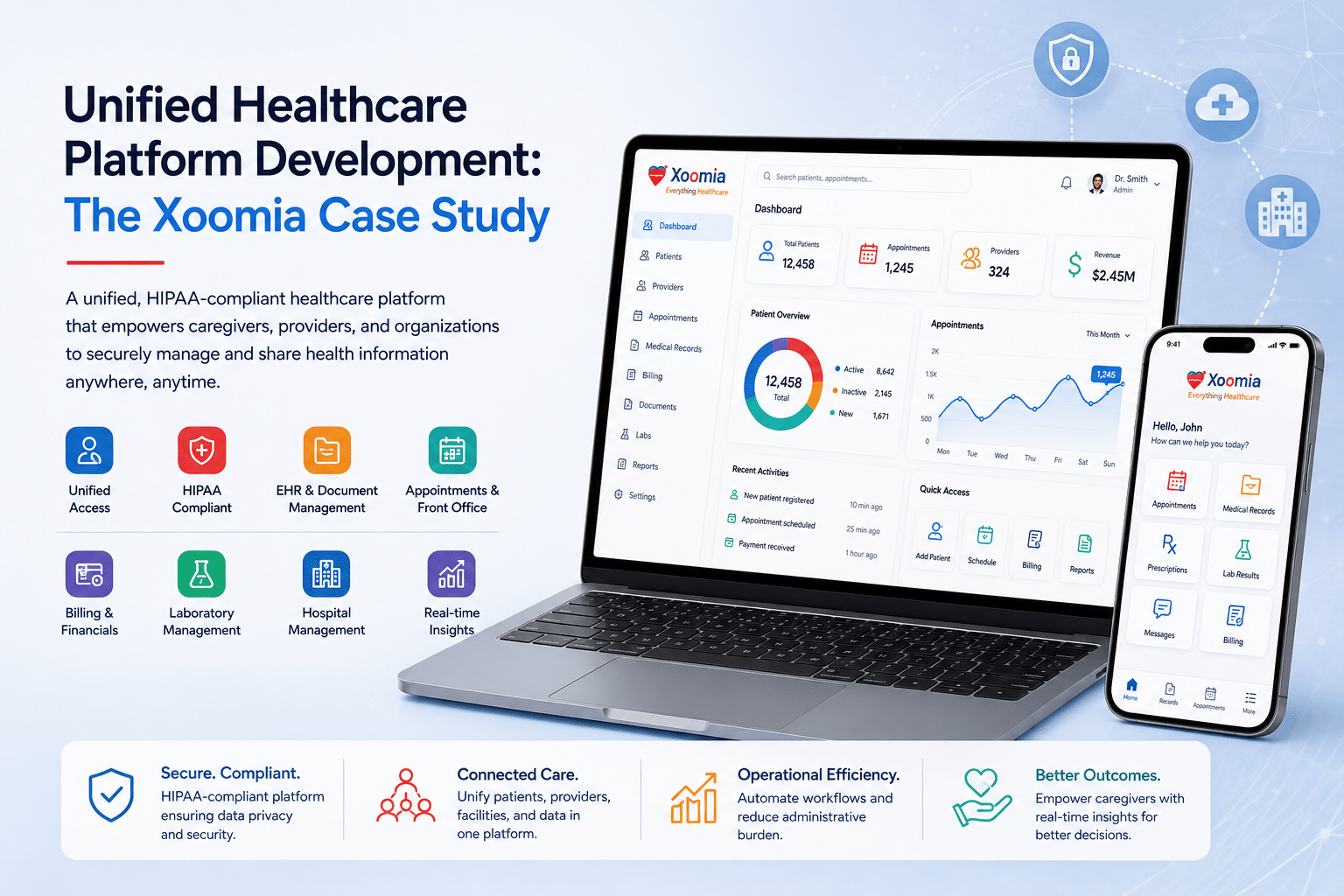
Xoomia is a unified healthcare system that allows caregivers, home health agencies, doctor offices, clinics, and government bodies to securely manage and share individual patient health information. The platform is HIPAA compliant and accessible anywhere, anytime, positioned around unified electronic documentation for health providers.
Facilities using Xoomia manage their patients proactively rather than reactively. The platform is delivered affordably, with no setup fees, no hardware purchase, and no requirement for in-house technical support.
Taction Software built the platform, spanning the unified record layer, the participant-specific interfaces, the integration engine connecting external systems, and the administrative and financial modules underneath.
Key Features
Login and signup. Authentication with role-based access separating caregiver, clinical, administrative, and oversight paths.
HIPAA-compliant SaaS solution. Multi-tenant architecture with encryption in transit and at rest, access control, and audit logging, accessible anywhere, anytime.
Unified EHR. A single record spanning patients, doctors, hospitals, and laboratories, so clinical history is not reassembled from separate sources at each encounter.
Reports and document management. Structured storage and retrieval of clinical documentation and reporting across participant types.
Billing and financial solution. Transaction management connected to the clinical and encounter record.
Front office solution. Appointment and doctor management for practices and clinics operating on the platform.
Hospital management solution. Facility-level operational management, extending the platform from community and home care into institutional settings. This connects to our broader clinical and hospital management software development practice.
Investment Ranges
Where a project lands depends on participant type count, permission complexity, external systems in scope, and whether existing patient records need migrating.
| Scope | Investment |
| MVP: unified record, two participant types, core documentation | $40,000 to $80,000 |
| Full platform: adds billing, front office, hospital management, external system integration | $80,000 to $200,000 |
| Enterprise: multi-region, government or payer participation, extensive system integrations | $200,000 and up |
Related Services
- 1EHR and EMR software development
- 2Clinical and hospital management software development
- 3Healthcare integrations and interoperability
- 4Mirth Connect integration
- 5HIPAA-compliant software development
- 6Dedicated healthcare development team
Frequently Asked Questions
What is a unified healthcare platform? A system where multiple participant types, such as caregivers, home health agencies, physician practices, laboratories, facilities, insurers, and government bodies, work from one shared patient record with role-appropriate access, instead of maintaining separate records and exchanging information manually.
How is a unified platform different from an EHR? A conventional EHR serves one organization. A unified platform serves a network of organizations that do not share an employer or an IT department, which makes access control, audit logging, and interoperability considerably harder than in a single-tenant EHR.
How do you handle permissions when this many parties share a record? Role-based access control designed into the data model before feature development, with audit logging on every access and modification. It cannot be added later without rebuilding the record structure.
Can the platform connect to hospital and laboratory systems we already use? Yes. Mirth Connect handles receipt, transformation, and routing of data from external clinical systems. System count and format variance are the main cost drivers, so bring your list to the scoping call.
Does a platform like this require hardware or IT staff at each participating organization? Not in this build. Xoomia was delivered as SaaS with no setup fees, no hardware purchase, and no in-house technical support requirement, specifically so smaller participants could adopt it.
How long does a unified healthcare platform build take? An MVP covering a unified record and two participant types typically runs three to five months. Timeline scales with participant type count, permission complexity, and external integrations.
Will the platform be HIPAA compliant? We build to HIPAA administrative and technical safeguards: encryption in transit and at rest, role-based access control, and audit logging. Full compliance also depends on your internal policies and business associate agreements, which we help scope.
Why Java, React, and Mirth Connect for this platform? Java for transactional integrity and complex permission handling, React for building multiple participant interfaces on shared components, Mirth Connect for healthcare data exchange with external systems. If your organization has an existing stack, we build in that instead.
Who owns the code? You do.
The Challenge
A patient in home or community care is handled by participants who do not share a system and often do not share an employer.
A caregiver visits the home. A home health agency coordinates the schedule. A doctor’s office holds the clinical history. A laboratory produces results. A pharmacy dispenses. A facility admits when care escalates. An insurer adjudicates. A government body oversees eligibility and compliance. Every one of them holds part of the record, and none of them holds all of it.
Xoomia needed four problems solved together.
No shared record across participant types. Information moves between these parties by phone, fax, and paper. What gets lost in transit is clinical context, and the cost of losing it is duplicated tests, medication errors, and avoidable admissions.
Different participants need different views. A caregiver in a home, a physician in an office, and a government reviewer need the same underlying record presented in entirely different ways, with entirely different permissions.
Adoption barriers at the small end of the market. Home health agencies and small practices do not have IT budgets, server rooms, or technical staff. A platform requiring setup fees, hardware, or in-house support excludes exactly the participants the network needs most.
Connection to systems already in place. Hospitals and laboratories already run their own systems. A unified platform that cannot receive from them is another silo with better branding.
Our Solution
One record, many participants, role-appropriate access.
Xoomia holds a unified electronic health record spanning patients, doctors, hospitals, and laboratories, and exposes it through interfaces built for each participant type. Around it sit the administrative and financial modules a care operation actually runs on, plus a Mirth Connect integration layer that brings in data from external clinical systems. Delivered as SaaS, the platform requires no hardware, no setup fee, and no internal IT capability from the organizations using it. This is the architectural approach behind our unified EHR and EMR software development work.
Technology Stack
React was the right choice specifically because of the participant-type problem. Building separate interfaces for caregivers, clinicians, and administrators on shared components keeps one codebase serving many audiences. If your organization already runs a stack, we build in it.
| Layer | Technology | Engineering rationale |
| Backend | Java | Mature ecosystem for complex permission models, transactional integrity, and long-lived healthcare systems with strict access control requirements |
| Frontend | React | Component model suits building distinct participant interfaces on shared data structures without duplicating the front end per user type |
| Integration engine | Mirth Connect | Industry-standard healthcare interface engine for routing and transforming data from hospital and laboratory systems |
| Delivery | Multi-tenant SaaS | No hardware or setup cost for participating organizations |
Ready to Build a Connected Care Platform
Quick Results
| Outcome | Detail |
| Participant types connected | Caregivers, home health agencies, doctor offices, clinics, government bodies, plus pharmacy, facility, and insurance participants |
| EHR scope | Unified record spanning patients, doctors, hospitals, and laboratories |
| Compliance posture | HIPAA-compliant SaaS architecture, accessible anywhere, anytime |
| Client cost model | No setup fees, no hardware purchase, no in-house tech support required |
| Modules delivered | Authentication, unified EHR, reports and documents, billing, front office, hospital management |
| Integration engine | Mirth Connect for cross-system health data exchange |
Results and Business Impact
One record across a fragmented care network. Caregivers, agencies, practices, laboratories, facilities, insurers, and government bodies work from shared information rather than exchanging fragments by phone and fax.
Care continuity across handoffs. The transitions between home care, office visits, laboratory work, and facility admission are the points where care usually breaks down. A unified record is what makes them survivable.
Adoption possible at the small end of the market. No setup fees, no hardware, and no in-house technical support means home health agencies and small practices can join the network. In a platform whose value depends on how many participants are on it, removing that barrier is a product decision, not a pricing one.
External clinical systems included rather than replaced. Mirth Connect integration means hospital and laboratory data enters the unified record, so the platform adds to the existing landscape instead of competing with it.
Administrative and clinical operations on shared data. Billing, front office, documentation, and hospital management run against the same record as clinical care, removing the reconciliation work that separate systems create.
Auditability across every participant. With this many parties touching one patient record, transaction-level audit logging is what makes shared access defensible under HIPAA review.