

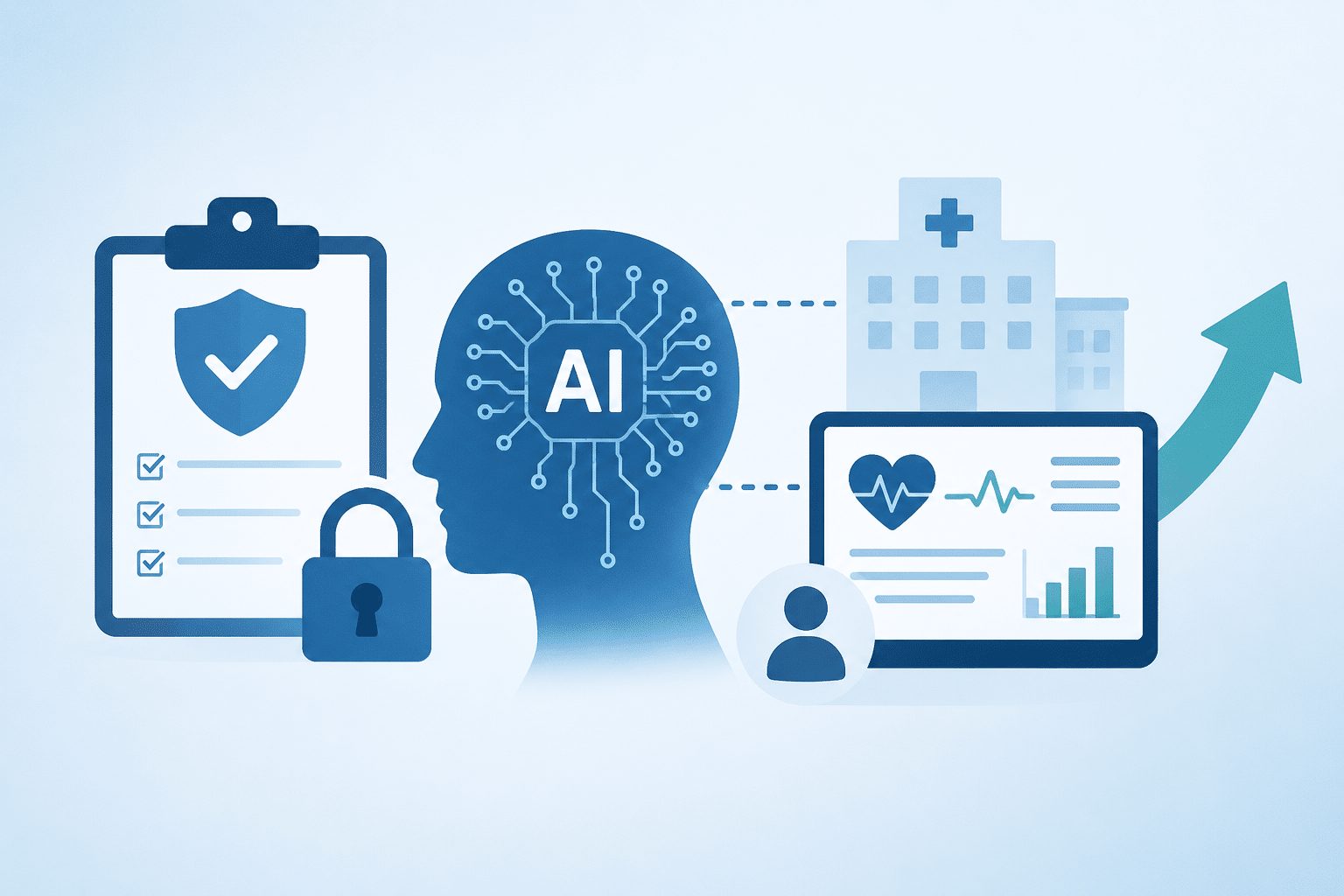
Artificial intelligence in healthcare has moved past the hype cycle. Hospitals no longer ask “should we use AI?” — they ask “which AI actually reduces readmissions, cuts documentation time, or catches a deteriorating patient before it’s too late?” The gap between flashy AI demos and dependable clinical deployment is where most projects stall. Success in 2025 rests on three pillars: Compliance, Integration, and Outcomes. This is a practical roadmap for CIOs, product managers, and clinical leads who need proof, not promises, before greenlighting an AI investment.
The Operational AI Stack: Features That Fix the Front and Back Office
Before AI touches a diagnosis, it should fix the operational bottlenecks draining staff time and revenue. These are the highest-ROI, lowest-risk entry points for most health systems.
Predictive Scheduling & Capacity Management
Machine learning models trained on historical admission patterns, seasonality, and local event data can forecast ER surges and optimize OR block scheduling. Predictive no-show algorithms that factor in weather, transportation access, and patient history have been shown to reduce no-shows by up to 30% when paired with automated reminder workflows.
Intelligent Patient Portals
NLP-powered chatbots now handle appointment booking, prescription refill requests, and pre-visit intake questionnaires — reducing front-desk call volume and improving data quality before the patient even arrives.
Revenue Cycle Automation
AI applied to prior authorization, claims scrubbing, and denial management can flag coding errors before submission, shortening the revenue cycle and reducing costly rework for billing teams.
Ambient Clinical Intelligence (AI Scribes)
Ambient documentation tools listen to patient-clinician conversations and generate structured notes automatically. This directly targets physician burnout — one of the most measurable and immediate wins available to health systems today.
The Clinical AI Stack: Features That Improve Diagnosis and Treatment
Once operational foundations are stable, clinical AI delivers the next layer of value — but with a much higher bar for validation.
Medical Imaging Triage
AI models trained on large annotated imaging datasets can flag time-critical findings — such as intracranial hemorrhage or pulmonary embolism — and push them to the top of a radiologist’s queue, shrinking time-to-diagnosis for the sickest patients.
Clinical Decision Support (CDS) Apps
CDS tools generate real-time alerts for drug-drug interactions, sepsis risk scores, and early signs of patient deterioration. When integrated correctly, they act as a second set of eyes rather than another alert clinicians learn to ignore.
Genomic & Precision Medicine
AI-assisted variant interpretation accelerates the translation of genomic sequencing into actionable treatment matching, particularly in oncology, where time-to-therapy decisions matter.
Remote Patient Monitoring (RPM)
Wearable and home-device data streams feed models that predict exacerbations in chronic conditions like COPD and congestive heart failure — enabling intervention days before a hospital visit becomes necessary.
The Compliance Prerequisite: Why HIPAA Is Your First Feature
No feature list matters if the underlying system can’t be trusted with protected health information (PHI). Compliance isn’t a checkbox added at the end — it’s the architecture the entire application is built on.
HIPAA Compliance Is Non-Negotiable
Any AI vendor touching PHI needs a signed Business Associate Agreement (BAA), enforced encryption at rest and in transit, and granular, role-based access controls. This is table stakes, not a differentiator.
The Cloud Security Trap
Generic public AI tools frequently pose hidden risks: unclear data residency, ambiguous retention policies, and — critically — the possibility that PHI submitted to a consumer-grade model gets used in future training runs. Healthcare organizations should demand explicit contractual guarantees against this.
Model Explainability (XAI)
A “black box” recommendation is a liability in a clinical setting. Techniques like SHAP and LIME allow clinicians and auditors to see why a model flagged a patient as high-risk, which is essential for both trust and legal defensibility.
Audit Trails
Every AI-driven decision — from a triage recommendation to a denied claim — must be logged with timestamp, model version, and input data reference, ready for regulatory review at any time.
How to Build an AI-Powered Clinical Decision Support App (Step-by-Step)
Building a CDS application is less about picking a fancy model and more about disciplined scoping and validation. Here’s the realistic sequence.
Step 1 — Define the Clinical Problem
Narrow scope wins. “Improve patient outcomes” is not a build spec; “predict sepsis onset in ICU patients within a 4-hour window” is. A tightly defined problem statement determines every downstream decision, from data requirements to success metrics.
Step 2 — Data Curation & Labeling
This is the hardest and most underestimated step. Clean, de-identified EMR data, properly labeled by clinical experts, is the true bottleneck of most healthcare AI projects — not the algorithm itself. Poor data quality here guarantees poor model performance later, regardless of architecture.
Step 3 — Model Selection & Training
Start simple. Logistic regression and gradient-boosted trees (like XGBoost) are often more interpretable and just as accurate as deep learning for many structured-data problems. Benchmark performance using standard clinical ML metrics such as AUROC and F1 score, and always compare against the existing clinical standard of care — not just against a theoretical baseline.
Step 4 — Integration with EHR (HL7/FHIR)
A model that isn’t embedded in the clinician’s existing workflow will be ignored. Integration via HL7 FHIR and SMART on FHIR standards allows the CDS tool to plug directly into Epic, Cerner, or other major EHRs, surfacing alerts inside the chart the clinician is already reviewing.
Step 5 — Validation & Deployment
Prospective validation in a sandboxed “shadow mode” — where the model runs silently alongside clinical decision-making without influencing it — is essential before any live rollout. This step catches performance drift and false-positive fatigue before they affect real patients. Companies like Taction software, which build HIPAA-compliant healthcare software and manage EHR interoperability projects for hospitals and digital health startups, typically treat this validation phase as non-negotiable before go-live, precisely because skipping it is where most CDS pilots quietly fail.
How to Choose the Best AI Healthcare Software Development Company in the US
With hundreds of vendors claiming “AI-powered” capabilities, evaluation criteria matter more than marketing claims.
Criteria 1 — Regulatory Readiness
Look for demonstrated experience executing HIPAA BAAs and, where the product functions as a medical device, navigating FDA 510(k) clearance pathways.
Criteria 2 — Clinical Validation
Ask for documented case studies with specific outcome metrics — reduced readmissions, hours of documentation saved, percentage improvement in triage speed — not just testimonials.
Criteria 3 — Integration Capability
Native HL7/FHIR connectors and proven compatibility with major EHR platforms should be demonstrable, not theoretical.
Criteria 4 — Model Explainability
A credible vendor can produce model cards and interpretability reports on request, showing exactly how a model reaches its conclusions.
Red Flags
Be wary of vendors promising “out-of-the-box” fixes for complex clinical problems. Healthcare AI that works is almost always customized to a specific data environment, patient population, and workflow — generic solutions rarely transfer cleanly.
Alternatives to Generic AI Tools: Why Niche Is Better for Healthcare
The Problem with Generic Tools
Consumer-grade chatbots and general-purpose LLMs are not trained on curated medical data and carry real hallucination risk — including generating incorrect drug dosages or fabricated clinical citations.
Niche Alternatives
Purpose-built medical language models (such as fine-tuned clinical LLMs and specialized BERT-based models), along with dedicated platforms for radiology triage, pathology analysis, and clinical documentation, are trained and validated specifically on medical data and workflows.
The Hybrid Approach
The pragmatic path is hybrid: use generic AI for low-risk administrative tasks like drafting patient communication templates, and reserve specialized, validated clinical AI for anything touching diagnosis, triage, or treatment decisions.
Conclusion: The Future Is Evidence-Based, Not Hype-Based
Start with operations, validate clinically, treat compliance as foundational, and choose partners with proven integration and explainability track records. So — what is the one metric you will use to measure your AI success?