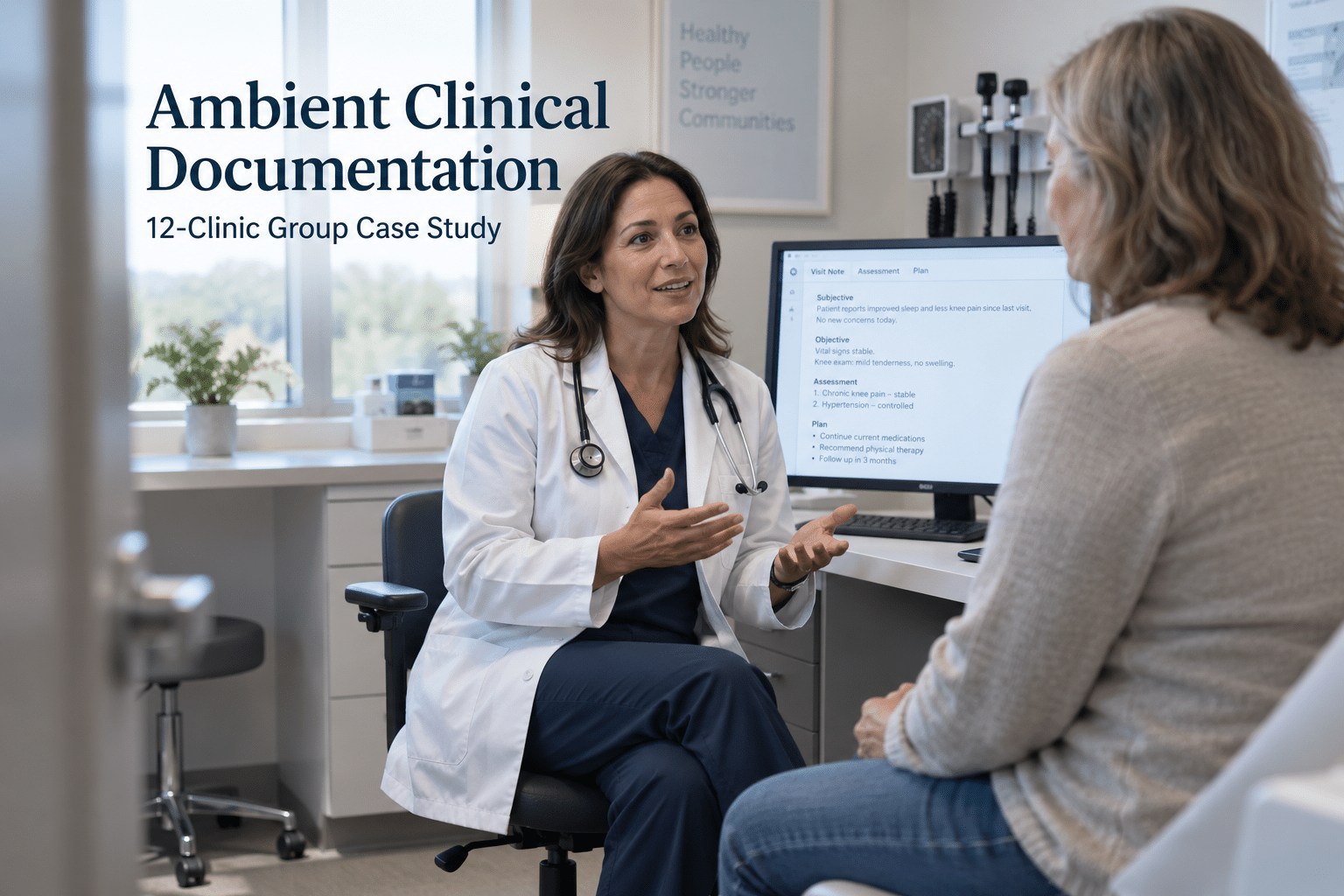
Ambient Clinical Documentation for a 12-Clinic Group
Building an AI-Assisted Clinical Documentation Workflow Around Real Patient Encounters Clinical documentation should support patient care—not compete with it. For a healthcare organization operating a...
Human Review Remained a Core Part of the Architecture
Clinical documentation is part of the legal medical record.
For that reason, the workflow was designed around AI-assisted documentation rather than autonomous documentation.
The generated note is presented as a draft.
The clinician remains responsible for reviewing the output, correcting or modifying information where necessary, and approving the final documentation.
This human-in-the-loop architecture creates an important separation between AI generation and clinical authorization.
The AI prepares the documentation.
The clinician decides what becomes part of the record.
EHR Integration: Bringing the Output Back Into Clinical Workflow
One of the biggest differences between an AI prototype and production healthcare software is what happens after the model produces an answer.
A standalone AI interface can create another workflow clinicians need to manage.
The documentation therefore needs a defined path back into the clinical environment.
Taction’s broader ambient-documentation architecture supports standards-based EHR integration patterns including FHIR resources and clinical encounter context.
The integration layer can associate documentation with the correct patient and encounter and support controlled write-back into the clinical workflow.
This reduces the need for clinicians to manually move generated documentation between systems.
Healthcare AI Architecture
A production ambient documentation system can be viewed as a controlled pipeline:
Clinical Encounter
↓
Secure Audio Capture
↓
Medical Speech Recognition
↓
Speaker Identification / Diarization
↓
Transcript Processing
↓
Clinical Context Layer
↓
LLM-Based Note Generation
↓
Structured Clinical Note
↓
Clinician Review and Editing
↓
Clinician Approval
↓
EHR Documentation Workflow
↓
Audit and Monitoring
Each stage has different clinical, security, integration, and reliability requirements.
Treating them as separate architectural layers also makes the system easier to evaluate and improve.
Designing for HIPAA and PHI Handling
Ambient documentation systems process some of the most sensitive information in healthcare: actual conversations between patients and clinicians.
Security and privacy therefore cannot be added after the AI functionality has been completed.
The architecture should define how PHI moves through every component involved in the workflow.
That includes:
Technical controls can include encryption in transit and at rest, access controls, audit logging, defined retention policies, environment isolation, and appropriate agreements with infrastructure or AI providers handling PHI.
The result is an architecture in which the AI pipeline is designed inside the healthcare security model rather than sitting outside it.
- 1audio capture
- 2transcription processing
- 3application services
- 4AI/LLM processing
- 5data storage
- 6EHR integration
- 7logging
- 8monitoring
- 9backups
- 10administrative access
Auditability Matters as Much as Generation Quality
A clinical AI system needs more than a final note.
Teams may need to understand:
Auditability provides the operational evidence needed to investigate errors, monitor adoption, and govern AI-assisted workflows.
For ambient documentation, this becomes particularly important because model output can eventually contribute to the medical record.
- 1which encounter produced the note
- 2which model or workflow generated it
- 3when the output was generated
- 4whether a clinician modified it
- 5what was ultimately approved
- 6which user performed the action
- 7whether processing or integration failed
Designing for Multiple Clinics
A 12-clinic deployment introduces operational considerations that do not appear in a single-user AI demonstration.
The system needs to accommodate differences in providers, templates, encounter patterns, terminology, and clinical workflows while maintaining a manageable technical architecture.
Instead of creating independent AI pipelines for every provider, the platform can separate common infrastructure from configurable documentation logic.
Shared capabilities can include transcription, security, model orchestration, monitoring, and integration.
Configurable layers can handle note formats, specialty requirements, provider preferences, and workflow rules.
This makes the system easier to expand as adoption grows.
Reliability and Failure Handling
Clinical AI cannot assume that every encounter will follow the ideal path.
Production architecture should anticipate:
Failure handling therefore becomes part of the product.
The workflow should prevent an unsuccessful AI process from silently creating incomplete or misleading clinical documentation.
Human review, explicit status handling, retry logic, monitoring, and audit trails help create safer operational boundaries.
- 1poor audio quality
- 2overlapping speakers
- 3incomplete encounters
- 4transcription errors
- 5AI generation failures
- 6model timeouts
- 7unavailable downstream services
- 8EHR API errors
- 9incomplete patient or encounter context
Why the Clinician Review Experience Matters
The quality of an ambient documentation system cannot be measured only by whether it can generate a note.
The generated draft must also be easy to review.
Clinicians need to quickly understand what the AI produced, make corrections, and approve the final version without introducing a new administrative burden.
Useful product signals include:
These signals help engineering and clinical teams identify where the system is helping and where the workflow or model still requires improvement.
- 1clinician edit rate
- 2rejected drafts
- 3regenerated notes
- 4sections frequently changed
- 5processing latency
- 6integration failures
- 7provider adoption
From AI Prototype to Production Clinical Workflow
The project demonstrates an important difference between healthcare AI demonstrations and deployable clinical software.
The LLM is only one component.
A production ambient documentation platform also requires speech processing, PHI controls, clinical workflow design, interoperability, clinician review, auditability, reliability engineering, and ongoing monitoring.
That is where much of the engineering work exists.
For healthcare organizations evaluating ambient documentation, the question is therefore not simply:
“Which AI model should we use?”
A more useful question is:
“How will AI-generated documentation move safely from the patient encounter to clinician review and ultimately into the clinical record?”
Building Ambient Documentation for Your Healthcare Organization
Taction Software develops healthcare AI systems for hospitals, health systems, clinics, digital-health companies, and healthcare software vendors.
Our ambient documentation engineering can cover:
Whether you are replacing manual documentation, adding ambient capabilities to an existing healthcare platform, or building an AI medical scribe product, the architecture should be designed around your clinical workflow—not around a generic LLM demo.
Planning an Ambient Documentation Project?
Bring us your EHR environment, clinical workflow, note templates, security requirements, and deployment constraints.
We can help map the path from encounter capture through clinician-approved EHR documentation.
Talk to a Healthcare AI Engineer →
- 1clinical workflow discovery
- 2ambient encounter capture
- 3medical speech recognition
- 4speaker diarization
- 5clinical NLP
- 6structured note generation
- 7specialty-specific prompting
- 8clinician review interfaces
- 9FHIR and EHR integration
- 10PHI architecture
- 11audit logging
- 12AI evaluation
- 13production monitoring
Frequently Asked Questions
What is ambient clinical documentation?
Ambient clinical documentation uses AI to capture a clinician-patient conversation, transcribe the encounter, and generate a structured clinical-note draft. The clinician reviews and approves the documentation before it becomes part of the medical record.
How is an ambient AI scribe different from medical transcription?
Traditional transcription primarily converts dictated speech into text. Ambient clinical documentation processes a natural clinical conversation and uses AI to organize relevant information into structured documentation such as a SOAP or progress note.
Can ambient documentation integrate with an EHR?
Yes. Ambient documentation platforms can use healthcare interoperability standards and EHR APIs to connect generated documentation with the appropriate patient and encounter. The exact integration approach depends on the target EHR and available interfaces.
Should AI-generated clinical notes be automatically added to the patient record?
A safer workflow keeps the clinician in control. AI-generated documentation should be treated as a draft that can be reviewed, edited, and approved according to the healthcare organization’s governance and clinical policies.
Is ambient clinical documentation HIPAA compliant?
HIPAA compliance depends on the complete implementation rather than the AI feature alone. Organizations need to evaluate PHI handling, vendors, BAAs where applicable, encryption, access controls, audit logging, retention policies, infrastructure, and operational procedures.
Can ambient documentation support different specialties?
Yes. Note structure, terminology, prompting, clinical context, and workflows can be configured for different specialties and visit types rather than relying on one universal documentation template.
Can Taction Software build a custom AI medical scribe?
Yes. Taction Software develops healthcare AI and ambient documentation systems covering speech processing, structured note generation, clinician review workflows, EHR integration, security architecture, and production deployment.
What should healthcare organizations evaluate before deploying ambient AI?
Important considerations include transcription quality, specialty fit, clinician review workflow, EHR integration, PHI handling, data retention, auditability, model evaluation, failure handling, latency, vendor agreements, and ongoing production monitoring.
The Solution
An Ambient Documentation Pipeline Built Around the Encounter
Taction approached the project as an end-to-end clinical documentation system rather than an isolated generative AI feature.
The workflow was structured around several connected layers.
1. Ambient Encounter Capture
The documentation workflow begins during the clinician-patient encounter.
Audio capture provides the source material from which the documentation pipeline operates. The architecture must therefore treat the recording as sensitive clinical information from the moment it enters the system.
Instead of requiring the clinician to dictate a separate note after the visit, ambient capture allows the documentation process to begin from the natural clinical conversation.
2. Medical Speech-to-Text Processing
Clinical conversations contain terminology that general speech-recognition systems frequently struggle with.
Medication names, abbreviations, diagnoses, anatomical terminology, numbers, measurements, and specialty-specific vocabulary all affect transcription quality.
The transcription layer converts the encounter audio into machine-readable text that can be processed by the documentation engine.
Speaker separation is also important because a clinical note must distinguish between information reported by the patient and observations, questions, or decisions made by the clinician.
3. Clinical Context and Transcript Processing
A raw transcript is not a clinical note.
Conversation includes greetings, repetition, clarification, incomplete sentences, unrelated discussion, and information that belongs in different areas of the medical record.
The processing layer prepares encounter information for structured documentation while preserving the clinical context needed by the generation system.
This creates a cleaner boundary between transcription and clinical-note generation.
4. AI-Generated Structured Clinical Notes
The processed encounter is transformed into a structured draft rather than a generic conversation summary.
Depending on the clinical workflow, the output can follow formats such as:
Prompting and generation logic can be tuned around the organization’s preferred documentation structure.
The goal is not simply shorter text.
The goal is to produce a useful clinical draft that reflects the encounter while fitting the format clinicians expect to review.
- 1SOAP notes
- 2History and physical documentation
- 3Progress notes
- 4Procedure notes
- 5Specialty-specific documentation templates